


Table of Contents
Yazd has been continuously inhabited for over 5,000 years — and it shows in the best possible way. Not in ruins or museums, but in the streets themselves: in the mud-brick alleys that keep you cool without air conditioning, in the underground water channels that have been flowing since ancient times, in the flame inside the Fire Temple that has not gone out since 470 AD. Yazd is not a city that was great once. It is a city that has never stopped.
And yet most travelers to Iran rush through it on the way between Isfahan and Shiraz, giving it a day at most — because they do not quite know what they are standing inside. Yazd is not just a pretty old town. It is the most sophisticated desert survival system ever built by human hands, and in 2017, UNESCO formally agreed: the Historic City of Yazd became the first Iranian city inscribed on the World Heritage List.
In this guide, we take you through everything you need to know about Yazd as one of Iran UNESCO World Heritage Site — its inscription story, the engineering genius behind its architecture, the key attractions, its role as the global centre of Zoroastrianism, how it compares to Isfahan, the day trips worth making from the city, and all the practical information you need to plan a visit that does this extraordinary place justice.
Historic City of Yazd and UNESCO Inscription
Yazd is a city in the heart of the Iranian plateau, located between the Dasht-e Kavir and Dasht-e Lut deserts in central Iran, approximately 270 km southeast of Isfahan. Archaeological evidence places human settlement in the region as far back as 5,000 years, making Yazd one of the oldest continuously inhabited cities on Earth. Its name — derived from Izad, meaning God or divine — reflects its ancient spiritual significance.
UNESCO inscribed the Historic City of Yazd on the World Heritage List in 2017, during the 41st session of the World Heritage Committee, on the basis of two criteria:
- Criterion III: Yazd bears exceptional testimony to the cultural traditions of the desert region — its earthen architecture, its district-by-district qanat system, its communal water cisterns, its bazaars, mosques, synagogues, and Zoroastrian temples together form an outstanding record of how desert civilizations organized and sustained themselves across millennia.
- Criterion V: Yazd is an outstanding example of a traditional human settlement that has adapted intelligently and sustainably to a harsh desert environment. Its windcatchers, qanats, earthen vaults, and domed roofs represent a vernacular architectural tradition that evolved over thousands of years to solve the problems of heat, drought, and isolation — and continues to function today.
The core inscribed zone covers 195 hectares within a buffer zone of approximately 666 hectares. What distinguishes Yazd from Iran’s other UNESCO sites — Persepolis, Pasargadae, Isfahan’s Naghsh-e Jahan Square — is a single defining quality: this is a living city. People are born, go to school, run businesses, cook dinner, and raise children inside the heritage zone. The ancient and the contemporary exist not side by side but layered on top of each other, in the same streets, in the same houses, in the same Friday mosque where worshippers have been gathering for a thousand years.
📷Photo by Amirabbas Rabhar Modami on Pexels
The Genius of Desert Survival: Windcatchers and Qanats
Before visiting Yazd’s individual monuments, it is worth understanding the two engineering systems that made the city possible — because they are the reason UNESCO inscribed it, and the reason you will see them everywhere.
Windcatchers (Badgirs)
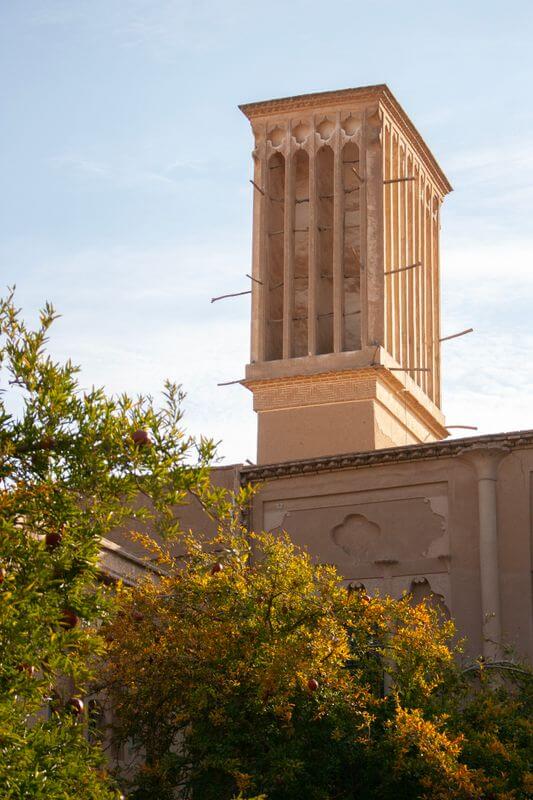
A windcatcher, or badgir in Persian, is a tower built above a building with openings oriented toward the prevailing wind. As wind enters the tower, it travels down a shaft into the rooms below — where it passes over a pool of water or across damp surfaces — and exits through lower vents, creating a continuous current of cooled air. No electricity, no refrigerant, no moving parts. A technology in use for at least 3,000 years that modern passive cooling systems are still trying to replicate.
Yazd has the highest concentration of windcatchers of any city on earth. They rise above the roofline in every direction, giving the city its silhouette and its nickname: the City of Wind Catchers. The most spectacular example is the windcatcher above the Dowlatabad Garden — the tallest in Iran at 33 metres — which still cools the pavilion below it on the hottest summer days.
Qanats
A qanat is a gently sloping underground aqueduct, hand-dug through rock and soil, that draws water from an aquifer beneath mountain foothills and delivers it by gravity to settlements in the plains below. The engineering challenge is enormous: maintaining a precise slope over distances of sometimes dozens of kilometres, ventilated by vertical shafts sunk from above, without any pumps or power source other than elevation.
Yazd’s entire urban fabric was organized around its qanat network. Each district of the historic city was built above its own qanat, with communal access points and water cisterns shared by residents of that district. The social and spatial structure of the city — its neighbourhoods, its communal spaces, its collective maintenance obligations — grew directly from the logic of the qanat. Zarch Qanat, originating northwest of the city, is one of the oldest and longest in the world, still delivering water after thousands of years of continuous use.
In 2016 — one year before Yazd itself was inscribed — UNESCO separately inscribed the Iranian Qanat system on the World Heritage List, recognizing eleven qanats across Iran as masterpieces of human ingenuity. Zarch Qanat is among them.
Together, the windcatcher and the qanat are not architectural ornaments. They are the reason Yazd exists.
Key Attractions: What You Will Actually See in Yazd
Jameh Mosque of Yazd
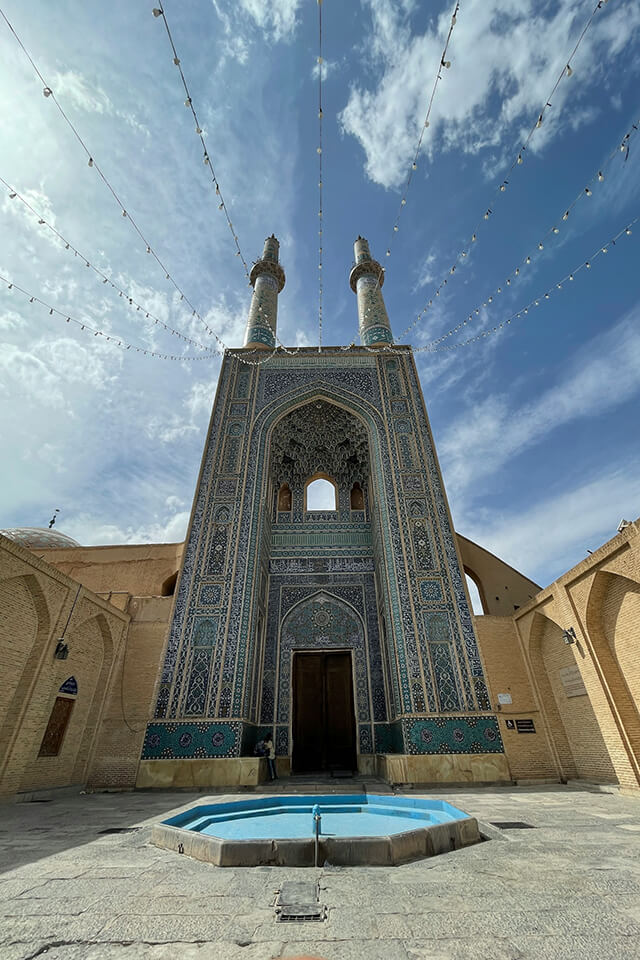
The congregational mosque of Yazd is one of the finest examples of Persian Islamic architecture anywhere in Iran. Its history stretches back to the 12th century, though the magnificent Timurid portal that dominates its facade was built in the 14th century and has been the defining image of the city ever since. The twin minarets rise 48 metres above the street — among the tallest in Iran — and are covered in intricate mosaic faience tilework in deep blues, turquoises, and golds. The interior, with its soaring dome and calligraphic tile panels, continues to function as an active place of worship. Visitors are welcome outside prayer times.
Amir Chakhmaq Complex
In the 15th century, the governor Amir Jalal-ud-Din Chakhmaq built a mosque, a caravanserai, a bathhouse, and a public square here, all gathered around the three-storey symmetrical façade that today makes this one of the most photographed structures in Iran. The facade is a grid of perfectly proportioned recessed arched niches — iwans — rising in three tiers above the square. After dark, when the complex is illuminated, the effect is theatrical. Beneath the complex, a covered bazaar offers Yazdi sweets, textiles, and handicrafts: the best place in the city to buy qottab or try a cup of tea beside a traditional samovar.
Dowlatabad Garden
One of the nine Persian Gardens collectively inscribed on the UNESCO World Heritage List, Dowlatabad is a walled oasis in the middle of the desert city: a formal chahar bagh garden laid out in the 18th century during the Zand period, with four symmetrically arranged quadrants, cypress trees, water channels fed by qanat, and a central pavilion. That pavilion is capped by the tallest windcatcher in Iran — 33 metres — which creates a cool, whispering microclimate inside the hall even in the depths of summer. The garden’s combination of engineering and beauty makes it one of the most satisfying single sites in Yazd.
Zoroastrian Fire Temple (Atash Behram)
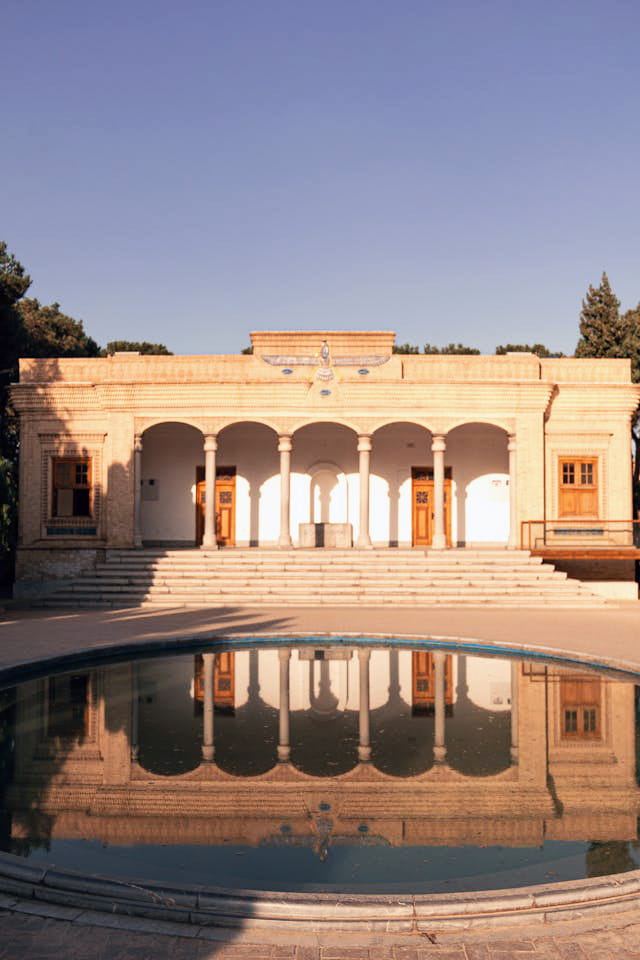
The Atash Behram, or Fire Temple, is the holiest category of Zoroastrian fire temple — the grade requiring the greatest ritual care in its establishment. The sacred flame burning inside this building has been continuously maintained since approximately 470 AD. It was transferred from temple to temple across ancient Persia during the Arab conquest of the 7th century, protecting it from extinction, before finding its current home in Yazd in 1474 AD, and its current building in 1934. Today the flame burns behind glass in a bronze vessel, visible through a window from the visitor’s area. The elegant building, reflected in the pool of its courtyard, is quietly beautiful. The symbolism is profound: a fire that has outlasted empires, conquests, and centuries.
📷Photo by Federico Artusi on Unsplash
Towers of Silence (Dakhmas)
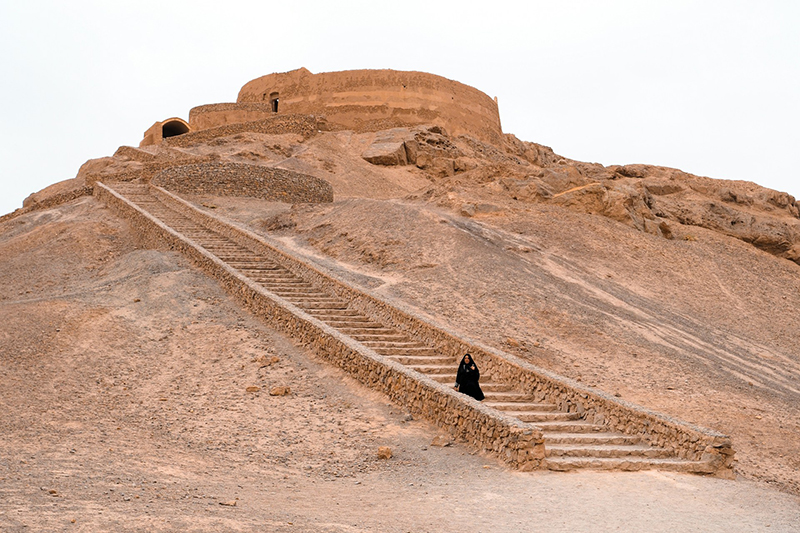
On two low hills at the southern edge of the city stand the Towers of Silence — twin circular structures open to the sky, where Zoroastrian communities once carried their dead to be exposed to the sun and to birds of prey. In Zoroastrian belief, earth, water, and fire are sacred and must not be polluted by contact with a corpse. Sky burial, called dakhma, solved this problem. The practice was discontinued in Yazd in the 1960s when the community adopted underground burial. What remains today is a pair of haunting hilltop structures surrounded by the ruins of the community buildings below them — preparation houses, water cisterns, and residences for the ritual attendants. The 30-minute walk from the base to the towers in the early morning or at sunset, with the desert stretching in every direction, is one of the most atmospheric experiences in Iran.
Fahadan Historic District
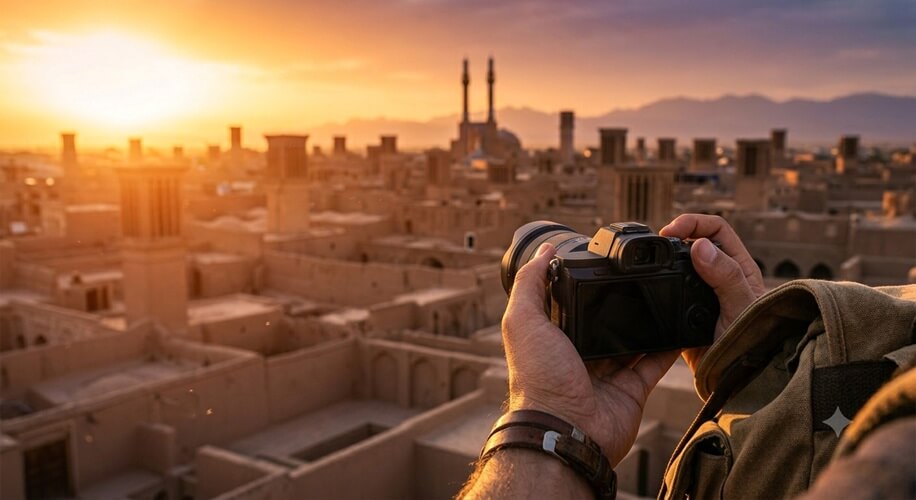
Fahadan is the old town’s living heart: a labyrinth of mud-brick lanes, arched passageways, wind towers, courtyard houses, and rooftop terraces that have been continuously inhabited for centuries. This is where the UNESCO inscription is most tangible — not in any single monument but in the fabric itself. Wander without a destination. Get mildly lost. Climb to a rooftop cafe at sunset and watch the city’s wind towers and domes turning gold in the fading light. Listen to the call to prayer echo across the domes at dusk. Fahadan rewards aimlessness more than most places.
Yazd Water Museum
Housed in a beautifully restored historic mansion in the old town, the Yazd Water Museum explains the city’s qanat system through scale models, historical tools, photographs, and a preserved section of actual qanat tunnel accessible below the museum. It is the best single place in Yazd to understand the engineering logic behind the city — and therefore the best place to start your visit before exploring the streets.
Alexander’s Prison (Zindan-e Eskandar)
Despite the dramatic name, this 15th century domed structure was almost certainly a madrasa — an Islamic school of theology and law. The “Alexander’s Prison” legend attached itself to it in later centuries, probably because its underground chambers and dark corridors felt suitably sinister to travellers with imagination. The building is architecturally remarkable regardless: a domed courtyard surrounded by vaulted cells and a deep cylindrical well open to the sky. Its Qajar-era tilework and the quality of the light inside make it one of Yazd’s most atmospheric interior spaces.
Zoroastrianism in Yazd: The World’s Oldest Monotheistic Religion
To visit Yazd’s Zoroastrian sites without understanding what Zoroastrianism is would be like visiting Rome’s churches without knowing anything about Christianity. The religion is the reason the city has its particular character, and it deserves a brief introduction.
Zoroastrianism was founded by the prophet Zoroaster — in Persian, Zarathustra — somewhere between 1500 and 1000 BCE, most likely in eastern Iran or Central Asia. It is widely considered the world’s first monotheistic religion: it posits a single supreme deity, Ahura Mazda (the Lord of Wisdom), in eternal opposition to Angra Mainyu (the Destructive Spirit), and places on each individual the moral responsibility to choose between them. Its ethical core — good thoughts, good words, good deeds — is three words that have shaped Iranian culture so deeply that they persist in the national character regardless of the religion practised today.
Zoroastrianism was the state religion of the Achaemenid Empire (the empire Cyrus and Darius built), the Parthian Empire, and the Sasanian Empire — continuously, for more than a thousand years. When the Arab conquest brought Islam to Persia in the 7th century CE, many Zoroastrians fled to India (where they became the Parsi community) or retreated to remote desert cities like Yazd, where they maintained their communities, their fire temples, and their traditions. Yazd today is the global centre of Iranian Zoroastrianism.
Fire is not worshipped in Zoroastrianism — this is a common misconception. Fire is a sacred symbol of Ahura Mazda’s light and purity, maintained in temples as a focus for prayer. The eternal flame in the Atash Behram is the physical expression of that unbroken continuity of belief. When you stand before it, you are in the presence of a flame that has been tended, without interruption, for 1,550 years.
Yazd vs Isfahan: Which Should You Visit?
This is the question most visitors to central Iran quietly wrestle with, and few travel articles answer it honestly. Here it is.
Isfahan wins on visual grandeur. The Imam Square, the Sheikh Lotfollah Mosque, the Ali Qapu Palace, the Khaju Bridge — Isfahan is one of the most beautiful cities in the world, full stop. If you have limited time and can only visit one, Isfahan is the choice for sheer architectural spectacle.
Yazd wins on depth, authenticity, and atmosphere. Isfahan shows you what Persia achieved at the height of its confidence. Yazd shows you how ordinary Persians lived, survived, thought, and prayed across five millennia. Isfahan is a showcase. Yazd is a way of life. The old town of Yazd — with its rooftop cafes, its mud-brick lanes, its wind towers and courtyard guesthouses — provides a quality of immersion that Isfahan’s more heavily touristed centre cannot match.
The practical answer: The two cities are 270 km apart, well connected by taxi, train and bus, and many visitors include both in the same itinerary as part of a central Iran route: Isfahan — Yazd — Shiraz (or the reverse). This is one of the great travel routes in the Middle East and is highly recommended.
If you are a first-time visitor to Iran with limited time, Isfahan comes first. If you are returning, or if Zoroastrian culture, desert architecture, and living heritage interest you more than monumental Islamic art, Yazd should be your priority.
📷Photo by Arteen Arakel Lalabekyan on Wikicommons
Day Trips from Yazd: Kharanaq, Chak Chak, and Meybod
The region around Yazd is one of the richest in Iran for day trips. The three destinations below are best combined into a single full day in the following order — north to south on the return to Yazd.
Kharanaq — The Ghost Village
About 70 km north of Yazd, the mud-brick village of Kharanaq has been inhabited for over 4,000 years. At some point in the last century, its residents left — and what remains is an entire ancient village, largely intact, slowly returning to the earth it was built from. The narrow lanes, the crumbling courtyard houses, the Qajar-era mosque with its strikingly slender minaret — all of it is walkable, largely unguarded, and almost always nearly empty of other tourists. For photographers, architecture enthusiasts, and anyone drawn to the atmosphere of abandoned places, Kharanaq is the most unexpectedly affecting destination in the Yazd region.
Chak Chak (Pir-e Sabz) — The Zoroastrian Pilgrimage
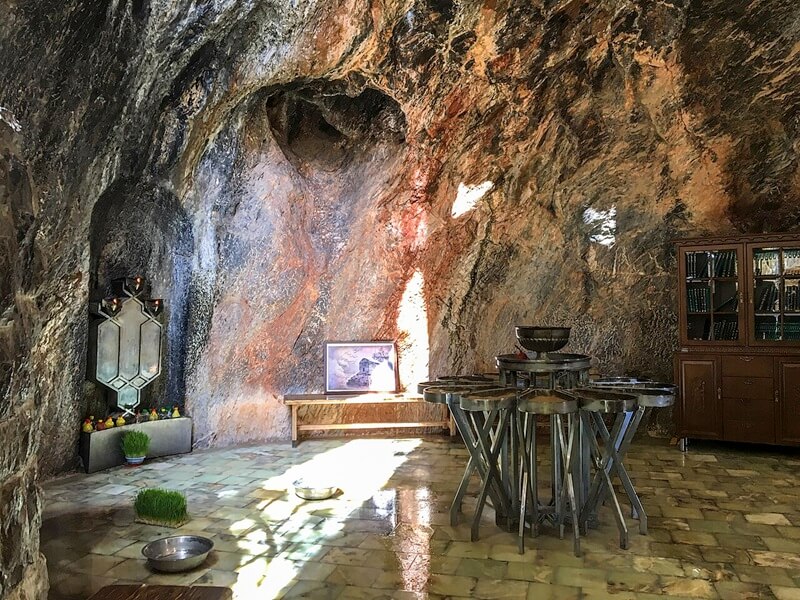
High in the Shirkooh mountains, 72 km northwest of Yazd, a temple is carved into a cliff face above the desert. This is Chak Chak — named for the sound of water dripping from the rock — the holiest Zoroastrian pilgrimage site in Iran. According to tradition, Nikbanou, the daughter of the last Sassanid king, fled here during the Arab conquest of the 7th century and prayed to Ahura Mazda for protection. The mountain opened and absorbed her; the drops of water from the cliff are her tears, still falling. Every year between June 14 and 18, thousands of Zoroastrians from Iran, India, and around the world make the pilgrimage to Chak Chak for a five-day festival of prayer, music, and community. Outside the festival period, the site is quiet and deeply atmospheric. From the parking area, 230 stone steps lead up to the cave temple; carry water and take your time.
Meybod — The Desert Town
The easiest of the three to reach — about 40 km northwest of Yazd, with occasional minibus connections — Meybod is a small desert town with a remarkable density of historical sites. Narin Castle, a mud-brick fortress with foundations dating back 5,000 years, gives panoramic views of the town from its highest point. The restored Abbasi caravanserai, the historic ice house (yakhchal) — a conical structure that stored ice through summer using ingenious passive insulation — and the Pigeon Tower, which once housed 14,000 pigeons whose droppings fertilized the surrounding fields, are all walkable from the town centre. Meybod is the most accessible of the three day-trip destinations and the easiest to combine with a half-day.
Practical note: There is no public transport to Kharanaq or Chak Chak. To combine all three in a single day, hire a private driver through your accommodation in Yazd or book a guided tour. Costs are modest and the day is worth every rial.
How to Get to Yazd and Getting Around
By train: Yazd has a well-connected train station. Overnight trains from Tehran take approximately 7 hours; day trains from Isfahan approximately 2.5 hours; trains from Shiraz approximately 5 hours. The train is the most comfortable and scenic option and is strongly recommended over the bus for long-haul legs.
By bus: VIP buses connect Yazd to Tehran, Isfahan, Shiraz, and Kerman. Journey times are similar to the train but comfort varies.
By air: Shahid Sadooghi Airport (IATA: AZD) handles domestic flights from Tehran, Mashhad, and Isfahan. If you are on a tight itinerary and flying into Yazd from Tehran, this is the fastest option.
Getting around in Yazd: The historic old town is entirely walkable — most major sites are almost close within less than an hour on foot of each other. Taxis are available and inexpensive for the Towers of Silence and Dowlatabad Garden, which sit slightly outside the old town core. For day trips to Kharanaq, Chak Chak, and Meybod, arrange a private driver through your guesthouse.
Practical Visitor Information
Best time to visit: Spring (March to May) and autumn (September to November) are ideal, with mild temperatures and clear skies. Summer heat in Yazd regularly reaches 38–42°C, making outdoor exploration genuinely difficult. Winter is cold but clear, with temperatures occasionally dropping below freezing at night.
How many days to allow: A minimum of two nights gives you time to explore the old town and key monuments without rushing. Three nights is recommended if you plan to do the Kharanaq–Chak Chak–Meybod day trip, which takes a full day.
Where to stay: Yazd’s traditional courtyard guesthouses — converted from historic mansions and caravanserais — are among the finest heritage accommodation options in Iran. Staying inside the old town is strongly recommended: waking up inside the Fahadan district, before the city fully stirs, is an experience in itself. Research options well in advance as the best properties book up quickly.
What to eat: Yazd is one of Iran’s most celebrated food cities, particularly for its sweets. Qottab — a crescent-shaped pastry filled with almonds and cardamom — is the city’s most famous export and is best bought fresh from the bazaar beneath the Amir Chakhmaq Complex. Baklava, haji badam (almond cookies), and pashmak (Persian cotton candy) are also staples. For meals, look for traditional restaurants in converted historic houses — courtyard dining in the evening is one of Yazd’s great pleasures.
Photography: Permitted at most sites. Photography is allowed inside Dowlatabad Garden, the Amir Chakhmaq Complex, Alexander’s Prison, and the Water Museum. At the Fire Temple, photography of the exterior and courtyard is welcome; photographing the sacred flame through its window is generally accepted though you should be respectful of worshippers. At the Towers of Silence, stay on marked paths.
Final Thought: Yazd Is the Iran Most Visitors Never Expect
Most travelers arrive in Iran expecting Persepolis, expecting Isfahan, expecting the great monuments of empire and dynasty. Yazd offers something different and, for many visitors, something more affecting: a city that solved impossible problems quietly, for five thousand years, without fanfare.
The windcatcher that has been cooling the same room since before the Islamic conquest. The qanat that has been delivering water through the desert since ancient times. The flame that has not gone out in fifteen centuries. Yazd’s extraordinary quality is that none of these things are in a museum. They are just the city, still working.
Walk through 5000 Years of Desert Civilization
FAQs about Yazd UNESCO World Heritage Site
1. When was Yazd inscribed as a UNESCO World Heritage Site?
Yazd was inscribed on the UNESCO World Heritage List in 2017 during the 41st session of the World Heritage Committee. It was the first Iranian city to receive the inscription.
2. Why is Yazd called the City of Wind Catchers?
Yazd has the highest concentration of traditional windcatcher towers (badgirs) of any city in the world. These towers are a defining feature of the city’s skyline and were used for centuries to naturally ventilate and cool buildings without electricity, drawing air down from height and passing it through underground channels or over water before circulating it through living spaces.
3. Is Yazd a Zoroastrian city?
Yazd is home to the largest Zoroastrian community in Iran and is considered the global centre of Iranian Zoroastrianism. While the majority of its population is Muslim, the city’s Zoroastrian heritage — its fire temples, Towers of Silence, festivals, and traditions — is deeply woven into its identity and is one of the primary reasons visitors come.
4. How old is Yazd?
Archaeological evidence suggests the area has been continuously inhabited for approximately 5,000 years. The city’s origins are associated with the Medes and the early Iranian civilizations of the first millennium BCE, though settlement in the region predates written history.
5. How many days do you need in Yazd?
Two full days allows you to explore the old town and all major monuments without rushing. Three days is ideal if you want to include the day trip to Kharanaq, Chak Chak, and Meybod.
6. Is Yazd safe to visit?
Yazd is consistently rated one of the safest and most welcoming cities in Iran for international visitors. It is a calm, relatively conservative city with a strong tradition of hospitality. Standard sensible travel precautions apply, as they do anywhere.
7. What is Yazd known for in terms of food?
Yazd is famous throughout Iran for its sweets — particularly qottab (almond-filled pastry), baklava, haji adam, and pashmak. The bazaar beneath the Amir Chakhmaq Complex is the best place to buy them fresh.
8. Can you visit Yazd without a guide?
The historic old town is navigable independently and getting pleasantly lost in Fahadan is part of the experience. However, a local guide adds significant depth — particularly for the Zoroastrian sites, where the history and symbolism are not self-evident from the structures alone. For day trips to Kharanaq, Chak Chak, and Meybod, a guide or at minimum a private driver is essential, as there is no public transport to these sites.
0 Comment