



Table of Contents
Persepolis was never the Achaemenid Empire’s capital city in any practical sense — it was something far more deliberate: a stage built to perform imperial power.
When Darius I broke ground around 518 BCE, he already had Susa handling diplomatic correspondence and Babylon managing economic administration. Persepolis served neither function. Instead, scholars broadly agree it was engineered as a ceremonial showcase, most likely the grand backdrop for Nowruz — the Persian New Year — when delegations from across the empire arrived bearing tribute.
Persepolis wasn’t built to govern an empire. It was built to make the empire visible.
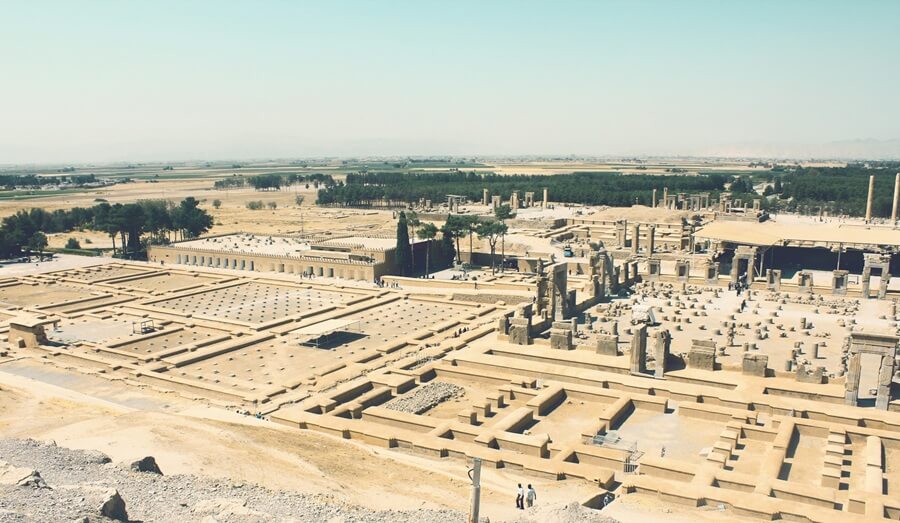
The engineering ambition alone signals serious intent. Darius ordered construction on a 125,000-square-meter artificial terrace cut into the base of Kuh-e Rahmat mountain, specifically designed to redirect destructive seasonal floodwaters. That’s roughly 17 football fields of leveled stone — before a single column was raised.
Every carved frieze, every monumental staircase, was calibrated to project one message: that dozens of distinct peoples — Medes, Elamites, Egyptians, Lydians — existed in harmonious submission to a single throne. If you’re traveling to Shiraz and the surrounding region, this subtext transforms the ruins from beautiful stonework into something unmistakably political.
That carefully constructed welcome begins the moment you approach the entrance — and the guardian figures waiting there reveal everything about how Darius’s successors refined his vision.
📷Photo by Amin Zeinali on Unsplash
What Is Persepolis? The Ceremonial Capital of Ancient Persia
Persepolis — known in Old Persian as Pārsa — was the ceremonial heart of the Achaemenid Empire, the dynasty that ruled over the largest empire the ancient world had yet seen. At its height, Achaemenid Persia stretched from the Aegean coast of modern Turkey to the Indus Valley in Pakistan, encompassing some 50 million people across three continents.
Yet for all that administrative complexity, Persepolis was not where the empire was run. It was where the empire was announced.
Located roughly 60 kilometers northeast of modern Shiraz in Iran’s Fars Province, the site sits at an elevation of around 1,770 meters, its terraces carved directly into the foothills of Kuh-e Rahmat — the Mountain of Mercy. For anyone visiting today, the approach from the plain below delivers the same visual impact it was designed to: you see it long before you reach it.
The name “Persepolis” is Greek, meaning “city of the Persians,” coined by Greeks who encountered the ruins after Alexander’s conquest. The Persians themselves called it Pārsa. Both names stuck — one for the people who built it, one for the people who burned it.
A Brief History: From Darius I to Xerxes and Beyond
Construction at Persepolis began under Darius I around 518 BCE and continued under his successors for well over a century. What visitors see today represents at least three major building phases.
Darius I (522–486 BCE) established the foundational platform and began the most iconic structures: the Apadana audience hall, the Council Hall, and the Treasury. His ambition was architectural theology — every stone placement reflected Achaemenid cosmology and the divine mandate of the Persian king.
Xerxes I (486–465 BCE), his son and successor, expanded the complex significantly. He completed the Gate of All Nations, added the Harem, and left his own trilingual inscriptions across the site. It is Xerxes who most visitors picture when they imagine Persepolis at its height — the terraces busy with delegations, the columns painted in brilliant color, cedar ceilings stretching overhead.
Artaxerxes I and later kings continued adding to the complex through the 4th century BCE, though the empire’s later decades saw more consolidation than expansion.
For roughly 200 years, Persepolis functioned as the empire’s ceremonial pulse — receiving tribute, hosting royal rituals, and projecting Achaemenid legitimacy to the known world. Then, in 330 BCE, Alexander arrived.
📷Photo by Mostafa Meraji on Unsplash
The Gate of All Nations: A Threshold of Imperial Welcome
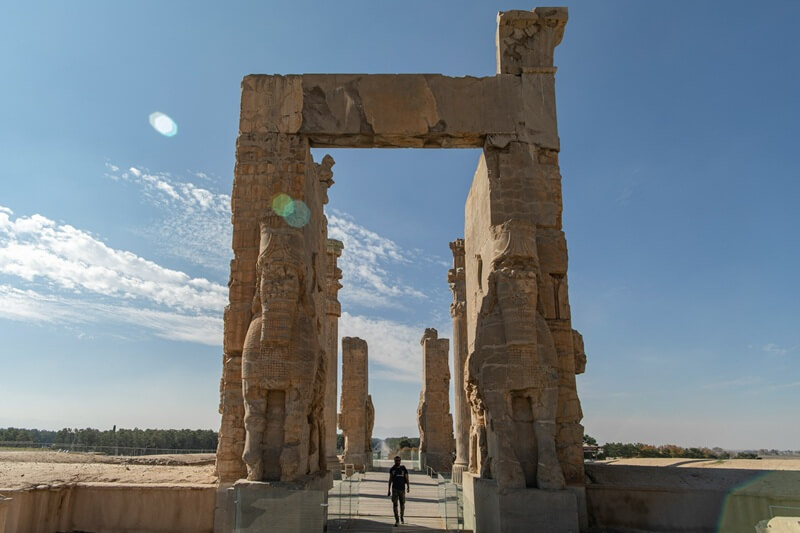
The Gate of All Nations at Persepolis was the empire’s opening statement — a monumental threshold designed to humble every visitor before they ever reached the king.
Flanking the entrance stood colossal Lamassu figures — winged, bull-bodied guardians with human heads — each carved from single massive limestone blocks. These hybrid creatures drew on ancient Assyrian and Mesopotamian traditions, a deliberate visual signal that Persian power absorbed and transcended its predecessors. They weren’t merely decorative; they projected divine protection and imperial permanence to every dignitary who passed between them.
Xerxes I reinforced that message in stone. His trilingual inscriptions — carved in Old Persian, Elamite, and Xerxes I reinforced that message in stone with trilingual inscriptions carved in Old Persian, Elamite, and Babylonian declaring that the gate was built with the aid of Ahura Mazda. Three languages meant three audiences, reflecting what scholars call a centrifugal cosmopolitanism: Persian ideology didn’t erase subject cultures — it incorporated them.
The gate functioned as a formal waiting area where delegations from across the empire gathered before royal audiences. Their patience was itself a performance of submission; their very presence proof of Persian reach.
Two pairs of guardian figures mark the gate: bull-bodied Lamassu face inward toward arriving visitors on the western façade, while man-headed lions face outward toward the Apadana on the eastern side. The transition from one to the other was not accidental — it was choreographed.
📷Photo by Reza Modiri on Unsplash
The Apadana: Engineering Awe in the Audience Hall
The Apadana was Persepolis at its most deliberately overwhelming — a throne room built not for comfort, but to make every visitor feel the full weight of Achaemenid power.
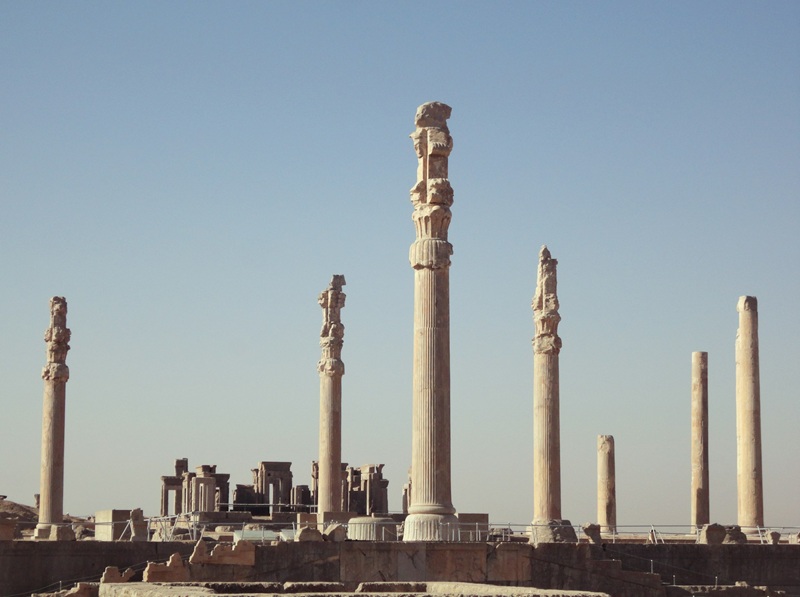
Understanding why Persepolis was built becomes clearest here. The Apadana’s 72 columns stretched 24 meters into the sky — roughly the height of an eight-story building — topped with distinctive capitals carved as back-to-back bulls and lions. No visitor could stand inside and feel anything other than small.
The hall’s architectural achievements were extraordinary:
- 72 stone columns arranged across a 1,000-square-meter footprint, many still standing today
- Bull and lion capitals — a fusion of Mesopotamian and Egyptian influences, uniquely Achaemenid
- Bas-relief processions depicting delegations from 23 subject nations carrying tribute: textiles, animals, precious metals
- A 2-kilometer underground drainage network carved into the bedrock, still functional after 2,500 years
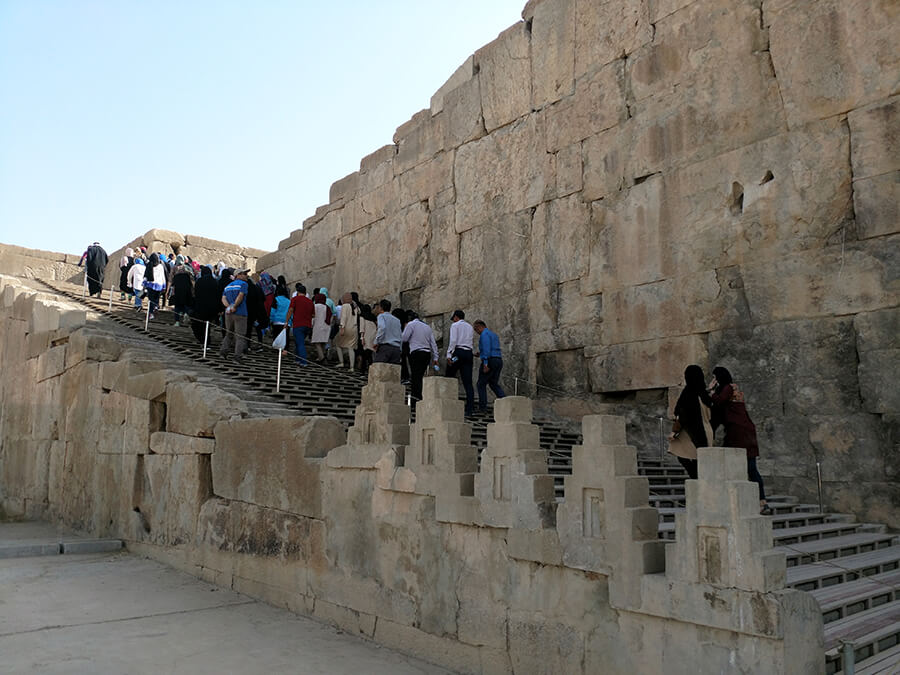
The tribute reliefs are the Apadana’s most enduring record. Carved along the eastern staircase, delegations from Lydians, Ethiopians, Indians, and beyond are shown in careful cultural detail — each nation’s dress and gifts rendered precisely. It’s less decoration than imperial ledger.
That engineering foresight — protecting the platform from erosion across millennia — is part of why so much survived at all.
The Reliefs of Persepolis: Reading the Walls
If the architecture of Persepolis was designed to overwhelm, the reliefs were designed to explain — a carved argument in stone for why Achaemenid rule was legitimate, universal, and permanent.
The most celebrated carvings run along the eastern staircase of the Apadana, where delegations from 23 subject nations are shown approaching the king bearing tribute. Each delegation is rendered in careful cultural detail: Lydians carry gold vessels, Ethiopians lead an okapi, Indians bring axes and a donkey, Scythians offer horses and folded textiles. The carvers knew their subjects — the delegations are ethnographically distinct enough that scholars have used them to map Achaemenid provincial geography.
What makes these reliefs unusual by ancient standards is their tone. Where Assyrian palace carvings glorified conquest — enemies trampled, cities burned, prisoners impaled — the Apadana reliefs show something closer to a harmonious procession. Subject peoples are not humiliated. They appear dignified, purposeful, even proud. The ideological message is subtle but clear: Persian power was not tyranny. It was order.
The reliefs also document daily court life with unexpected intimacy. Persian nobles whisper to one another. A Median guard rests his hand on a colleague’s shoulder. Servants carry food. An attendant adjusts the king’s parasol. These details have no propaganda function — they are simply observed life, preserved in limestone for 2,500 years.
For anyone visiting Persepolis as part of a trip through Shiraz and Fars Province, the reliefs reward slow attention. A single panel can hold an hour of looking.
Alexander’s Fire: The Destruction of Persepolis in 330 BCE
The Alexander’s burning of Persepolis in 330 BCE remains one of antiquity’s most debated acts of destruction — a single night that ended the empire’s ceremonial heart.
Alexander’s army looted approximately 2,500 tons of gold and silver from the Persepolis Treasury alone, a haul so vast that ancient sources record it required 20,000 mules and 5,000 camels to transport it away. After centuries of tribute flowing in from every corner of the known world, the empire’s accumulated wealth vanished in weeks.
Then came the fire. The central debate divides historians into two camps:
- Intentional revenge — Alexander burned the palaces as deliberate retribution for Xerxes’ destruction of Athens in 480 BCE, a symbolic act of Greek justice
- Drunken accident — ancient sources, including Diodorus Siculus, describe a banquet where the flames were started impulsively, later regretted by Alexander himself
The truth may blend both motives. What’s certain is the result: Persepolis’ grand cedar roofs collapsed, and the terraces fell silent.
The great irony is that the fire preserved what it destroyed. Intense heat baked thousands of raw clay administrative tablets into permanent ceramic records — the very documents that today tell us how the empire functioned. If you’re planning to walk these ruins yourself, those tablets are why so much of the story survived.
The physical city was gone, but its identity proved harder to extinguish — a tension that echoes into surprisingly modern interpretations of the Persepolis name.
Persepolis as a UNESCO World Heritage Site
Persepolis was inscribed as one of the Iranian UNESCO World Heritage Sites in 1979, recognized as one of the outstanding examples of Achaemenid art and architecture and among the most significant archaeological sites anywhere in the world.
The inscription acknowledged the site’s exceptional universal value across multiple criteria: as a masterpiece of human creative genius, as an outstanding example of an architectural ensemble illustrating a significant stage in human history, and as a site directly associated with events of universal historical significance.
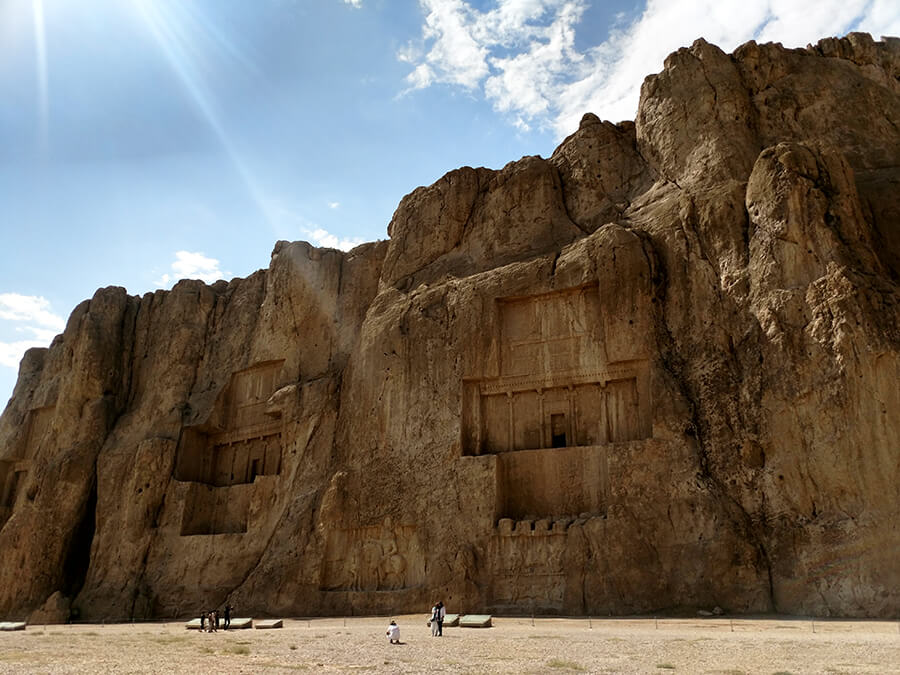
Persepolis sits within a broader constellation of Achaemenid heritage in Fars Province. Naqsh-e Rostam — the royal necropolis carved into a cliff face just 6 kilometers away — holds the rock-cut tombs of Darius I, Xerxes I, Artaxerxes I, and Darius II. Pasargadae, the earlier Achaemenid capital founded by Cyrus the Great, lies roughly 90 kilometers to the northeast and is a separate UNESCO inscription. Together, these three sites form one of the world’s most concentrated zones of ancient imperial heritage.
Preservation at Persepolis faces ongoing challenges. Salt crystallization threatens the limestone reliefs from within. Tourism pressure, though currently managed, risks long-term surface wear. Climate shifts affecting moisture levels in the terrace bedrock add another layer of concern. Iranian and international conservation teams continue monitoring and intervention work, though access for foreign researchers has varied considerably with political conditions.
For travelers, the UNESCO status means the site is maintained to international standards, with ongoing archaeological and conservation work visible during visits.
How to Visit Persepolis from Shiraz
Persepolis is one of the most rewarding day trips from Shiraz, and for anyone visiting Iran, it is not optional — this is one of the ancient world’s great sites.
Getting there: The ruins sit approximately 60 kilometers northeast of Shiraz, roughly a 1-hour drive. Taxis and private drivers are the most practical option; negotiate a return fare in advance and ask the driver to wait. Organized day tours from Shiraz typically include Persepolis alongside Naqsh-e Rostam and sometimes Pasargadae — a sensible combination that covers the main Achaemenid sites in a single day.
How much time to allow: Persepolis itself warrants a minimum of 2–3 hours for a meaningful visit. If you intend to spend time with the reliefs properly — which you should — allow 3–4 hours. Adding Naqsh-e Rostam (30 minutes) and the Persepolis Museum (45 minutes) makes for a full day.
Best time to visit: Early morning in spring (March–May) or autumn (September–November) is ideal. The site is open-air and exposed, and summer temperatures in Fars Province regularly exceed 40°C by midday. The morning light is also considerably better for photographing the reliefs, which face east.
What to bring: Water, sun protection, and comfortable walking shoes are essential. The terrace involves significant walking on uneven stone. The site has limited shade.
On-site facilities: There is a museum at the site entrance housing artifacts recovered from the terrace, including administrative tablets and decorative objects. A small café and souvenir area are also available near the entrance.
Entrance and access: Foreign visitors require a separate ticket from domestic visitors; prices are subject to change so confirm locally. Photography throughout the site is permitted, including of the reliefs.
Combining Persepolis with Nearby Achaemenid Sites
Persepolis is the centerpiece, but the surrounding area contains some of the most remarkable ancient monuments in Iran — and combining them makes the history of the Achaemenid Empire genuinely legible in a way no single site achieves alone.
Naqsh-e Rostam:
Sits just 6 kilometers north of Persepolis, making it a natural first or last stop on any visit. Four massive rock-cut tombs are carved into a cliff face some 30 meters above the plain — the resting places of Darius I, Xerxes I, Artaxerxes I, and Darius II. Each tomb façade is carved in the form of a cross, with an image of the king before a fire altar at the center. Below the tombs, the later Sasanian kings carved their own relief panels into the same cliff, creating an extraordinary 1,500-year palimpsest of Iranian royal iconography.
Ka’ba-ye Zartosht
Stands directly opposite the tombs at Naqsh-e Rostam — a mysterious cube-shaped tower of uncertain function, possibly a fire temple or a repository for royal regalia. It’s visited in the same stop as the tombs.
Pasargadae
The earlier Achaemenid capital founded by Cyrus the Great around 550 BCE, lies roughly 90 kilometers northeast of Shiraz. The Tomb of Cyrus — a simple gabled structure on a stepped platform — is among the oldest surviving royal tombs in the world. The site is quieter and less dramatic than Persepolis, but the tomb carries enormous historical weight. UNESCO-listed separately.
Shiraz itself forms the natural base for all of these excursions. The city’s own heritage — the tomb of the poet Hafez, the Nasir al-Mulk Mosque with its famous stained glass interior, the Vakil Bazaar, and the Eram Garden — more than justifies spending 2–3 nights here before or after exploring the Achaemenid sites.
Final Thoughts: Standing Where Empires Were Made Visible
Persepolis doesn’t reveal itself all at once. The first pass gives you scale — the platform, the columns, the sheer audacity of building something this permanent. The second pass gives you detail — a Lydian dignitary’s bracelet carved in limestone, a Median guard’s hand resting on a colleague’s shoulder, drainage water still finding its ancient channel beneath your feet.
That layering is what makes Persepolis worth more than a glance between bus stops. It rewards the visitor who arrives knowing what they’re looking at — and leaves them wanting to know more.
If you’re planning a trip to Shiraz and want to experience Persepolis the way it deserves, Compassimo’s guided daily tours take you through the site with expert local context that no guidebook fully replaces.
Want to Explore Persepolis by A Local Guide?
FAQs for Persepolis
1. How far is Persepolis from Shiraz and how do I get there?
Persepolis is approximately 60 kilometers northeast of Shiraz, about a 1-hour drive. The most comfortable way to get there is on a guided day tour with pickup and drop-off included — which also means you won’t spend mental energy on logistics and can focus entirely on the site. Independent travelers can also hire a private taxi from Shiraz and ask the driver to wait, or take a minibus to Marvdasht and a local taxi from there.
2. How long does a Persepolis day tour take?
A well-paced day tour from Shiraz typically runs 7–9 hours. Persepolis itself warrants at least 3 hours to do it properly — longer if you want to spend real time with the Apadana reliefs. Most tours also include Naqsh-e Rostam (30–45 minutes), and optionally Pasargadae, which adds another 1–1.5 hours to the day.
3. Can Persepolis, Naqsh-e Rostam, and Pasargadae be visited in one day?
Yes — and this is the recommended combination. The three sites together tell a complete story of Achaemenid Persia, from Cyrus the Great’s tomb at Pasargadae to the royal necropolis at Naqsh-e Rostam to the ceremonial capital at Persepolis. A guided tour covers all three comfortably in a single full day, departing Shiraz in the morning and returning by early evening.
4. What is the best time of year to visit Persepolis?
Spring (March–May) and autumn (September–November) are ideal. The site is entirely open-air with limited shade, and summer temperatures in Fars Province regularly exceed 40°C by midday, making extended exploration genuinely uncomfortable. Morning visits are recommended in any season — the light is better for the reliefs, and the site is quieter before group tours arrive mid-morning.
5. What should I wear and bring to Persepolis?
Iran’s general dress code applies: women should wear a headscarf and cover their arms and legs; men should wear long trousers and a shirt. The site is not a mosque or shrine, so modest casual clothing is fine — there is no need for formal or traditional dress. Comfortable walking shoes are essential, as the terrace involves significant walking on uneven stone. Bring water, sun protection, and a hat.
6. Is a guide necessary at Persepolis, or can I visit independently?
You can visit independently, but a knowledgeable guide transforms the experience. The carvings and structures at Persepolis carry layers of meaning — political, religious, and architectural — that are easy to miss without context. Understanding which nation each delegation in the Apadana reliefs represents, or why the Gate of All Nations uses three languages, changes what you’re looking at from impressive stonework into legible history. Most visitors who go unguided leave wishing they hadn’t.
7. Is Persepolis suitable for travelers who aren’t history specialists?
Absolutely — and in many ways it’s more rewarding for the curious non-specialist than for the academic. You don’t need prior knowledge of Achaemenid history to be moved by the scale of the Apadana or the detail of the relief carvings. What helps is arriving with a little context about who built it and why, which is exactly what this guide is for. A good tour guide handles the rest on the day itself.
0 Comment