

Table of Contents
According to the UNESCO Isfahan Monitoring Report 2023, Iranian handicrafts include 299 recognized handicraft fields out of approximately 602 identified worldwide. That is not a coincidence of geography. It is the consequence of 3,000 years of civilizational continuity, regional specialization, and the kind of craft culture that does not treat making things by hand as a hobby — but as an identity.
Iran ranks first globally for the number of cities and villages registered by the World Crafts Council (WCC), with 14 designated craft hubs as of 2024 — more than any other country on earth. Isfahan province alone accounts for 200 of the 299 recognized handicraft styles produced in Iran. Official handicraft exports reached $224 million in 2024, with an estimated equal value moving through the informal ‘suitcase trade’ — the practical reality of how most travelers actually bring these objects home.
The World Crafts Council designation is not honorary. It requires a city to demonstrate a living craft economy: active workshops, apprenticeship systems, and verified production standards. Iran’s 14 WCC-registered hubs — including Isfahan, Tabriz, Lalejin, Zanjan, and Mashhad — represent a map of specialisation, where each city has developed its own material vocabulary over centuries. A turquoise inlay piece from Neyshabur is not interchangeable with one from a Tehran tourist stall. A carpet from Tabriz carries a provenance that no imitation can replicate.
The crafts described here are organized by city, technique, and the specific markers that separate investment-grade work from souvenir-grade imitation. Whether you are a collector, a traveler assembling a considered gift list, or a designer sourcing authentic Persian pieces for a contemporary interior, the knowledge here will protect your investment and deepen your appreciation of what you are buying.
The future outlook for Persian crafts is, despite economic pressures, one of genuine resilience. A new generation of Iranian designers is working within traditional frameworks to produce pieces that speak to both heritage collectors and contemporary aesthetics — a development worth understanding before you spend.
Essential Terminology for the Persian Collector
Navigating a Persian bazaar without understanding its vocabulary is like reading a wine list in a language you do not speak. These are the terms that matter.
1. Khatamkari The Persian art of marquetry — the inlaying of geometric patterns onto wooden surfaces using thousands of precisely cut pieces of wood, camel bone, brass wire, and sometimes shell. A master craftsman cuts between 200 and 250 individual elements per square centimetre. The technique originates from the Safavid period and remains centred in Isfahan and Shiraz.
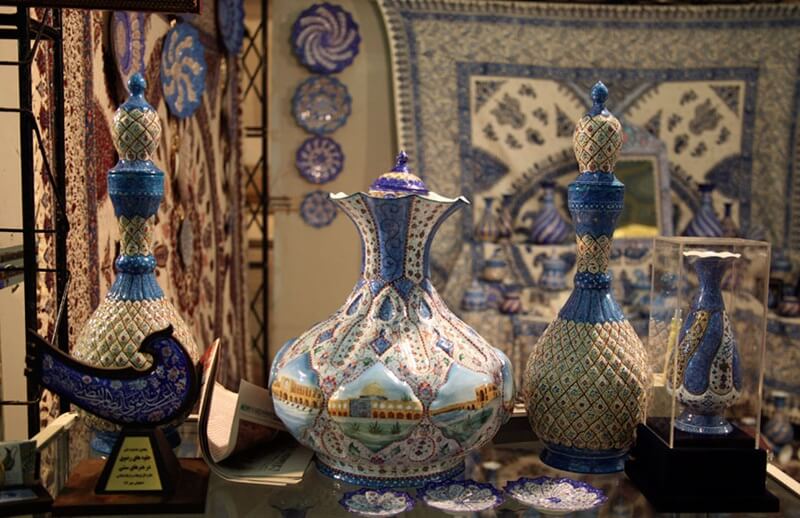
2. Minakari The tradition of enamel painting on metal — typically copper — in which mineral pigments are hand-applied and fused through multiple kiln firings at temperatures around 750°C. The name derives from the ancient Persian word for heaven. The colours only fully emerge in the heat, making each piece technically unrepeatable. Centred in Isfahan.
3 .Ghalamzani Literally “pen strike” — the art of engraving and embossing intricate patterns onto copper, silver, or brass surfaces using a small chisel and hammer. The rhythmic percussion of Ghalamzani workshops is one of the defining sounds of Isfahan’s bazaar. Work ranges from decorative copper bowls to fine silver ceremonial pieces.
4. Firoozeh Koobi The craft of inlaying turquoise stones — usually from the Neyshabur mines of Khorasan — onto copper, brass, or silver vessels. The result is a mosaic-like surface in which the blue of the stone contrasts with the warm metal base. Authentic Firoozeh Koobi uses natural, untreated turquoise; souvenir-grade versions frequently substitute dyed howlite or resin-stabilized stone.
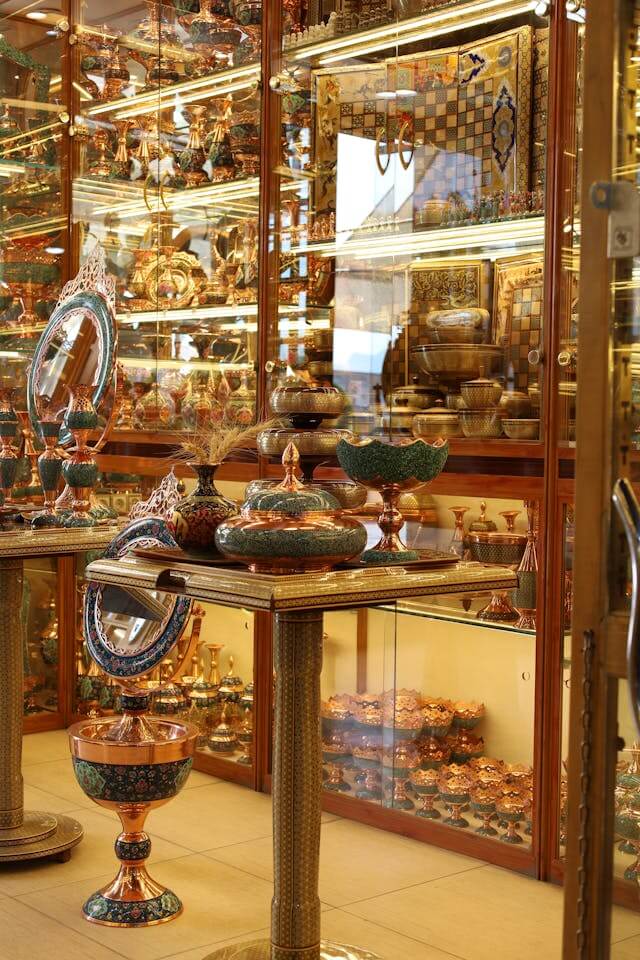
📷 Photo by MarYam IzD , via Pexels
5. Termeh A hand-woven luxury fabric produced in Yazd from a blend of silk, wool, and cotton on traditional looms. Defined by its intricate boteh (paisley) patterns and jewel-toned palette of pomegranate, saffron, and indigo. Authentic Termeh shows equal pattern clarity on both sides of the cloth — a quality marker no machine-made imitation achieves.
6. Ghalamkar The traditional woodblock-printed textile of Isfahan, in which hand-carved pear wood stamps are used to apply repeating botanical and geometric patterns onto cotton or linen fabric. The printing is done entirely by hand, color by color, using a layering technique that produces a depth of tone not achievable by screen printing.
7. Pateh The intricate needlework embroidery of Kerman, traditionally worked on wool using silk thread in dense, all-over botanical patterns. One of Iran’s oldest textile traditions and one of its most labor-intensive — a single Pateh panel can represent hundreds of hours of work.
Persian Carpets: the Crown Jewel of Tabriz and Beyond
Iran has been producing hand-knotted carpets for at least 2,500 years. The Pazyryk carpet — excavated from a frozen Siberian tomb and dated to the 5th century BCE — already demonstrates the full technical vocabulary of a craft tradition that had not yet reached its peak. What followed over the next two millennia is one of the most sustained expressions of applied human intelligence in art history.
The defining quality marker of a Persian carpet is knot density: the number of knots per square inch, each tied individually by hand around the warp threads of the foundation. Fine city-made carpets from Tabriz and Kashan achieve between 300 and 800 knots per square inch. The most extraordinary examples — museum-quality silk carpets from Qom — can exceed 1,000. A machine-made carpet, regardless of its visual appeal, has a uniform, mechanically even knot back. A hand-knotted Persian carpet has the faint, beautiful irregularity of ten million human decisions.
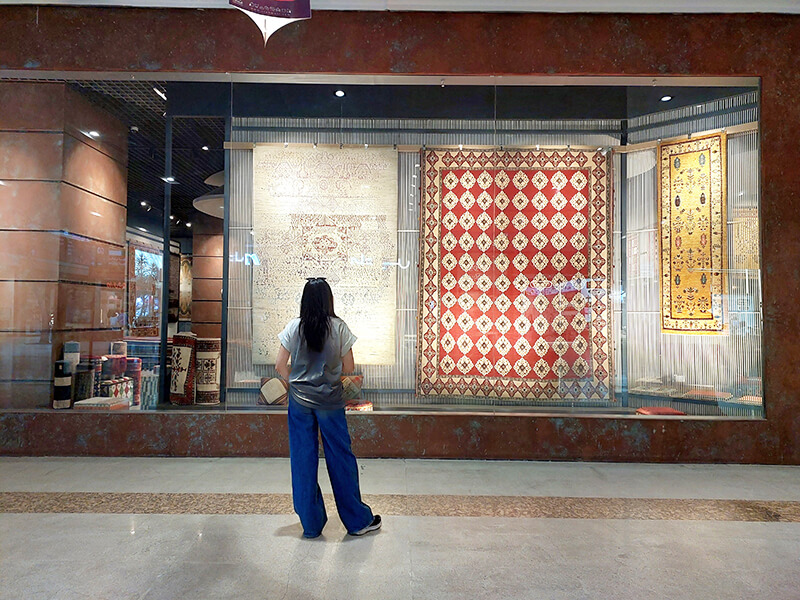
Regional carpet styles at a glance:
- Tabriz — Medallion and pictorial designs, high knot density, silk highlights, formal palette. Best for collectors and large formal spaces.
- Kashan — Arabesque and floral patterns, dense wool pile, vegetable dyes, heirloom quality. Best for investment buyers.
- Isfahan — Shah Abbasi floral, balanced composition, cotton warp, deep reds. Best for a first serious purchase.
- Qom — Silk on silk, the highest knot density available, luminous sheen, miniature detail. Museum-grade collecting.
- Qashqai (Shiraz) — Gabbeh and Kilim, flat-weave or coarse pile, figurative imagery, tribal provenance. Best for lifestyle buyers at accessible prices.
Carpet vs Kilim — the essential distinction: A carpet is pile-weave, constructed by knotting individual thread loops around the foundation. A kilim is flat-weave — no pile, no knotting, made by interlacing warp and weft. Kilims are lighter, less expensive, and equally ancient. A Qashqai kilim is not a lesser carpet. It is a different language, spoken by nomadic weavers who carried their looms on migration
The Art of Persian Calligraphy and Fine Paper Arts
Calligraphy is the most underserved category in the Western market for Persian souvenirs, and one of the most culturally significant. While carpets and Minakari dominate both the search results and the souvenir stalls, fine Persian calligraphy represents a form of artistic expression that has been considered, for over a thousand years, the highest of all Persian arts — superior even to painting.
Script styles: understanding what you are looking at
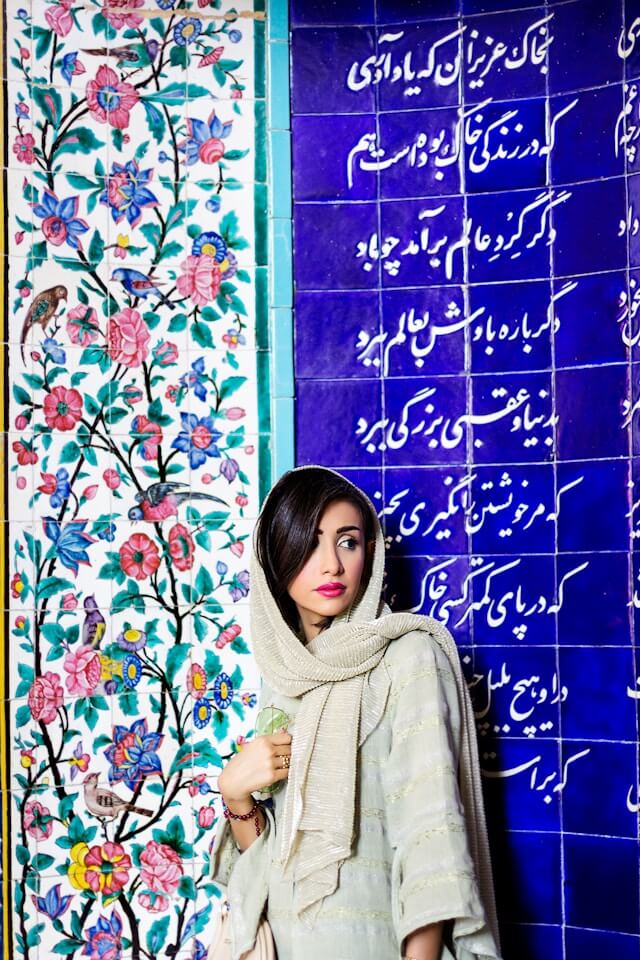
The dominant script in Persian calligraphy is Nastaliq — a flowing, diagonal style developed in 14th-century Iran that combines the older Naskh and Taliq scripts. Its defining characteristic is the sweeping downward curve of its horizontal strokes, which create a visual rhythm across the page that is simultaneously mathematical and lyrical. Nastaliq is to Persian calligraphy what the sonnet is to English poetry: a form so refined that mastery of it alone constitutes a lifetime’s work.
Shekasteh Nastaliq (broken Nastaliq) is the cursive, more spontaneous variant — less formal, more expressive, and increasingly sought by collectors interested in the intersection of calligraphy and abstract art.
Materials: what separates a print from a painting
Authentic Persian calligraphy is executed with a reed pen — called a qalam — cut from dried reed grass, on either marbled paper (Abr), handmade unbleached cotton paper, or occasionally deerskin. The ink is a mineral-based mixture — traditionally made from soot, gum arabic, and vitriol — that does not fade over centuries. Aged paper acquires a warmth of tone that no reproduction achieves.
Tazhib — the art of illumination — is the gold-leaf and pigment decoration that frames calligraphic text in the manuscript tradition. A calligraphy panel with Tazhib border work represents two distinct artists and two distinct craft traditions in a single object. These are the most collectible format.
Modern Iranian calligraphers are producing work that blends traditional Nastaliq with contemporary composition — large-format pieces suitable for modern interiors that carry the full weight of the classical tradition.
Iranian Pottery and Ceramics: from Lalejin to Meybod
Iran’s ceramic tradition predates its carpet weaving. Pottery shards found at Sialk, near Kashan, have been dated to 5500 BCE, making Iranian ceramics one of the oldest continuous craft traditions on earth. Today, the two cities that define contemporary Iranian pottery represent two completely different aesthetic and technical schools.
Lalejin, in Hamadan province, holds the WCC designation as the global hub for pottery — a city of approximately 20,000 inhabitants that contains over 3,000 active pottery workshops. Its tradition is characterized by cobalt-blue and white glazed pieces in intricate floral and arabesque patterns — a vocabulary that arrived via the Silk Road from China and was absorbed into a distinctly Persian idiom over centuries.
Meybod, near Yazd, produces a completely different aesthetic. Its characteristic Sun and Bird motif — a circle representing the sun, a bird representing the human soul — appears on terracotta vessels and tiles in earthy ochres and turquoise blues. The symbolism is pre-Islamic, rooted in Zoroastrian cosmology, and the motif has been in continuous production in Meybod for over a thousand years.
Metalwork and Marquetry: Minakari, Khatamkari, & Ghalamzani
Isfahan is described in Persian as nesf-e jahān — half the world. In the context of its metalwork traditions, the phrase is not an exaggeration. The city’s concentration of Minakari, Ghalamzani, and Khatamkari workshops represents an artistic ecosystem that has been evolving since the Safavid court established Isfahan as its capital in the 16th century.
Minakari and Ghalamzani
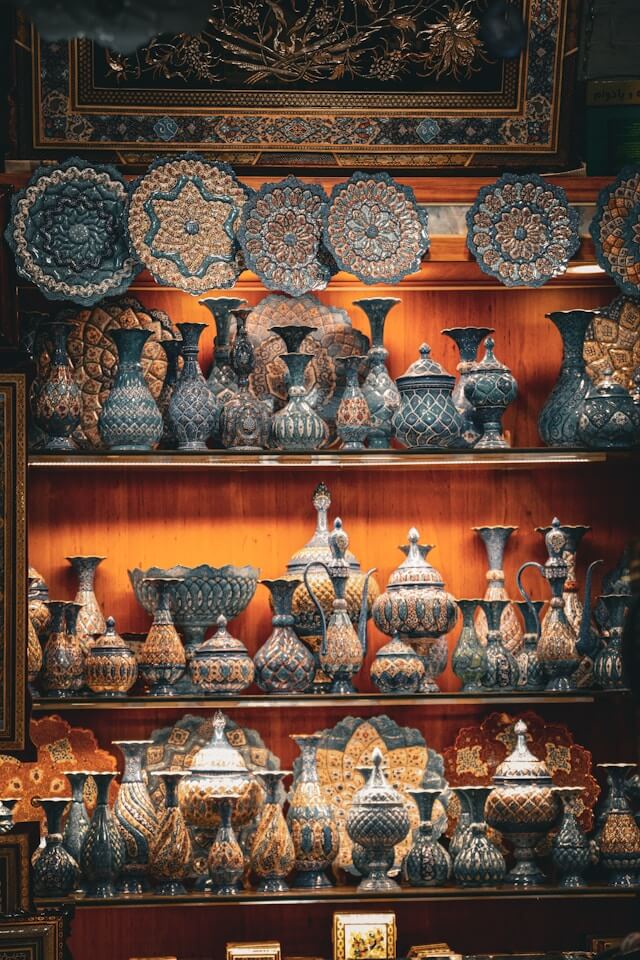
Minakari is a multi-stage process. The copper base is first shaped and polished, then coated with a white enamel ground layer and fired. The artist then hand-paints each color — beginning with the highest-temperature pigments and working down to the most heat-sensitive — firing the piece between each color layer. A single Minakari bowl may undergo seven or eight firings before completion. The cobalt blue that defines classic Isfahan Minakari is achieved at approximately 750°C and cannot be predicted precisely in advance. Two pieces fired side by side will emerge with subtly different blues. This is not a flaw. It is the signature of the fire.
Quality markers for Minakari: the painted design should show natural variation in brushstroke width. The enamel surface should be smooth and continuous with no cracking at colour boundaries. Avoid pieces where the underlying copper shows through at the edges of the enamel.
📷 Photo by Hossein Nasr on Unsplash
Ghalamzani at its highest level is executed on silver. The engraver works entirely by hand, tracing no preliminary design onto the metal — the pattern exists in his muscle memory, accumulated over years of apprenticeship. An Isfahan master will have spent a minimum of five years in apprenticeship before working on silver. Copper Ghalamzani is the entry point; silver is the investment.
Khatamkari and Zanjan filigree
Khatamkari begins with the rod. The craftsman prepares thin rods of each material — orange wood, ebony, teak, camel bone, brass wire — cut to precise triangular cross-sections, then binds them into a cylinder whose cross-section already forms the finished six-pointed star pattern. The cylinder is sliced into wafers approximately one millimetre thick, which are laid edge to edge onto the wooden base like a mosaic, glued under pressure, and polished. The finest Khatam work contains 250 individual elements per square centimetre. A standard jewellery box contains approximately two million pieces. There is no machine that replicates this convincingly.
Zanjan’s Malileh (silver filigree) represents a completely different technical tradition: the drawing of silver into wire as fine as 0.2mm, then twisting and soldering it into three-dimensional lace structures without any solid metal backing. The WCC designates Zanjan as the world authority on this craft. A quality Malileh piece feels simultaneously delicate and structurally precise — any wobble or asymmetry in the soldered joints indicates inferior work.
Textiles Beyond Carpets: Termeh and Ghalamkar
Iran’s woven and printed textile traditions extend far beyond carpet weaving. For the buyer whose luggage cannot accommodate a rolled carpet, these are the most practical and equally authentic alternatives.
Termeh (Yazd) — Best for formal table runners, framed wall panels, and luxury gift-wrapping for significant occasions. A hand-woven Termeh tablecloth is one of the most prestigious traditional gifts in Iranian culture.
Ghalamkar (Isfahan) — Best for tablecloths, cushion covers, framed textile art, and upholstery projects. Traditional Ghalamkar is printed using hand-carved pear wood stamps — one stamp per colour, applied in sequence. Look for slight misalignment between colour layers as a mark of authenticity, not a defect.
Pateh (Kerman) — Best for wall hangings and collector pieces. All-over silk thread embroidery on wool, in patterns so dense the ground fabric is entirely concealed. A large Pateh panel represents hundreds of hours of work.
Jajim (Northwest Iran) — Best for floor runners and sofa throws. A flat-weave textile produced by tribal communities across Azerbaijan and Kurdistan, in bold geometric patterns using naturally dyed wool. More accessible in price than kilims, equally authentic in provenance.
📷Photo by Bahareh Moradian on Unsplash
Edible Souvenirs: Saffron and the Red Gold Standard
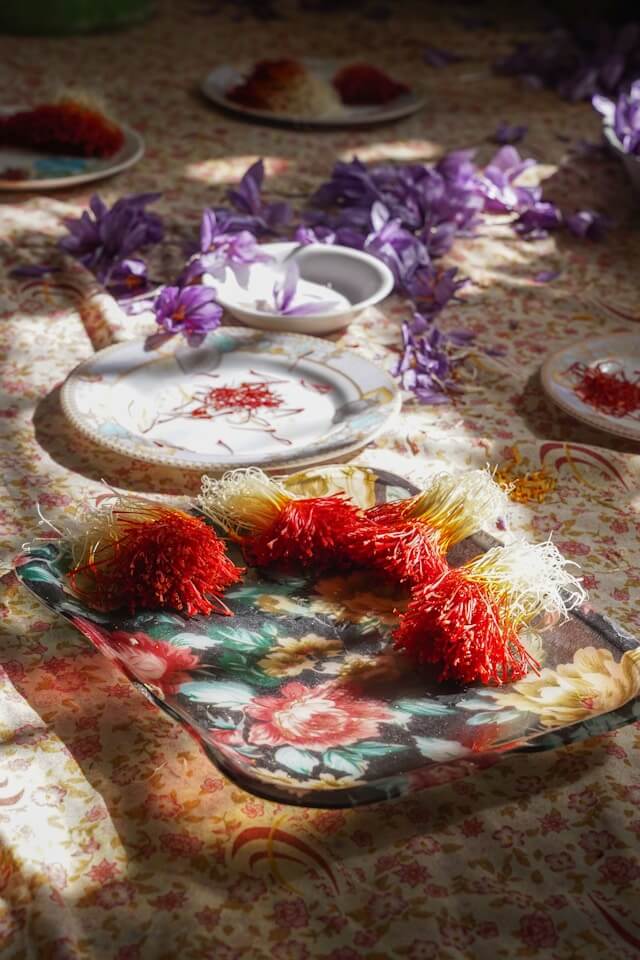
Iran produces approximately 94% of the world’s total saffron supply. The majority comes from South Khorasan province — specifically the area around Qaen and Birjand — where the combination of semi-arid climate, cold nights, and mineral-rich clay soil produces a stigma of exceptional length, colour intensity, and aroma. Saffron has been traded from this region along the Silk Road since antiquity, and it remains, by weight, one of the most expensive agricultural products on earth.
Quality test — three steps to authentic saffron:
Step 1, Visual: Grade A saffron consists entirely of deep crimson stigma tips with no yellow style attached.
Step 2, Water test: Place five or six threads in a glass of cold water. Genuine saffron releases color slowly — the water should turn a deep golden-yellow over 10 to 15 minutes. Counterfeit saffron releases an immediate, aggressively red color within seconds.
Step 3, Smell test: Authentic saffron has a complex, slightly medicinal aroma — honey, hay, and a faint metallic note. An intensely sweet smell indicates adulteration.
Nowruz and Gift-Giving Etiquette in Iran
To understand Iranian handicrafts fully, you need to understand the culture of giving that surrounds them. In Iran, a gift is never merely an object. It is a statement of the relationship between giver and receiver, calibrated by occasion, by relative social position, and by the particular vocabulary of Iranian etiquette.
Nowruz — the Persian New Year celebrated at the spring equinox, usually March 20 or 21 — is the most significant gift-giving occasion in the Iranian calendar. The tradition of Eidi (Nowruz gifts, typically given by elders to younger family members) has expanded over centuries from coins and sweets to include fine handicrafts, textiles, and jewelery. For a visitor to Iran during Nowruz, the bazaars in the two weeks before the equinox represent the handicraft market at its most vibrant — and most competitive.
Taarof in the bazaar: Iranian politeness culture includes the practice of taarof — a ritual of offered refusal in which a vendor may initially decline payment, or a craftsman may insist their work is unworthy of your interest, as a form of social courtesy. Neither statement should be taken literally. The correct response to “please take it as a gift” is a polite insistence on paying. The correct response to “this is not worthy of you” is a sincere compliment on the craft. Taarof is a form of respect, not negotiation. Understanding it prevents awkwardness and deepens the interaction.
The 10 Most Famous Iranian Handicrafts to Buy
1. Persian Carpets The defining Iranian export and one of the world’s great art forms. Hand-knotted, vegetable-dyed wool or silk carpets from Tabriz, Kashan, Isfahan, or Qom represent both cultural legacy and financial investment.
2. Minakari Copperware Hand-painted enamel on copper, fired multiple times to achieve the characteristic Isfahan blue. Available as bowls, vases, jewelry boxes, and plates.
3. Khatamkari Inlay Pieces Marquetry jewelry boxes, backgammon boards, picture frames, and pen cases made from thousands of hand-cut wood, bone, and metal elements.
4. Khorasan Saffron premium grade, vacuum-sealed, from a reputable spice merchant.
5. Neyshabur Turquoise Jewelry Natural, untreated turquoise from the oldest active turquoise mines on earth, set in silver or used in Firoozeh Koobi inlay.
6. Ghalamkari Textiles Woodblock-printed cotton tablecloths, runners, and cushion covers in traditional botanical patterns. Practical, lightweight, and genuinely handmade.
7. Lalejin Pottery Cobalt-blue and white glazed ceramics from the WCC-designated world pottery capital in Hamadan province.
8. Persian Calligraphy Art Original Nastaliq or Shekasteh Nastaliq panels, with or without Tazhib illumination borders. The most undervalued category in the international market.
9. Termeh Silk Fabric Hand-woven Yazd silk and wool in traditional paisley patterns, used for table runners, wall hangings, or framing.
10. Rosewater from Kashan Distilled from Damask roses harvested each May in the villages around Kashan, Persian rosewater has been used in cooking, ritual, and medicine for over a thousand years.
Final Thought: See Iranian Handicrafts for Yourself
Because some things can only be understood in person.
Everything in this guide — the knot counts, the quality tests, the city names to trust — is genuinely useful. But there is a version of this knowledge that no article can give you, and it happens the moment a craftsman in Isfahan places an unfinished Khatam rod in your hand and says: feel how precise that has to be.
That is the moment we build our tours around. Not a performance of Persian culture for visitors — but real access to the workshops, the bazaars, and the people behind the craft. We know which Ghalamzani masters in Isfahan still apprentice the old way. We know the Termeh weaver in Yazd whose work ends up in collections abroad. We know the saffron merchant in Qaen who will explain, patiently and with obvious pride, exactly why his harvest is different.
Ready to go beyond the guide?
FAQs for Iranian Handicrafts
1. Which city in Iran is best for buying handicrafts?
It depends on what you are looking for. Isfahan is the most concentrated single destination — Minakari, Khatamkari, Ghalamzani, and Ghalamkari textiles all originate here. Tabriz is the carpet capital. Yazd is essential for Termeh silk weaving. Kashan for rosewater, fine carpets, and ceramics. Lalejin (near Hamadan) for pottery specifically. Each city has a living craft economy, not just a souvenir market — and the difference is visible the moment you arrive.
2. Can I bring Persian handicrafts back through customs?
Most Persian handicrafts — carpets, Minakari, textiles, ceramics, saffron — can be exported freely. However, antique items over 50 years old require an export permit from the Iranian Cultural Heritage Organisation, and items containing certain materials (ivory, tortoiseshell) are subject to CITES regulations at your destination country. Reputable sellers are familiar with these rules. When buying significant pieces, ask the seller explicitly whether an export certificate is needed and request a receipt with a full description of the item.
3. What is the best time of year to visit Iran for handicraft shopping?
Spring and autumn are the ideal travel seasons in Iran (March–May and September–November), with mild temperatures across the major craft cities. The two weeks before Nowruz — the Persian New Year, around March 20–21 — are especially vibrant: bazaars are fully stocked, workshops are at peak production, and the gift-giving culture of Eidi means you are shopping alongside Iranians buying for each other, not just tourists buying for themselves. Kashan in May coincides with the Damask rose harvest — rosewater distillation is visible in the villages.
4. How should I navigate bargaining and taarof in Iranian bazaars?
Taarof is Iran’s ritual of polite refusal — a vendor may say “please take it as a gift” or “this is not worthy of you.” Neither statement is literal. The correct response is a sincere compliment and a polite insistence on paying. Bargaining exists in bazaars but is gentler than in many countries — persistent aggressive negotiation is considered rude. A respectful counter-offer of 10–20% below the asking price is reasonable; accepting gracefully when a seller holds firm is the correct move.
5. How do I know if a Persian carpet is genuinely hand-knotted?
Turn the carpet over and examine the back. A genuine hand-knotted carpet shows slight irregularities in the knot structure — the faint, beautiful evidence of ten million individual human decisions. A machine-made carpet has a perfectly uniform, mechanically even reverse. On the front, run your hand against the pile: hand-knotted carpets have a subtle directional sheen. Ask for the city of origin: Tabriz, Kashan, Isfahan, and Qom are the four names that carry real provenance.
6. What is the difference between authentic Minakari and a cheap imitation?
Authentic Minakari from Isfahan is hand-painted and fired multiple times at around 750°C. Look for natural variation in brushstroke width, a smooth continuous enamel surface, and — most tellingly — subtle differences in the cobalt blue between two pieces fired side by side. Imitations use transfer prints or decals: the design will be perfectly uniform and slightly raised from the surface as a single layer.
7. How can I test if saffron from Iran is genuine?
Three steps. First, visually: Grade A Iranian saffron is deep crimson with no yellow style attached. Second, the water test: place a few threads in cold water — genuine saffron releases color slowly over 10–15 minutes, turning the water golden-yellow. Fake saffron bleeds red within seconds. Third, smell: authentic saffron has a complex honey-and-hay aroma with a faint metallic note. An intensely sweet smell signals adulteration.
8. Is Neyshabur turquoise different from turquoise sold elsewhere?
Yes — significantly. The Neyshabur mines in Khorasan province are among the oldest continuously operating turquoise mines on earth, producing stones prized for their intense sky-blue color and natural hardness. Authentic Neyshabur turquoise is sold untreated. Much of what is sold as “turquoise” in tourist markets worldwide is dyed howlite or resin-stabilized stone. When buying, ask specifically for natural, untreated Neyshabur turquoise and request a certificate from the seller.
9. What is Khatamkari and why is it so expensive?
Khatamkari is the Persian art of marquetry — inlaying geometric patterns onto wooden surfaces using thousands of precisely hand-cut pieces of wood, camel bone, and brass wire. A master craftsman cuts 200 to 250 individual elements per square centimetre. A standard jewellery box contains approximately two million pieces. The price reflects not the materials, which are modest, but the accumulated hours of extraordinary precision work — there is no machine that replicates it convincingly.
10. Can Compassimo help me buy and ship handicrafts home safely?
Yes. We advise on what to buy, where to buy it, and what to pay — and we can assist with packing, documentation, and export procedures for larger or more valuable pieces such as carpets. Our guides know which sellers provide genuine certificates of authenticity and which do not.
0 Comment