

Table of Contents
If Tehran is Iran’s restless, contradictory present, Shiraz is its unhurried, poetic past. This is the city Iranians themselves describe with a kind of tenderness reserved for very few places — the City of Roses, the City of Poets, the city where gardens were designed as earthly rehearsals for paradise. Walk through Shiraz in spring, when the orange blossoms are out and the air over the old quarter smells faintly of jasmine, and you will understand immediately why generations of poets and mystics chose to stay.
Shiraz’s identity is layered in a way that rewards slow travel. It was a Sassanid stronghold centuries before Islam arrived, a literary capital under the Injuids in the 14th century when Hafez and Saadi were writing the poems Iranians still recite from memory today, and the seat of the Zand dynasty in the 18th century, when Karim Khan chose to rule not as a king but as vakil — the people’s representative — and built a capital to match that humility and ambition in equal measure. And just an hour outside the city lie the ruins of Persepolis, the ceremonial heart of the First Persian Empire, which makes Shiraz the single most essential base for understanding Iran’s ancient past.
This guide goes well beyond the standard sightseeing list. It is built for the cautious, curious international traveler who wants real context — historical, religious, culinary, and practical — for the best things to do in Shiraz.
Navigating the City of Poets: Why Shiraz
Shiraz sits in a broad valley in Iran’s southern Fars province, ringed by the Zagros Mountains, at an elevation that gives it a noticeably gentler climate than much of the rest of the country. Its name is inseparable from three things in the Iranian imagination: poetry, gardens, and a wine tradition that — as you’ll see later in this guide — has a far more complicated legacy than most visitors realize.
The city’s old core, radiating out from the Zand-era Vakil Complex, is compact and walkable in a way that few Iranian cities are. Most of the headline attractions in central Shiraz sit within a 20–30 minute walk of one another, which makes Shiraz one of the most pleasant Iranian cities to explore on foot. Beyond the center, the city’s real trump card reveals itself: nowhere else in Iran puts you closer, in a single day, to the ceremonial capital of the Achaemenid Empire, the fortress-palaces of the early Sassanid kings, and a living nomadic culture that has migrated through these same mountains for centuries.
Getting there: Shiraz International Airport (SYZ) is well connected to Tehran, Isfahan, and other major Iranian cities, as well as a small number of regional international routes. Overnight trains run from Tehran, taking longer than flying but offering a comfortable, scenic alternative. However you arrive, download Snapp or Tap30 (Iran’s ride-hailing apps) and grab a local SIM card on arrival — both work exactly as they do elsewhere in the country.

Step Into the Zand Capital: The Vakil Complex
In the 18th century, Karim Khan Zand made Shiraz the capital of Iran and set about building a civic center that would embody his rule: practical, generous, and built for the people rather than for personal glorification. The result is the Vakil Complex — a citadel, a mosque, a bazaar, and a bathhouse, all commissioned as a single coherent project. Today it remains the historic heart of the city, and walking through all four in a single visit is the single best way to understand 18th-century Shiraz.
Arg-e Karim Khan (Karim Khan Citadel)
The citadel is Shiraz’s most imposing structure: a rectangular fortress with four round corner towers, thick brick walls, and a quietly elegant interior courtyard planted with citrus trees — a striking contrast to the building’s military exterior. It served as Karim Khan’s residence and seat of government, and later as a prison during the Pahlavi era, a detail that still surprises visitors when they learn it. Most people find the citadel’s grounds — the garden courtyard, the old bathhouse within its walls, and the views from its corner towers — more rewarding than the interior exhibits, though both are worth your time.
Vakil Mosque
A short walk from the citadel, Vakil Mosque is one of Shiraz’s most beautiful religious buildings and a masterclass in Zand-era design. Its tiled entrance portal is richly decorated, and the prayer hall’s forty-eight carved stone columns — each cut from a single piece of stone — are among the finest stonework anywhere in Iran. Unlike many of Iran’s grandest mosques, Vakil Mosque has an intimacy to it; it rarely feels overwhelmed by crowds, which makes for unhurried photography and quiet contemplation.
Vakil Bazaar
Connected directly to the mosque and citadel, Vakil Bazaar took an estimated 21 years to build and was modeled on the historic bazaar of Lar, further south in Fars province. Its long vaulted brick corridors were engineered with small windcatchers and a traditional ventilation system that still keeps the bazaar noticeably cooler than the streets outside — an old solution to Shiraz’s hot summers that remains genuinely effective today.
Inside, look for hand-painted enamelware, finely woven carpets and kilims, and above all khatamkari — a Persian marquetry technique using tiny inlaid pieces of wood, metal, and bone to form intricate geometric patterns, applied to jewelry boxes, picture frames, and decorative trays. Shiraz is one of the best places in Iran to buy genuine khatamkari directly from the artisans who make it.
Practical note: As elsewhere in Iran, the bazaar is closed on Fridays. Prices on souvenir items are generally negotiable.
Vakil Bathhouse (Vakil Hammam)
Tucked within the same complex, the Vakil Hammam is a beautifully restored Zand-era bathhouse, its vaulted central chamber decorated with fine plasterwork and twisted “candy-cane” columns. Rather than functioning as a working bathhouse today, much of it has been converted into a small museum, with costumed wax figures illustrating the traditional roles and rituals of hammam life — the barber, the masseur, the tea server — set against the original architecture. It’s a quick but evocative stop that brings the social function of a historic hammam to life even if you don’t experience the bathing ritual here yourself.
📷Photo by Mohammad Reza VF on Unsplash
Walk Through Paradise: The Persian Gardens of Shiraz
Few cities anywhere have built as much of their identity around gardens as Shiraz. The Persian garden, with its symmetrical layout, channeled water, and cypress-lined avenues, was conceived as an earthly echo of paradise — and Shiraz’s gardens, several with roots going back to the Seljuk era and elaborated under the Qajars, remain some of the finest surviving examples in the country.
Eram Garden
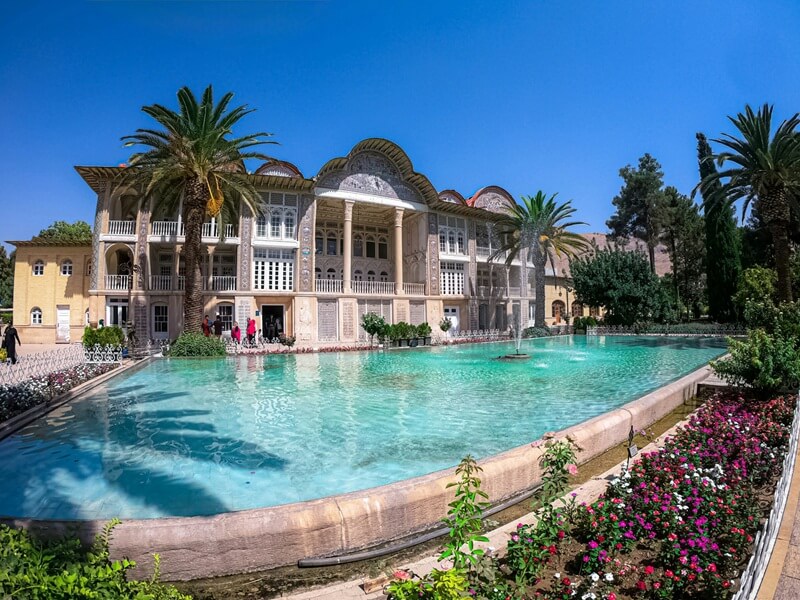
Eram is Shiraz’s most celebrated garden and part of the UNESCO-recognized “Persian Garden” listing. Its roots trace to the Seljuk period, but the garden took its present form in the 19th century, when it came under the ownership of Qajar-era nobility, including figures connected to the Qashqai tribal leadership, before its grand three-story pavilion was built by the same architect responsible for the Pink Mosque. The pavilion’s facade is decorated with a remarkable semicircle of tile plaques depicting historical and mythological figures, while the garden itself — cypress avenues, reflecting pools, and one of the tallest cypress trees in Iran — is at its most beautiful in spring, when the citrus blossoms perfume the entire grounds. The site now functions as a botanical garden maintained by Shiraz University.
Narenjestan-e Qavam and Zinat al-Molk House
Built over roughly a decade in the late 19th century by the powerful Qavam family, Narenjestan-e Qavam (“Orange Garden”) pairs a citrus-filled courtyard with one of the most opulent Qajar mansions in the city. The interior Mirror Hall is a dazzling set piece of mirrored tilework and stained glass, and the building’s two sections — an outer house for formal receptions and an inner house once reserved for family life — were historically linked by an underground passage, a detail that hints at how Qajar elite households separated public and private life. The complex is well worth combining with the Vakil area, as it sits only a short walk from the bazaar.
Afifabad and Delgosha Gardens
For a quieter, less touristed garden experience, Afifabad Garden dates back to the Safavid era and was once a royal recreational retreat, while Delgosha Garden — whose name translates roughly to “heart-opening” — has a history stretching back centuries and offers some of the most peaceful walking paths in the city. Both are excellent additions for travelers spending three or more days in Shiraz who want to escape the more visited sites.
The Pink Mosque and the Sacred Architecture of Shiraz
Nasir-ol-Molk Mosque (the Pink Mosque)
No image represents Shiraz in the popular imagination quite like the Nasir-ol-Molk Mosque, commonly known as the Pink Mosque. Commissioned in 1876 by the Qajar nobleman Mirza Hasan Ali Nasir-ol-Molk and completed twelve years later, the mosque takes its nickname from the rose-colored tiles that cover its facade — an unusual departure from the blues and turquoises typical of Iranian religious architecture. Its real magic, though, happens inside: more than 750 stained-glass windows flood the western prayer hall with shifting color in the early morning light, turning the carpeted floor into a shifting kaleidoscope for the first hour or two after sunrise.
Visitor tip: Arrive right at opening, ideally before 8am, and head straight for the western hall. The light effect fades noticeably by mid-morning and is essentially gone by early afternoon, which is the single most important piece of planning advice for any Shiraz itinerary.
Shah-e Cheragh Shrine
A short distance away, Shah-e Cheragh (“King of the Light”) is the third most important Shia pilgrimage site in Iran, after the shrines in Mashhad and Qom. According to local tradition, the site was discovered in the 12th century when a mysterious light was seen emanating from the ground, leading to the discovery of the tomb of Ahmad ibn Musa, a brother of the eighth Shia Imam, who died in Shiraz in the 9th century while fleeing Abbasid persecution. The shrine reached its present grandeur in the 14th century under the patronage of a regent queen, and its interior is now one of the most extraordinary spaces in Iran: walls, ceilings, and columns covered almost entirely in tiny mirrored mosaic tiles that scatter light from the chandeliers into a shimmering, glittering field.
Practical note: Non-Muslims generally cannot enter the inner shrine unaccompanied. Bags are left at the entrance, and visitors are paired with a free guide who will walk you through the complex — an arrangement that surprises many first-time visitors but is handled smoothly and courteously in practice. Modest, conservative dress is required, and women will be provided a chador to wear inside if needed.
In the Footsteps of Hafez and Saadi: Shiraz’s Poetic Soul
This is the experience that has no real equivalent anywhere else in Iran. Shiraz produced two of the greatest poets in the Persian language — Hafez in the 14th century and Saadi a century earlier — and both are buried in the city in memorial gardens that remain, to this day, places where ordinary Iranians come not as tourists but as pilgrims of literature.
Tomb of Hafez
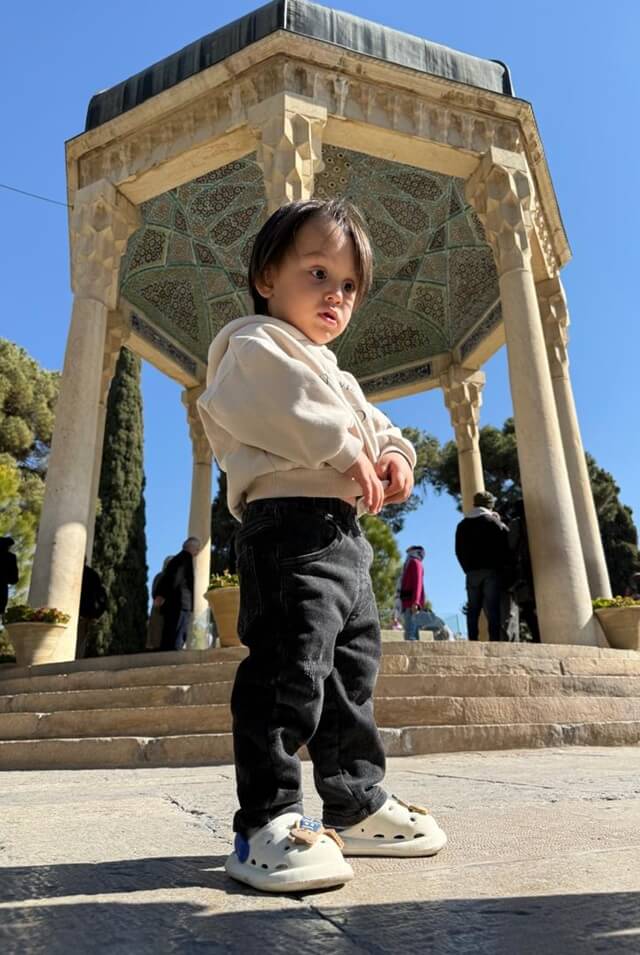
Set within a quiet garden of orange and cypress trees, the Tomb of Hafez is one of the most emotionally resonant sites in the country. Hafez’s poetry — sensuous, mystical, often subversive toward religious hypocrisy of his time — occupies a place in Iranian culture somewhere between Shakespeare and scripture; many Iranian households keep a copy of his collected Ghazals (Divan) at home and use it for fal-e Hafez, a tradition of opening the book at random to seek guidance or insight. Visit in the evening, when locals gather informally around the marble tomb, often reciting verses aloud or quietly reflecting. If you can, ask someone nearby to read a poem aloud in the original Persian — even without understanding the words, the rhythm and cadence reveal why this poetry has endured for over six centuries.
Tomb of Saadi
Saadi, author of the Bustan and Golestan — two of the most influential works of classical Persian literature, prized for their blend of moral wisdom and storytelling — is buried in a separate memorial garden elsewhere in the city. The setting is calmer and less visited than Hafez’s tomb, with a reflecting pool and shaded colonnade that invite a slower, more contemplative visit. Together, these two sites explain something essential about Shiraz: this is a city that has always measured its greatness as much in verses as in monuments.
Eat Your Way Through Shiraz: Food Tours and Essential Dishes
Shiraz takes real pride in its food, and the city has its own distinct culinary identity within Iranian cuisine — milder, herbier, and built around a handful of dishes you won’t easily find with the same quality elsewhere in the country.
The Essential Dishes
Kalam Polo Shirazi — the dish most associated with the city: a fragrant rice pilaf cooked with cabbage, dill, and seasoned meatballs (often lamb or beef), unlike anything found in other regional Iranian cuisines. It’s the single dish locals will most often point you toward if you ask what to try.
Shirazi Salad — a simple, refreshing chopped salad of cucumber, tomato, and onion, dressed with lime juice and dried mint, that has spread across Iran and the wider region but remains most closely tied to its city of origin. It’s the perfect counterbalance to richer stews and kebabs.
Faloodeh Shirazi — Shiraz’s signature dessert, and one of the oldest frozen desserts in the world: thin vermicelli-like noodles made from starch, frozen into a semi-granita texture, and served with rosewater syrup, lime juice, and sometimes a few drops of sour cherry syrup. Faloodeh shops around the old Zand Complex have been making it the same way for generations, and it’s especially welcome on a hot Shiraz afternoon.
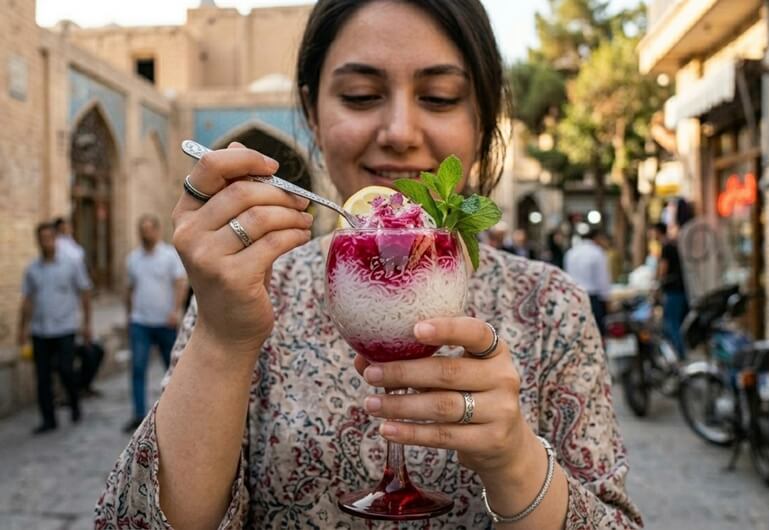
Traditional kebabs and stews — as elsewhere in Iran, expect excellent koobideh and joojeh kebab, along with regional variations on classic stews. Several of Shiraz’s best-known restaurants operate out of restored historic houses near the bazaar, pairing the food with genuinely beautiful Qajar-era courtyard settings.
Food Tours and Where to Eat
A growing number of local guides offer half-day food walks through the Vakil Bazaar district, taking in traditional bakeries, faloodeh shops, and family-run restaurants that don’t always show up in guidebooks. For independent exploration, the area around the Zand Complex has a strong concentration of both traditional restaurants and newer cafés, making it an easy base for an afternoon of grazing your way through the city’s specialties.
For travelers who want to go beyond eating and into understanding, our Persian cooking class is the best next step — a hands-on session where you prepare a traditional Shirazi meal yourself and pick up the techniques and stories behind the food along the way.
Explore the Museums and Historic Houses of Shiraz
Zinat al-Molk House (Fame Museum)
Adjacent to Narenjestan-e Qavam, the Zinat al-Molk House — named for a charitable, well-regarded daughter of the Qavam family — is one of Shiraz’s most graceful surviving Qajar mansions, with mirrored halls, stained glass, and finely carved wooden doors. Its basement now houses the city’s “Hall of Fame” museum, an idiosyncratic but engaging collection of wax figures depicting notable historical and cultural figures from Shiraz’s past. It’s a quick, slightly eccentric add-on to a Narenjestan visit rather than a destination in its own right, but worth the short detour.
Pars Museum
Housed in a restored octagonal pavilion that was once part of Karim Khan’s royal gardens, the Pars Museum holds a small but interesting collection connected to the Zand era — including weapons, manuscripts, and personal items associated with Karim Khan himself. The building’s architecture, set within its own garden, is as much a draw as the collection inside.
Quran Gate
On the northeastern edge of the old city, where the road leads out toward Marvdasht and Persepolis, the Quran Gate marks the traditional entrance to Shiraz. According to local tradition, a handwritten Quran was once placed above the archway to bless travelers entering or leaving the city — a custom tied to the deep symbolic importance Shiraz has always placed on literature, learning, and the written word. Today it’s a relaxed gathering spot in the evenings, with informal cafés and families taking in the cooler evening air on the surrounding hillside.
Day Trip to Persepolis and Pasargadae: The Achaemenid Heartland
No visit to Shiraz is complete without this day trip, and most visitors consider it the single most important excursion in all of Iran.
Persepolis (Takht-e Jamshid)
About an hour’s drive northeast of Shiraz, Persepolis was the ceremonial capital of the Achaemenid Persian Empire, founded by Darius the Great in the late 6th century BC and developed over the following two centuries by his successors. This was where the empire received tribute and hosted its grandest ceremonies — not a residential capital so much as a vast stage for projecting imperial power and the empire’s astonishing cultural diversity. The site’s monumental stone staircases, the Gate of All Nations, and the famous relief carvings depicting representatives from across the empire bringing gifts to the king are among the finest surviving examples of Achaemenid art anywhere in the world. Alexander’s forces burned the complex in 330 BC, and what remains today — though partial — is still staggering in scale and ambition. Plan for at least two to three hours on site, and go in the morning before both the heat and the crowds build.
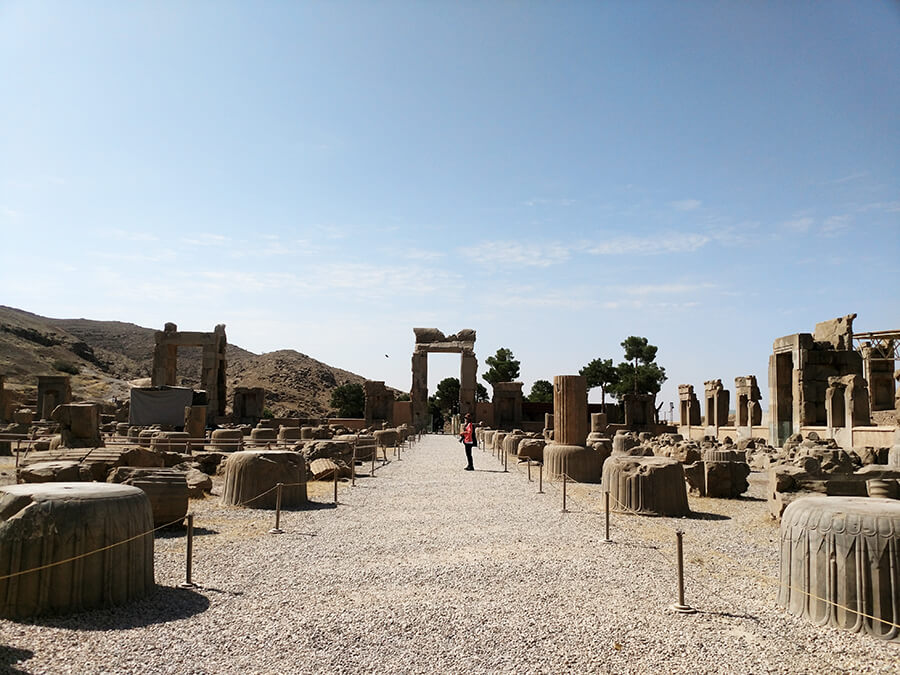
Naqsh-e Rustam
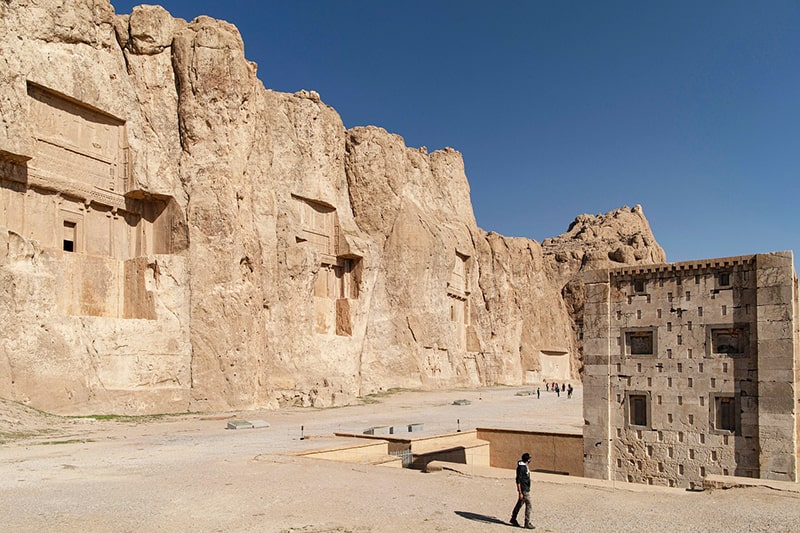
A short drive from Persepolis, Naqsh-e Rustam is an essential companion stop and should never be skipped. This dramatic rock face holds the monumental tombs of four Achaemenid kings — including, most likely, Darius the Great — carved high into the cliff in the form of cross-shaped facades. Beneath and around them are a series of large Sassanid-era rock reliefs, carved centuries later, depicting royal investiture ceremonies and military victories, including a famous relief showing the Sassanid king Shapur I triumphing over a captured Roman emperor. The juxtaposition of Achaemenid tombs and Sassanid reliefs on the same cliff face makes Naqsh-e Rustam one of the most visually striking and historically layered sites in the country — a single rock wall that spans nearly a thousand years of Persian imperial history.
Pasargadae
Further afield — roughly 130 kilometers from Shiraz, generally visited as a separate excursion or combined into a longer day — Pasargadae was the first capital of the Achaemenid Empire, founded by Cyrus the Great in the 6th century BC. Its centerpiece, the Tomb of Cyrus, is a deceptively simple gabled stone structure that has had an outsized influence on world history: it’s widely regarded as an architectural ancestor of later imperial tomb design across the region, and Cyrus himself is remembered, including in the biblical Book of Ezra, as the ruler who allowed exiled peoples to return to their homelands. Standing before the tomb of a man credited with one of the earliest known declarations of religious tolerance is, for many travelers, one of the most quietly moving moments of an Iran trip. If you would like to experience Pasargadae alongside Persepolis, consider joining our Pasargadae and Persepolis Tour for a deeper journey into the world of ancient Persia.
Beyond Persepolis: Sassanid Shiraz at Bishapur and Firuzabad
Most visitors to Shiraz stop at Persepolis and consider their ancient-history box checked. Far fewer make it to the region southwest of the city, where an entirely different — and in some ways even more atmospheric — chapter of Persian history is preserved: the early capital cities of the Sassanid Empire, the dynasty that ruled Iran from the 3rd to the 7th centuries AD and that, after the Achaemenids, represents the second great flowering of pre-Islamic Persian civilization.
In 2018, UNESCO formally recognized this region as the “Sassanid Archaeological Landscape of Fars Region,” covering eight sites across Firuzabad, Bishapur, and Sarvestan. For travelers interested in archaeology beyond the Achaemenid headline acts, this is one of the most rewarding and least-crowded excursions available from Shiraz.
Firuzabad: Birthplace of an Empire
About 100 kilometers south of Shiraz, Firuzabad was where Ardashir I, the founder of the Sassanid dynasty, first established his power after defeating the last Parthian king in 224 AD. The region holds several remarkable sites, best visited in sequence:
Qal’eh Dokhtar, the “Maiden Castle,” is a dramatic fortified palace built by Ardashir I in 209 AD on a mountainside overlooking the approach road, constructed across three terraced levels and reached via a steep staircase. Local tradition connects its name to Anahita, the ancient Persian goddess of water.
The Palace of Ardashir, sometimes called the Ardashir Fire Temple, sits on the plain below and is larger and more architecturally ambitious than Qal’eh Dokhtar — a complex of domed halls and a symmetrical reception space built to project the new dynasty’s royal legitimacy rather than to serve as a defensive structure.
The Rock Relief of Ardashir’s Victory, carved into a cliff face nearby, depicts Ardashir’s triumph over the Parthian king Ardavan V in striking, finely detailed relief — notable for focusing on a specific historical event rather than a religious or symbolic scene, which is relatively rare in Sassanian rock art.
Bishapur: The Planned Sassanid City
Further west, near the town of Kazerun, Bishapur was founded by Ardashir’s successor, Shapur I, as a more deliberately planned capital — a rectangular city with orthogonal streets and a sophisticated double-wall defense system, in contrast to Firuzabad’s circular layout. Excavations here remain partial, but the site includes the remains of what was long thought to be Shapur’s palace and is now believed to have been a fire temple, along with traces of Roman-influenced mosaic flooring — physical evidence of the Roman prisoners of war Shapur is known to have used as laborers and craftsmen after his military victories.
Nearby, the rock reliefs at Tang-e Chogan depict several of these Sassanid military triumphs in dramatic detail, including scenes connected to Shapur’s famous victories over Roman emperors — a thematic echo of the relief you’ll already have seen at Naqsh-e Rustam, but rendered here at an even larger scale.
Practical note: This excursion typically requires a full day from Shiraz, ideally with a private driver or guide given the spread-out nature of the sites and the patchy public transport options. It pairs naturally with a broader interest in pre-Islamic Persian history and is one of the highlights of any dedicated archaeology-focused itinerary in the region.
Live Like a Nomad: A Day with the Qashqai Tribes
One of the most genuinely memorable experiences available from Shiraz has nothing to do with ancient ruins or tiled monuments at all — it’s the chance to spend time with the Qashqai, a Turkic-speaking nomadic and semi-nomadic people who have herded sheep and goats through the Zagros Mountains north of Shiraz for centuries.
The Qashqai practice a seasonal migration known as kooch, moving their flocks between summer highland pastures and winter lowland grazing grounds in pursuit of the best conditions for their animals — a rhythm of life that has remained recognizably consistent for generations, even as modern roads and settled life have changed it in other ways. Several Qashqai families in the mountains north of Shiraz welcome visitors for day trips or overnight stays, offering a level of access and hospitality that few nomadic cultures anywhere in the world extend so openly to outsiders.
A typical visit involves being collected from your hotel in Shiraz and driven up into the Zagros foothills, often stopping en route at Maharloo Lake or one of the regional Sassanid sites along the way. Once at the camp, you’ll typically be welcomed with tea, shown around the tents and the surrounding pasture, and invited to share a meal cooked over an open or wood-fired stove — frequently including freshly baked bread and dishes built around the family’s own livestock and dairy. Guests are often invited to walk with the shepherds, help with the animals, or simply sit and talk through a guide, learning about the practical realities of a way of life that blends deep tradition with the everyday pressures of modern Iran.
Best time to visit: The most rewarding window is late spring through mid autumn — roughly May through October — when most Qashqai families are in their highland pastures and the mountain scenery is at its greenest. Visits are best arranged in advance through a local guide or tour operator with established relationships with specific families, both out of practical necessity and out of respect for the fact that you are a guest in someone’s home and livelihood, not a paying spectator at an attraction.
📷Photo by Hadis Faghiri on Wikicommons
Shiraz’s Natural Surroundings: Qalat Village and Maharloo Pink Lake
Beyond the historic and archaeological excursions, two nearby spots offer a different kind of escape from the city.
Qalat Village
About 20 kilometers northwest of Shiraz, Qalat is a small mountain village known for its terraced gardens, fruit orchards, and a noticeably cooler microclimate than the city below — a popular weekend retreat for Shirazis themselves. Its old stone houses, built into the hillside, and its relaxed teahouses make it an easy half-day escape, particularly appealing in summer when Shiraz itself can feel uncomfortably warm.
Maharloo Pink Lake
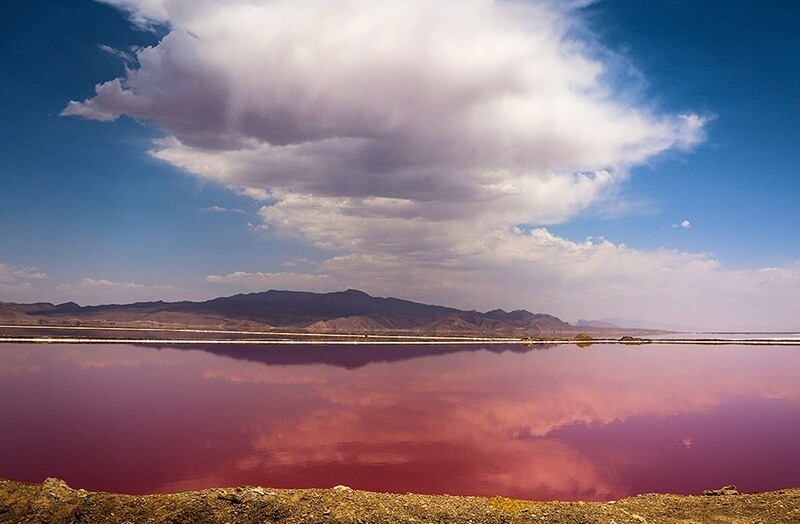
Roughly 25 kilometers southeast of the city, Maharloo Lake is a seasonal salt lake whose water can take on a striking pink hue, caused by salt-loving algae and minerals, particularly visible during the warmer, drier months when evaporation concentrates the lake’s mineral content. The surrounding salt flats and shifting colors make it a popular stop for photographers, and it’s often combined with the route toward the Qashqai nomad camps or the Sassanid sites at Firuzabad, since all three lie in roughly the same direction south of the city.
Shiraz’s Café Culture and Contemporary Arts Scene
It would be a mistake to think of Shiraz purely as a city of monuments. Around the Zand Complex and in the newer commercial districts further from the historic core, a contemporary café culture has taken root — specialty coffee shops, dessert cafés serving updated takes on faloodeh, and small bookshops that lean into the city’s literary identity rather than away from it.
Given Shiraz’s deep historical association with poetry and the arts, it’s perhaps unsurprising that the city’s younger creative scene often engages directly with that legacy — galleries and informal cultural spaces that reinterpret classical Persian literary themes through contemporary visual art, alongside live acoustic music in some of the more bohemian cafés near the university district. It’s a quieter, more understated scene than Tehran’s, but it rewards travelers who build in unstructured time to simply sit in a café, order tea or coffee, and watch the city’s daily life unfold.
Spending Power: Is $100 a Lot of Money in Shiraz?
As with the rest of Iran, the short answer is yes — emphatically. For visitors holding USD or EUR, Shiraz offers exceptional value, though the same currency and cash logistics that apply across Iran apply here too.
What $100 gets you in practical terms in Shiraz:
- A comfortable mid-range hotel or guesthouse for two nights in the historic district
- All meals for a full day, including a sit-down restaurant dinner
- Entry to all the major sites in this guide — the Vakil Complex, Eram Garden, Narenjestan-e Qavam, the Pink Mosque, and more — which are individually inexpensive, typically a few dollars
- A private driver day trip to Persepolis and Naqsh-e Rustam
A full restaurant dinner for two, including kalam polo, kebab, salad, and drinks, will typically run the equivalent of $8–15 USD. Day-trip costs to Persepolis or the Sassanid sites vary depending on whether you join a group tour or arrange a private driver, but both remain affordable relative to comparable historical day trips elsewhere in the world.
Critical money logistics (same across Iran):
- Bring clean, undamaged USD or EUR notes — worn or torn bills are frequently refused.
- Exchange only at licensed exchange bureaus (sarafi).
- Carry a range of denominations, since large bills can be hard to break in smaller shops and bazaars.
- International credit and debit cards do not work anywhere in Iran, including Shiraz. There is no workaround.
- Keep a reasonable amount of cash on hand at all times, since ATMs are not accessible to foreign cardholders.
Essential Shiraz Travel Tips
When to Visit
Spring (March–May) is unanimously considered the best time to visit Shiraz, and for good reason: this is when the city’s gardens and orange trees are in bloom, the air carries the scent of jasmine and orange blossom, and Nowruz (Persian New Year, around March 20–21) adds an additional layer of cultural richness to the trip. Autumn (September–October) offers a similarly pleasant climate with fewer crowds. Summers in Shiraz are hot, though generally more bearable than Tehran’s, given the city’s higher elevation and drier air. Winters are mild by Iranian standards and rarely see snow in the city itself, though the surrounding Zagros mountains, including areas near Qalat, can become difficult to access after heavy snowfall.
Getting Around
Shiraz’s historic core is genuinely walkable — most visitors find they can cover the Vakil Complex, the Pink Mosque, Shah-e Cheragh, and Narenjestan-e Qavam comfortably on foot over one or two days. For sites further out, including the gardens, the tombs of Hafez and Saadi, and day trips to Persepolis or the Sassanid sites, Snapp/Tap and licensed taxis are reliable and inexpensive. Shared taxis (dar baste for a private ride, or shared line taxis for set routes) are common and cheap but require some familiarity with Persian place names.
Connectivity
A local SIM card (Irancell or MCI) is easy to buy on arrival and gives you affordable data for navigation and translation apps. As elsewhere in Iran, some international platforms are filtered, so download a VPN before you arrive if you want uninterrupted access to apps like Instagram or WhatsApp.
Cultural Etiquette
Shiraz’s religious sites, particularly Shah-e Cheragh, call for especially modest and conservative dress — long sleeves, loose-fitting clothing, and a headscarf for women are essential, and a chador will be provided if needed. Elsewhere in the city, the same general Iran-wide dress code applies. Friday remains the weekly day of rest, and the Vakil Bazaar, along with most government sites, will be closed. As across Iran, expect extraordinary hospitality — Shirazis take particular pride in their city’s reputation for warmth and culture, and are often eager to share a poem, a recommendation, or an invitation for tea with curious visitors.
Final Thoughts: Is Shiraz Worth It?
If you only have time for one city beyond Tehran on an Iran trip, Shiraz makes the strongest possible case for itself. It offers a rare combination: an exceptionally walkable historic core, some of the most photogenic religious architecture anywhere in the world, gardens that explain an entire civilization’s aesthetic philosophy, two of literature’s most beloved poets buried within city limits, and — within a single day’s reach — the ceremonial capital of one empire and the founding sites of another. Add to that a living nomadic culture still migrating through the surrounding mountains, a wine history more interesting than almost anyone realizes, and food specialties found nowhere else in the country, and it becomes clear why every serious Iran itinerary builds in at least two or three nights here.
Ready to plan your Shiraz trip?
Building the right itinerary for Shiraz — balancing the city’s historic core, its archaeology day trips, and experiences like the Qashqai nomad visit — takes local knowledge and careful planning. Browse our ready-made Shiraz tours, covering everything from the city’s poets and gardens to dedicated archaeology routes through Persepolis, Naqsh-e Rustam, Bishapur, and Firuzabad. Prefer something built around your own pace and interests? Our team also offers free consultation and fully tailor-made itineraries — just contact us and we’ll help you plan it.
Ready to See Shiraz’s Gardens, Mosques, and Ruins in Person?
Want a Local Guide to Show You the Best of Shiraz?
FAQs for Top Things to Do in Shiraz
1. Is Shiraz safe for tourists?
Yes. Shiraz is widely considered one of the most relaxed and visitor-friendly cities in Iran. Crime against tourists is rare, and Shirazis are known even by Iranian standards for their hospitality. As with anywhere, take normal precautions with belongings in crowded areas like the bazaar.
2. How many days do I need in Shiraz?
Three to four days is the recommended minimum: one day for the Vakil Complex, the Pink Mosque, and the poets’ tombs, one full day for Persepolis, Naqsh-e Rustam, and Pasargadae, and at least one more for the gardens, museums, and either the Sassanid sites at Bishapur and Firuzabad or a Qashqai nomad experience. Five days allows a more relaxed pace and room for both archaeology excursions.
3. What is the best time of year to visit Shiraz?
Spring (March–May) is the best time to visit, when the gardens and orange trees are in bloom and Nowruz adds extra cultural richness. Autumn (September–October) is a close second. Summers are hot but generally more bearable than Tehran’s.
4. How far is Persepolis from Shiraz, and how do I get there?
Persepolis is roughly an hour’s drive from central Shiraz. Most visitors arrange a private driver or join a small-group day tour that also covers Naqsh-e Rustam, since the two sites are only a short distance apart and are almost always visited together.
5. Is alcohol legal in Shiraz, given its connection to “Shiraz wine”?
No. Despite the city’s historical association with Shirazi wine and its name’s link to the globally known Shiraz/Syrah grape, alcohol production and consumption are illegal throughout Iran, including in Shiraz. There is no legal way to taste wine in the city today.
6. Can non-Muslims visit Shah-e Cheragh shrine?
Yes, non-Muslim visitors are welcome but cannot enter the inner shrine unaccompanied. Bags are left at the entrance, and a free guide will accompany you through the complex. Conservative dress is required, and a chador will be provided for women if needed.
7. Do I need a visa to visit Shiraz?
Visa requirements are the same as for Iran generally: most Western nationals can obtain a tourist visa, though citizens of the US, UK, and Canada typically require a guided tour or formal invitation letter. Check current requirements with us before booking.
8. Is Shiraz walkable?
Yes, more so than most Iranian cities. The historic core around the Vakil Complex, the Pink Mosque, Shah-e Cheragh, and Narenjestan-e Qavam can comfortably be explored on foot over one to two days, with taxis or Snapp needed mainly for the gardens, tombs, and day trips further out.
9. Is Shiraz expensive for tourists?
No — like the rest of Iran, Shiraz offers excellent value for visitors holding USD or EUR. A full restaurant dinner for two typically costs $8–15 USD, most site entry fees are a few dollars or less, and accommodation is significantly cheaper than comparable Western destinations.
0 Comment