


Table of Contents
“Note: As of early 2026 the palace is temporarily closed to the public due to the regional security situation. Verify status before planning a visit.”
Step through the arched entrance of Golestan Palace and the roar of central Tehran dissolves. In its place: fountains threading through manicured gardens, facades encrusted in turquoise and cobalt tile, and halls where every surface — ceiling, wall, column — glitters with thousands of mirror fragments. This is where Persian craftsmanship absorbed European grandeur and produced something entirely its own, and it has been doing so for over four centuries.
Inscribed on the Iranian UNESCO World Heritage List in 2013, Golestan Palace is Iran’s only Qajar-era heritage site on the list, and the only one set inside a living capital city. That distinction — urban, royal, still breathing — makes it unlike anything else in the country’s extraordinary heritage inventory.
Quick Facts
| UNESCO inscription | 2013 |
| Dynasty | Qajar (1794–1925); origins Safavid (16th c.) |
| Location | Arg Square, central Tehran |
| Size | 4.5 hectares |
| Key structures | 8 primary / 12 total |
| Architect (1865 rebuild) | Haji Abol-hasan Mimar Navai |
| Opening hours | 9 AM–7 PM (summer) / 9 AM–5 PM (winter) |
| Closest metro | Panzdah-e Khordad (Line 1) |
History: From Safavid Citadel to Qajar Throne Room
Golestan’s story begins not with a palace but with a mud-brick wall. In the sixteenth century, the Safavid dynasty enclosed Tehran inside a defensive citadel, and within those walls a modest royal garden — golestan means “garden of flowers” in Persian — took root.
It might have stayed a footnote in Iranian history were it not for one decisive moment: in 1794, Agha Mohammad Khan of the Qajar dynasty seized power and declared Tehran his capital. The old Safavid garden suddenly found itself at the center of an empire. The Qajars built their halls around it, one reign at a time, until the complex sprawled across 4.5 hectares of the city’s heart.
The palace reached its defining form under Naser al-Din Shah, who ruled for nearly half a century (1848–1896) and was the first Persian monarch to visit Europe — traveling to Russia and the continent in 1873, 1878, and 1889. He returned each time with new ideas. Architects were commissioned to blend the neoclassical symmetry he had admired abroad with the tile-work, mirror mosaic, and iwan arches of Persian tradition. The result, completed largely by 1874, is the Golestan we visit today.
The Qajar dynasty fell in 1925, and the palace’s last coronation — that of Reza Shah, founder of the Pahlavi line — was held on its Marble Throne. Later, in 1967, Mohammad Reza Shah Pahlavi chose Golestan for his own crowning. After the 1979 Revolution abolished the monarchy, the complex was converted into a museum. UNESCO’s inscription in 2013 ratified what Iranians had long known: this is a site of global significance.
Architecture: The Qajar Synthesis
UNESCO designated Golestan under the criterion of exemplifying “the architectural and artistic achievements of the Qajar era, including the introduction of European motifs and styles into Persian arts.” That phrase is worth unpacking, because it is exactly what you see when you look at the facades.
The Persian vocabulary is everywhere: muqarnas (honeycomb vaulting) descend from archways, mirror mosaic (āina-kāri) shatters light across interior walls, intricate stuccowork frames doorways, and lattice windows filter the sun into geometric patterns. Then the European language appears alongside it: semicircular pediment windows borrowed from neoclassicism, chandeliers dropping from vaulted ceilings, oil portraits lining state halls in the manner of a European gallery.
Neither tradition overwhelms the other. Architect Haji Abol-hasan Mimar Navai’s 1865 reconstruction managed this balance with rare skill, and the buildings he designed — particularly the north-side audience halls — show both vocabularies working in harmony along a single unified façade.
Hall by Hall: The Eight Key Structures
Marble Throne (Takht-e Marmar, 1806)
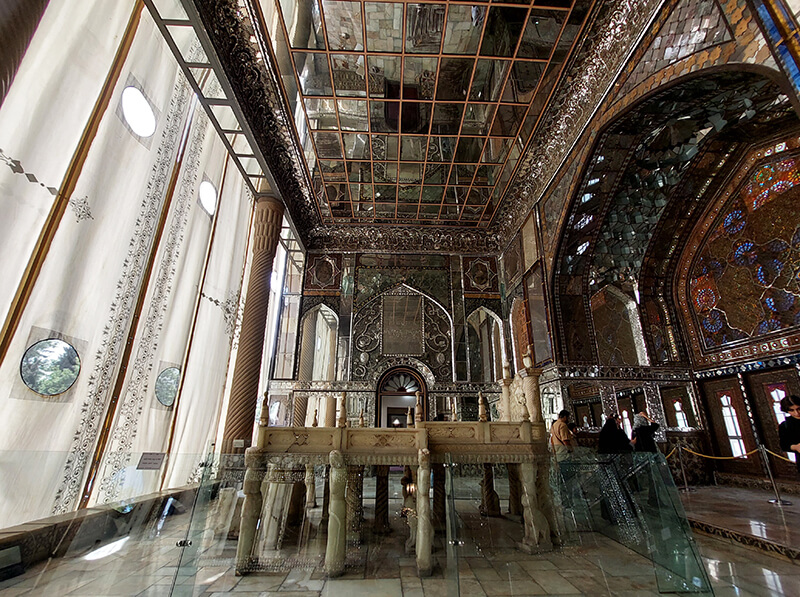
The Marble Throne pavilion — also called Iwan-e Takht-e Marmar or Divankhaneh — is the symbolic and ceremonial heart of Golestan Palace. The site itself dates to the reign of Karim Khan Zand in the mid-eighteenth century, making it one of the oldest corners of the complex, but the famous throne was commissioned by Fath-Ali Shah in 1806. He instructed Isfahani stonemasons to carve the throne from yellow Yazd marble, and the result is a structure of extraordinary precision: the marble is engraved with figures of courtiers, soldiers, and mythological scenes in a style that speaks entirely of Qajar court aesthetics.
The open terrace surrounding the throne is covered in plasterwork, calligraphy, stone carvings, woodwork, gold-leaf lattice, and mirror inlay — every surface a different craft, yet the whole reads as unified and intentional. Above the throne itself, a shamseh (sun medallion) catches the light, a symbol of royal authority used across Persian royal architecture for centuries.
Every Qajar king was crowned here, from Fath-Ali Shah onwards. The throne saw its final coronation in 1925, when Reza Shah — founding monarch of the Pahlavi dynasty — formally took power on this same terrace, bringing a century and a half of Qajar use to a close. Standing before it today, it is one of those rare spots where the weight of that history is genuinely, physically present.
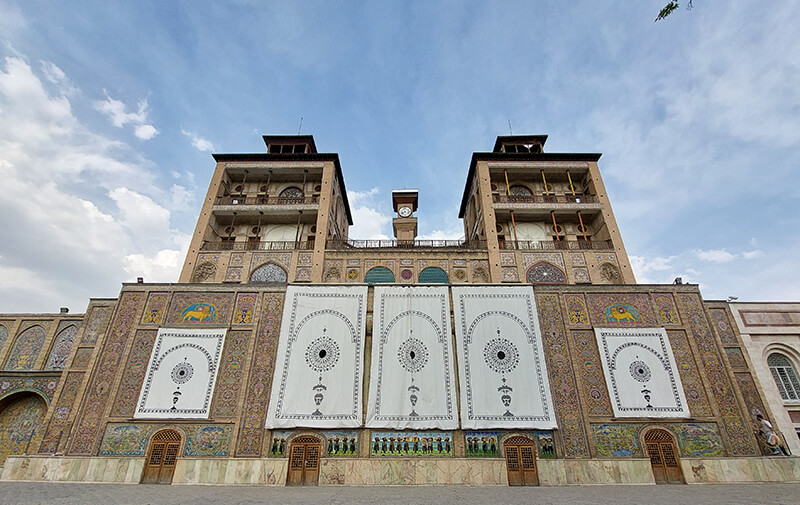
Shams-ol-Emareh / Sun Building (1867)
When Naser al-Din Shah first saw pictures of European multi-storey towers — before he had ever set foot on the continent — he was struck by something Tehran entirely lacked: height. He ordered a building tall enough to see the whole city from its upper floors. The result, completed in 1867, was the Shams-ol-Emareh, meaning “Edifice of the Sun,” and it became Tehran’s first multi-storey building and the tallest structure in the city for decades.
The design by Moayer-ol-Mamalek combined two identical five-storey towers connected by an arched facade, clad in seven-colour Qajar tilework depicting European natural landscapes and western architecture — a striking choice, using Persian tile craft to represent foreign scenes. The column bases are carved with plant and animal motifs. Between the towers sits the famous clock, a gift from Queen Victoria of Britain to Naser al-Din Shah, mounted prominently so Tehran’s population could read the time from the street below.
Inside, the walls carry mirror work, painted plasterwork, and Qajar-era oils. From the upper windows, the Shah could survey his capital; today visitors climbing those same floors get one of the few elevated views of old central Tehran. The building remains the visual centerpiece of the entire Golestan complex — the first thing the eye finds and the last thing it leaves.
Hall of Mirrors (Talar-e Ayeneh, 1874)
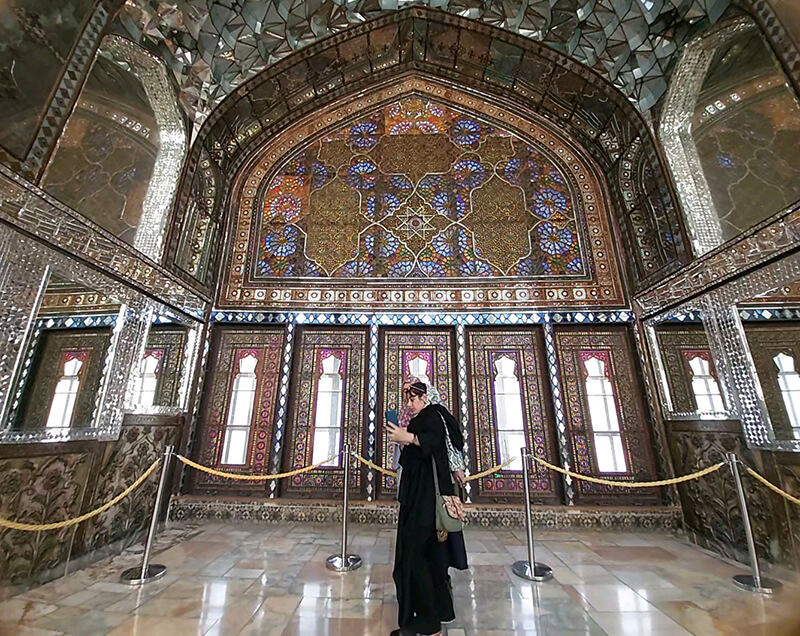
Built in 1874 as part of Naser al-Din Shah’s major reconstruction of the north wing, the Hall of Mirrors is the room most visitors remember long after they have left. Its walls and vaulted ceiling are covered entirely in thousands of small mirror fragments, cut and set at slightly different angles so that any light entering the hall — from the tall arched windows or the chandeliers above — is caught, broken, and thrown back from every surface simultaneously. The effect is not just decorative; the room seems to expand beyond its physical dimensions, becoming a space made entirely of reflected light.
The technique is called āina-kāri — mirror mosaic — and it was a Qajar-era refinement of an older Persian decorative tradition. What distinguishes Talar-e Ayeneh is the scale and discipline of its application: there is no undecorated surface, and the transition from wall to ceiling to arch is seamless. European chandeliers hang from this Persian-mirrored vault, one of the clearest single images of the Qajar synthesis anywhere in the palace.
The hall also houses one of Iran’s most celebrated paintings. Kamal al-Mulk, the Qajar court’s greatest painter and a figure often compared to European Old Masters for his technical command of realism, created a large-scale oil painting of this very room — capturing its mirror-and-light interior in a medium imported from Europe. The painting, and the room it depicts, now occupy the same space, making Talar-e Ayeneh both a work of architecture and a piece of art history.
Windcatcher Building (Emarat-e Badgir, 1813)
The Windcatcher Building is Golestan’s most quietly ingenious structure. Built in 1813 during the reign of Fath-Ali Shah, its four tall badgir (windcatcher) towers rise from the roofline and function as passive ventilation shafts — catching the prevailing breezes, drawing them down through the building, and directing them across pools of water in the basement Pond House (Howz Khaneh) before circulating the cooled air through the rooms above. In a Tehran summer, where temperatures regularly exceed 35°C, this was not aesthetic flourish but practical engineering, and it worked well enough that the system remained in use throughout the Qajar period.
The Pond House in the basement served as a summer chamber — a cool retreat beneath the hot city where the royal household could escape the midday heat. The basement pools, fed by channels, reflect the arched ceilings above them in dark, still water. The combination of functional ingenuity and aesthetic care — the space is also richly decorated with tilework and mirrors — is characteristic of Qajar architecture at its most considered.
Today the Howz Khaneh has been converted into a photographic archive and gallery displaying the work of Naser al-Din Shah himself. He was a devoted and skilled amateur photographer, among the first rulers anywhere in the world to take up the medium seriously, and the prints on display are remarkable — candid court scenes, formal portraits, and landscape photographs that form an extraordinary visual record of nineteenth-century Iran. The camera and the windcatcher, separated by a century of technology, share the same basement.
Diamond Hall (Talar-e Almas, 1801)
Built in 1801 under Fath-Ali Shah, the Diamond Hall is one of the oldest palatial structures in the Golestan complex. Its name derives not from any gemstone but from the way its interior behaves in light: pointed arch niches lined with muqarnas — the intricate honeycomb vaulting of classical Persian architecture — are covered entirely in mirror fragments, and when sunlight enters through the tall stained-glass windows set into the upper walls, the reflections fracture into cascades of color across every surface. The effect gave the room its name, and on a bright morning it earns it.
The hall was used as an audience and reception chamber during the early Qajar era, and its walls carry a series of large oil portraits of Fath-Ali Shah — a monarch famous for his elaborate beard and jewel-laden court dress, depicted here in the formal postures of Qajar royal painting. These portraits are important documents of early nineteenth-century Iranian court culture, and the contrast between the flat Persian pictorial tradition and the European oil medium reflects the era’s artistic transitions.
Architecturally, Talar-e Almas represents the Qajar period before full European influence arrived. The muqarnas, the arched niches, the proportions — all are rooted in classical Persian form. What makes it notable within the Golestan complex is precisely this: it offers a reference point, a way to see what the palace looked like before Naser al-Din Shah’s European-informed reconstructions changed its character.
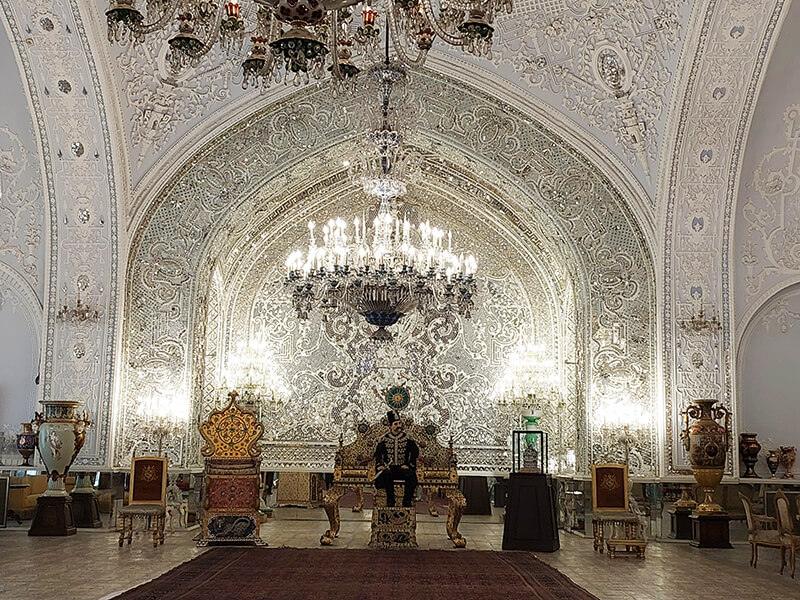
Reception Hall (Talar-e Salam, 1874)
Built in 1874, the Reception Hall was the formal state room where Naser al-Din Shah received ambassadors, dignitaries, and petitioners. Originally intended as a museum space, its scale and grandeur quickly made it the natural venue for official audiences, and the hall was fitted out accordingly: European-style oil paintings of court scenes line the walls, ornate stuccowork in the neoclassical manner frames the archways, and chandeliers hang from a high vaulted ceiling encrusted in mirror mosaic. The crown jewels were once displayed here, lending the room a level of official ceremony difficult to replicate elsewhere in the palace.
The architectural language of Talar-e Salam is the most openly European of any building in the complex. Broad columns divide the hall into nave and aisles in a manner closer to a European state room or assembly hall than to a Persian iwan. Yet the surfaces — the mirror work, the tilework on the outer facade, the muqarnas at the transition between wall and vault — assert their Persian identity clearly. The tension between the two vocabularies is not a contradiction here; it is the point.
The basement of the Salam Hall houses the Special Museum, which holds royal memorabilia, diplomatic gifts, and objects from the Qajar court including Naser al-Din Shah’s personal effects. It is one of the less-visited spaces in the palace, and one of the more intimate — the objects are small-scale and personal in a way the grand halls above are not.
Hall of Brilliance (Talar-e Berilian, 1874)
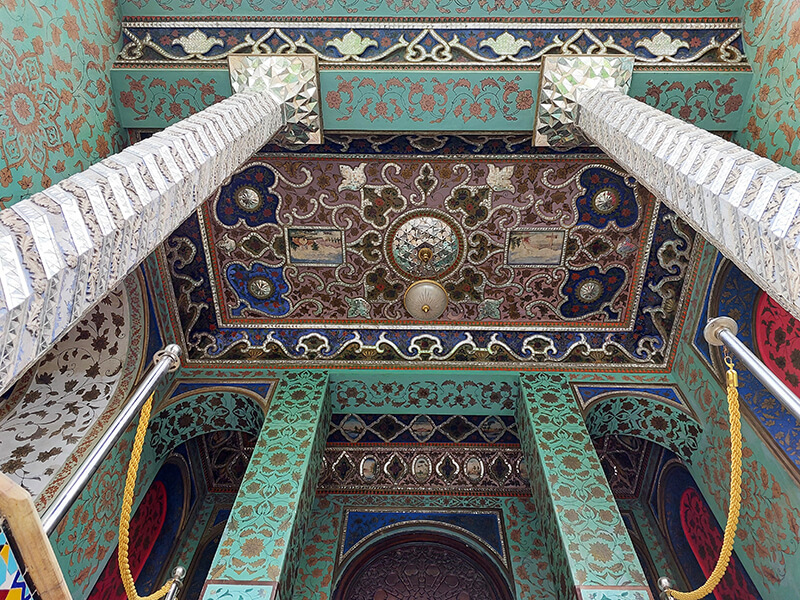
If the Hall of Mirrors uses mirror mosaic with discipline — deploying it as architecture — the Hall of Brilliance takes the same material and pushes it to its expressive limit. Every wall, every arch, every inch of ceiling in Talar-e Berilian is covered in mirror fragments and cut glass, punctuated by crystal chandeliers that hang at intervals throughout the space. The name (berilian derives from “brilliant,” as in a cut gemstone) describes exactly what the room does: it turns light into spectacle.
The hall was built in 1874 as part of the same reconstruction campaign that produced the Mirror Hall and the Reception Hall, and in some respects it represents the terminus of that project — the point where the Qajar decorative impulse reaches its fullest elaboration. Where other halls balance ornament with structure, here ornament is the structure. The visual experience is closer to the interior of a jewelry box than a state room.
Despite its extravagance, Talar-e Berilian served serious ceremonial purposes — royal receptions, formal banquets, events requiring the maximum display of court wealth and power. The overwhelming sensory effect was entirely deliberate. Entering the hall, even today, produces a visceral response that no photograph adequately prepares you for.
Khalvat-e Karim Khani (1759)
The Khalvat-e Karim Khani is the oldest surviving structure in the entire Golestan complex, built in 1759 during the reign of Karim Khan Zand — a ruler of the short-lived Zand dynasty who preceded the Qajars and briefly made Shiraz, not Tehran, his capital. The fact that this small pavilion survives at all is partly accidental: it predates the Qajar rebuilds and sits at the edge of the complex, removed enough from the main construction campaigns to have been preserved rather than replaced.
The building is a khalvat — a private retreat or intimate reception room — and its proportions reflect that purpose. Where the Qajar halls are theatrical in scale, designed for audiences and ceremony, this space is human-sized and inward-looking. The decoration is restrained by Golestan standards: fine plasterwork, carved stucco niches, and painted panels in the eighteenth-century Persian manner, without the European inflections that characterise the later buildings.
Spending time in the Khalvat-e Karim Khani after working through the mirrored grandeur of the Qajar halls is a genuinely clarifying experience. It is a reminder that the Qajar palace was built on top of something older, quieter, and differently conceived — and that the site’s history does not begin with the dynasty that defined it.

The Gardens of Golestan Palace
The buildings frame, rather than dominate, the palace garden. Reflecting pools, fountain jets, and formally planted beds fill the central space — enough green and water to make the complex feel genuinely removed from the city outside its walls, even though Arg Square and the Grand Bazaar are minutes away. The garden is the one part of Golestan where photography is unrestricted, and the tilework on the facades, windcatchers, and fountain surrounds makes for exceptional shots.
UNESCO Designation and the 2026 Damage
Golestan was listed by UNESCO in 2013 under World Heritage criterion (ii), recognising its influence on the development of Iranian architecture through the nineteenth and early twentieth centuries. The site was also registered on Iran’s national heritage list as early as 1955.
In March 2026, the palace was damaged when a nearby airstrike struck Arg Square. Windows, decorative glass panels, and sections of the outer walls were affected. The Mirror Hall, which had just completed a round of renovations, suffered decorative damage. UNESCO responded by communicating the geographical coordinates of all listed sites to the parties concerned and calling for the protection of cultural property under international law — with intentional destruction constituting a war crime under the International Criminal Court.
Iran’s Ministry of Cultural Heritage filed a formal complaint with UNESCO, and antiques within the complex were relocated to secure storage. The episode serves as a reminder of how precarious even the most celebrated heritage sites can be, and why documentation and international protection frameworks matter.
Getting to Golestan Palace
Golestan sits in the old city center and is straightforward to reach.
Metro: Tehran Metro Line 1 (the red line) stops at Panzdah-e Khordad station, a five-minute walk from the palace entrance. This is the easiest and most reliable option — central Tehran traffic can be heavy, particularly on weekday mornings.
Bus: Several BRT and regular bus lines serve the Grand Bazaar area. Bus use can be challenging if you do not know Persian.
Taxi / rideshare: Snapp and Tapsi (Iranian ride sharing apps) both work well for drop-off at the palace gate. Ask to be taken to Kakh-e Golestan or Panzdah-e Khordad.
On foot: If you are staying near the Grand Bazaar or the old city district, Golestan is an easy walk — under fifteen minutes from the bazaar’s northern gates.
Attractions Nearby Golestan Palace
Golestan sits at the geographic and historical center of old Tehran, surrounded by some of the city’s most compelling sights. Among all the things you can do in Tehran, here’s a few close to the Golestan Palace:
Grand Bazaar (Tehran Bazaar): Iran’s largest covered market begins almost at the palace’s southern wall. An hour wandering its copper, carpet, and spice lanes before or after the palace makes for a full half-day in old Tehran.
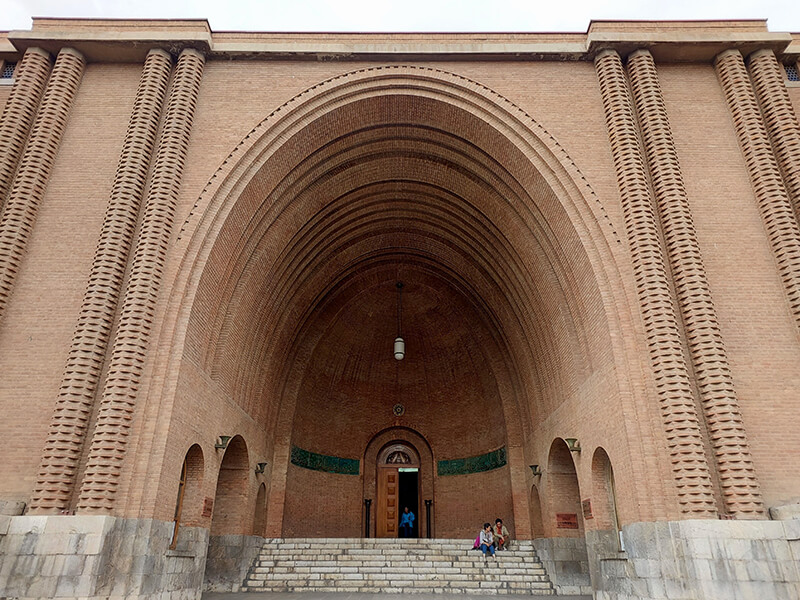
National Museum of Iran (Iran Bastan Museum): A fifteen-minute walk north, housing pre-Islamic and Islamic-era artifacts including objects from Persepolis and the iconic Parthian-era salt men — a natural companion for anyone tracing Iran’s deeper history.
Treasury of National Jewels: Inside the Central Bank building nearby. Home to the Peacock Throne, the Sea of Light diamond, and extraordinary Qajar crown jewels. Entry is timed and should be booked ahead.
Imam Khomeini Square (Toop-khaneh): The historic public square immediately adjacent to the palace, where city life has played out for centuries. Good tea houses and food stalls on its edges and the famous Dar al-Fonun higher education institute of Qajar era is located close to this square.
Glassware and Ceramics Museum (Abgineh Museum): A short walk from Golestan on 30 Tir Street, this museum is worth visiting as much for its building as for its collection.
The mansion was built in 1915 by Ahmad Qavam, a prominent Qajar-era political figure, and its architecture is a rare blend of Persian styles fused with European influences — Russian and Rococo elements alongside Seljuk-period brick reliefs and a horseshoe-shaped wooden staircase. The Qajars-meet-Europe aesthetic makes it a surprisingly fitting companion to Golestan itself.
Inside, the collection spans glassware and ceramics from the second millennium BCE to the present, including Nishapur slip-painted ceramics from the early medieval period, glass works from the twelfth and thirteenth centuries — considered the golden age of Iranian glassmaking — and lustreware from Gorgan excavations. Calm, uncrowded, and genuinely beautiful — one of Tehran’s most underrated cultural stops.
Visitor Guide for the Golestan Palace Complex
Tickets: The garden has a separate entry fee from the individual halls. There are twelve structures in total; each requires an additional ticket. A combination ticket covering the main buildings is available and better value if you plan to spend more than two hours. Decide in advance which halls matter most to you.
Time to allow: Two hours covers the highlights at a comfortable pace. A full morning or afternoon lets you visit four or five halls without rushing.
Best days: Weekdays are significantly quieter than Thursdays and Fridays (the Iranian weekend). The palace closes on certain Islamic holidays.
Guides: English signage inside the halls is limited. An audio guide is available at the entrance and is worth taking. Accredited local guides offer a richer experience — Qajar history is dense with personalities and the guides bring the rooms to life.
Photography: Garden, facades, and outdoor areas can be freely photographed. Most interior halls prohibit photography; check the notice at each entrance.
Final Thought: Golestan Palace Deserves More Than a Glance
Golestan Palace is one of those rare places that rewards slowness. The more time you give it — lingering in the garden, letting your eyes adjust to the mirror halls, reading the faces in Fath-Ali Shah’s portraits — the more it gives back. It is not just a collection of beautiful rooms; it is the place where Iran’s modern identity began to take shape, one coronation, one diplomatic reception, one European idea absorbed and transformed at a time.
If you are planning a trip to Tehran and want to experience Golestan the way it deserves — with the stories behind the halls, the names behind the thrones, and the context that turns beautiful tilework into living history — we would love to be your guide. Our daily Tehran tours include a guided visit to Golestan Palace, with a local expert who knows these rooms well. Explore our Tehran day tours →
Four centuries of history wait behind these mirrored walls
FAQs for Golestan Palace Complex
1. What is Golestan Palace and why is it famous?
Golestan Palace is a historic royal complex in central Tehran, built around a Safavid-era garden and developed into its current form by the Qajar dynasty over the eighteenth and nineteenth centuries. It is famous for its exceptional blend of Persian and European architecture, its role as the seat of Qajar royal power, and its UNESCO World Heritage status, inscribed in 2013. It is the only Qajar-era site on the UNESCO list in Iran.
2. When was Golestan Palace built?
The site dates to the sixteenth century, when the Safavid dynasty established Tehran’s royal citadel. The Qajar dynasty transformed it into a palace complex from 1794 onwards, with the most significant reconstruction carried out by Naser al-Din Shah between 1865 and 1874. Most of the buildings visitors see today date from that period.
3. What does “Golestan” mean?
Golestan is a Persian word meaning “garden of flowers” or “rose garden” — from gol (flower/rose) and stan (place/land). The name refers to the royal garden at the heart of the complex, around which all the palatial buildings are arranged.
4. How many buildings are in Golestan Palace?
The complex contains twelve structures in total, of which eight are considered the primary palatial buildings. These include the Marble Throne, Shams-ol-Emareh, Hall of Mirrors, Diamond Hall, Windcatcher Building, Reception Hall, Hall of Brilliance, and the Khalvat-e Karim Khani. Each building requires a separate entrance ticket.
5. What is the most famous hall in Golestan Palace?
The Hall of Mirrors (Talar-e Ayeneh) is the most celebrated interior in the palace. Its walls and vaulted ceiling are covered entirely in thousands of mirror fragments set at varying angles, creating a dazzling effect as light multiplies across every surface. It also houses a large-scale oil painting of the hall itself by Kamal al-Mulk, Iran’s most celebrated Qajar court artist.
6. How do I get to Golestan Palace?
The easiest way is by Tehran Metro Line 1 (red line) to Panzdah-e Khordad station, a five-minute walk from the palace entrance. Rideshare apps Snapp and Tapsi both serve the area — ask for Kakh-e Golestan or Meydan-e Arg. Getting there by car is difficult due to traffic restrictions in the area, so public transport is strongly recommended.
7. Is Golestan Palace a UNESCO World Heritage Site?
Yes. Golestan Palace was inscribed on the UNESCO World Heritage List in 2013 under criterion (ii), which recognises sites that exhibit an important interchange of human values. UNESCO cited the palace as an outstanding example of Qajar-era architecture and its influence on the development of Iranian arts and architecture through the nineteenth and early twentieth centuries.
8. How long does it take to visit Golestan Palace?
Plan for at least two hours to cover the main highlights comfortably. If you intend to visit all twelve structures, a full half-day is more realistic. Visitors are advised to wear comfortable shoes, as there are several staircases and short walking distances between the halls. Weekdays are significantly quieter than the Iranian weekend (Thursday and Friday).
9. Was Golestan Palace damaged in 2026?
Yes. In early 2026, shockwaves and debris from nearby airstrikes caused damage to windows, decorative glass panels, and sections of the palace’s outer walls during the escalation of regional tensions. UNESCO documented the damage and called for the protection of the site under international cultural heritage law. Iran’s Ministry of Cultural Heritage relocated antiques within the complex to secure storage. The situation underscored the vulnerability of even the most protected heritage sites to armed conflict.
Explore the full series: Iran’s UNESCO World Heritage Sites →
0 Comment