


Visa rules and travel advisories change frequently — always verify with official sources before booking.
Table of Contents
⚠️ A Note on the Current Situation: We’re writing this from Iran, and we care about every traveler who comes through our doors — that care starts with honesty. As of September 2026, the US State Department maintains a Level 4: Do Not Travel advisory for Iran. There is no US embassy in Iran, and consular support is extremely limited — the Swiss Embassy in Tehran has suspended routine services and been temporarily closed due to the security situation. We’re not telling you what to decide; we’re making sure you have the real picture before you invest time, money, or trust in a trip. Check the official State Department advisory directly before making any plans.
There is a particular kind of traveler drawn to Iran — the kind who lingers under the mirrored ceilings of Shiraz, who wants to understand how a dome built a thousand years ago still holds a room’s sound the way it was designed to. For American travelers, that pull runs into a practical wall almost immediately. US citizens cannot apply for an Iran visa independently. Entry requires a licensed Iranian tour operator, an authorization code issued by Iran’s Ministry of Foreign Affairs, and travel with a guide for the length of the trip. There’s no shortcut through this, and no version of the process that skips it.
This guide walks through exactly how that process works — realistically, not optimistically — and, just as importantly, where things stand right now for American travelers considering Iran at all. We work in cultural travel to Iran, not political commentary, but honesty about the current situation is part of doing this work responsibly. That starts with the single most important thing to know before anything else.
Direct answer: US citizens can obtain an Iran visa only through a licensed Iranian tour operator who secures a Ministry of Foreign Affairs authorization code; independent applications are not accepted, and travelers must be accompanied by a licensed guide for the entire trip. Processing typically takes 30–45 working days, and applications from the USA are submitted via the Iranian Interests Section at the Pakistani Embassy in Washington, DC.
At a Glance: Iran Visa for American Travelers
| Detail | Information |
|---|---|
| Visa type for US citizens | Tourist visa (requires authorization code + full-guided tour) |
| Can US citizens apply independently? | No — must use licensed Iranian tour operator |
| Authorization code timeline | 30–60 working days (standard window) |
| Where to apply | Iranian Interests Section, Pakistani Embassy, Washington, DC |
| Current US travel advisory | Level 4: Do Not Travel |
| US embassy in Iran? | No — closed since 1980; Swiss Embassy acts as protecting power |
| Guided tour required? | Yes — mandatory for entire stay |
| Visa-free islands | Kish and Qeshm (up to 14 days, air arrival only) |
| Dual nationals | Iran does not recognize dual citizenship; no Swiss consular access if detained |
| Payment in Iran | US cards do not work; cash required |
Why Iran Visa for US Citizens Differs
Most nationalities visiting Iran can apply for an e-visa or arrange a visa on arrival through a relatively standard process. Americans, along with British and Canadian citizens, fall under a separate track — a consequence of the absence of diplomatic relations between Washington and Tehran rather than anything particular to individual travelers.
Because there’s no US embassy to process a visa application, the functional touchpoint becomes the Iranian Interests Section, operating out of the Pakistani Embassy in Washington, DC. Before an application even reaches that office, though, it needs to clear a separate step: authorization from Iran’s Ministry of Foreign Affairs, arranged through a licensed Iranian tour operator. If you’re comparing entry rules across nationalities, our guide to who can enter Iran without applying in advance lays out how differently that process runs for other passport holders — American travelers are exception to that simplicity.
Iran Travel Authorization Code
This authorization code is the real starting point of the process, and it has to happen as the first step of a formal Iran visa application goes anywhere.
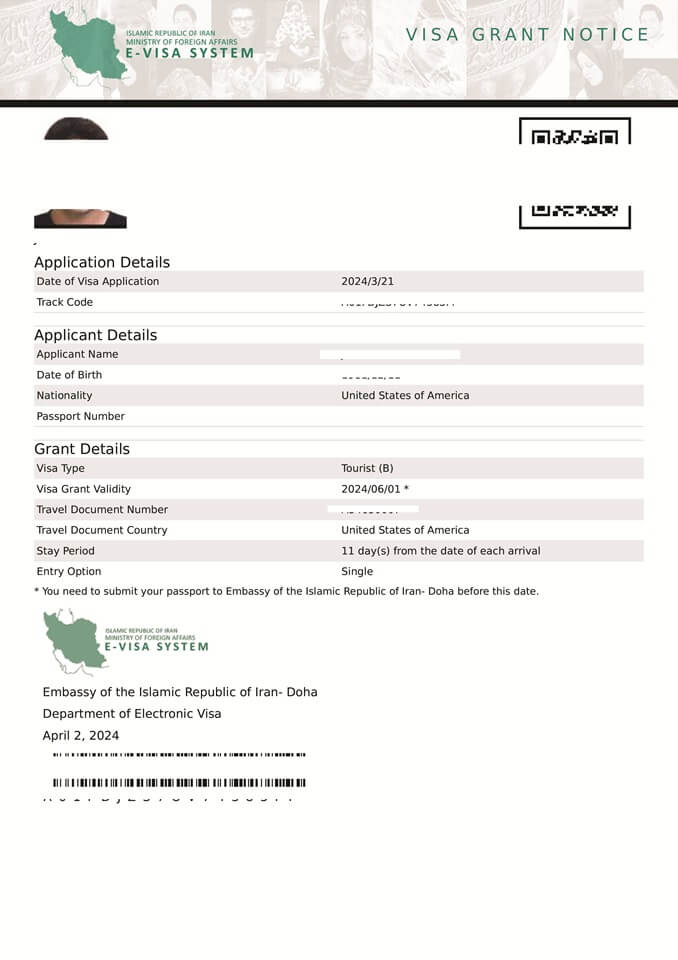
Iran visa application process for US citizens is like this:
- A licensed Iranian tour operator submits a detailed day-by-day itinerary on the traveler’s behalf, along with the required documentation
- Iran’s Ministry of Foreign Affairs reviews the application and background information
- If approved, an authorization code (also called a Visa Grant Notice) is issued via email
- That code becomes the basis for the formal visa application at the Iranian Interests Section in Washington, DC or any Iran embassy/consulate anywhere in the world
Documents typically requested at this stage include:
- A scan of a passport valid for at least six months beyond the travel dates
- A detailed tour itinerary arranged by the operator
- A personal information form (full name, date of birth, and similar details)
- A professional background summary or resume
- Passport-style photograph (digital, white background)
- Completed visa application form
- Proof of travel insurance explicitly covering Iran
Iran Visa Processing Time
Plan around 30 to 45 working days for the authorization process to clear. This isn’t a worst-case estimate — it’s the standard window, and Iranian public holidays or gaps in an application can push it toward the longer end. Booking flights or making non-refundable arrangements before authorization comes through is a common and avoidable mistake; approval isn’t guaranteed, and the Ministry’s review does include background screening.
Why Independent Travel Isn’t an Option
There’s no version of this process that ends with a US citizen picking up a visa and traveling solo. The authorization is tied to the tour operator’s itinerary, and the visa itself is issued on the understanding that the traveler will be accompanied by a licensed guide for the trip’s duration. This is a regulatory requirement, not a suggestion — and it’s worth separating from the safety conversation above, since it applies regardless of the current advisory level.
Submitting Iran Visa Application in the US
Once the authorization code arrives, the formal visa application goes to the Iranian Interests Section at the Pakistani Embassy in Washington, DC — the office that handles Iranian consular matters for the US in the absence of direct diplomatic relations.
Travelers based in the DC area can typically submit documents in person. For everyone else, applications are usually mailed in, along with the passport, application forms, the authorization code, and payment for visa processing.

Full-Guided Tour: What’s Required
The guided-tour requirement often gets framed by other sites as a restriction to work around. It’s more useful to understand it as it actually functions: American, British, and Canadian travelers are required to be accompanied by a licensed guide for their entire stay, whether as part of a small group or a private itinerary.
In practice, this shapes the kind of trip you’ll have more than it limits it. A guide handles logistics that would otherwise be genuinely difficult to navigate solo — language, transportation between cities, access to sites, and the day-to-day judgment calls that come from actually knowing a place. Most structured itineraries also build in unstructured time within cities, so it isn’t the same as being escorted minute to minute — but the requirement itself, accompaniment for the full trip, is not optional or negotiable for US passport holders.
Visa-Free Entry to Southern Islands
There’s one genuine exception worth knowing about: US citizens can enter Kish Island or Qeshm Island without the full visa process, for stays of up to 14 days. This applies to air arrivals only, requires advance coordination with a certified local guide who meets travelers at the airport, and typically needs a few days’ notice to Iranian authorities beforehand.
It’s worth being clear-eyed about what this is and isn’t. It’s a genuinely simpler entry path to two specific islands in the Persian Gulf — not a way to visit mainland Iran, and not an exception to the current travel advisory, which applies to the country as a whole.
Iran Visa for US-Iranian Dual Nationals
Iran does not recognize dual citizenship. If you hold both US and Iranian nationality, Iranian authorities treat you solely as an Iranian citizen while you’re in the country — which means the visa process described above generally doesn’t apply to you the same way, and more importantly, it means Swiss consular access is not extended to you if anything happens, since Iran does not permit those visits for dual nationals.
Anyone in this situation should treat their circumstances as materially different from a non-dual US citizen’s, not as a variation on the same trip. Dual nationals must exit Iran on Iranian passports when they depart.
Money, Documents, and Digital Habits
A few practical realities that shape any trip, separate from the visa itself:
- US-issued cards don’t work in Iran. Sanctions mean there’s no access to Visa, Mastercard, or similar networks, and no Western Union equivalent. Trips are typically planned around cash brought in advance, arranged in coordination with the tour operator. Or you can ask your tour operator to provide you an Iranian debit card.
- Passport requirements are strict but standard: six months’ validity beyond your travel dates, and at least one blank visa page.
- Devices and social media get more scrutiny than travelers expect. Prior travel to Israel, in particular, is worth being aware of as a sensitivity in the review process. Reviewing what’s on your phone and your public social accounts before departure is a reasonable precaution, not paranoia.
- Travel insurance for this specific trip is worth understanding in detail — standard policies often carry exclusions for destinations under a Level 4 advisory. Our breakdown of what a standard policy will and won’t cover for Iran goes through this in more depth.
If you’re earlier in your research, our complete guide to planning a trip to Iran covers the broader picture beyond the visa process — timing, regions, and what a trip actually looks like day to day.
Final Thoughts: An Honest Starting Point
Iran remains one of the most layered, historically dense countries a traveler can visit — Isfahan’s squares, Persepolis’s columns, Yazd’s wind towers built for a climate no modern engineering has really improved on. That pull is real, and it’s the reason this article exists at all.
It’s also true that, for American citizens specifically, getting there currently involves both a genuinely demanding administrative process and a US government advisory that shouldn’t be treated as background noise. Those two facts sit next to each other, and a responsible resource holds both rather than picking the more convenient one.
Compassimo’s role here isn’t to tell you what to decide. It’s to make sure that whatever you decide, you’re working from an accurate picture — the real timeline, the real requirements, and the real current status, not a version smoothed over to make booking easier. If you’re weighing a trip to Iran and want to talk through what the process would actually look like for your specific situation, that’s a conversation worth having before anything else.
Ready to Talk About Your Specific Situation?
FAQs about Iran Visa for Americans
1. Can US citizens get a visa to visit Iran?
Yes, but not independently. US citizens must apply through a licensed Iranian tour operator, who secures an authorization code from Iran’s Ministry of Foreign Affairs before a formal visa application can be submitted.
2. Is it currently safe for Americans to travel to Iran?
The US State Department maintains a Level 4 “Do Not Travel” advisory for Iran. Anyone considering travel should review the current advisory directly before making plans, since this reflects an active government position rather than a general precaution.
3. How long does an Iran visa take for US citizens?
Realistic processing time is 30 to 45 working days from the start of the authorization process. This isn’t guaranteed, and can run longer around Iranian public holidays, so it shouldn’t be planned tightly against a fixed travel date.
4. Can US citizens travel independently in Iran?
No. American travelers are required to be accompanied by a licensed guide for the full duration of their trip, whether through a group tour or a private itinerary arranged by a tour operator.
5. What is the Iran travel authorization code?
It’s a pre-approval issued by Iran’s Ministry of Foreign Affairs, arranged by a licensed tour operator based on a detailed itinerary and supporting documents. A formal visa application cannot proceed without it.
6. Is there a US embassy in Iran?
No, and there hasn’t been since 1980. The Embassy of Switzerland’s Foreign Interests Section in Tehran has historically handled emergencies for US citizens, though routine consular services have been suspended since October 2025 and the section has been temporarily closed at various points due to the security situation, with the US Embassy in Bern handling cases in the meantime.
7. Can US citizens visit Kish or Qeshm Island without a visa?
Yes, for stays of up to 14 days, arriving by air with advance coordination through a certified local guide. This applies only to the islands themselves, not to mainland Iran, and doesn’t change the broader travel advisory.
8. What happens if a US citizen’s Iran visa application is rejected?
Rejections happen for various reasons, including incomplete documentation or details flagged during the Ministry’s review. Reputable tour operators generally have policies addressing refunds or rebooking in this scenario, which is worth confirming before paying in full.
0 Comment