


Table of Contents
Persian food is unlike anything else in the Middle Eastern culinary world — not because it’s fiery or bold, but because it’s refined. Layered with fragrance, balanced by sourness, and anchored by ingredients that have been cultivated for thousands of years, traditional Iranian food rewards curiosity with some of the most complex and satisfying flavors you’ll ever encounter.
This guide covers the 20 best Persian dishes you need to know — from the iconic crispy rice crust that every Iranian cook treats as a badge of honor, to slow-braised stews that simmer for hours, to smoky saffron-lacquered kebabs pulled straight from live coals. Whether you’re navigating a Persian restaurant menu for the first time or deepening a long-standing appreciation, this is your definitive reference.
The Philosophy Behind Persian Flavors
Before diving into the dishes, understanding two foundational principles will change how you taste everything on this list.
The Sard/Garm balance. Iranian cooking is rooted in a wellness philosophy that classifies every ingredient as either Sard (cold) or Garm (hot) — not in temperature, but in its energetic effect on the body. Pomegranates are cold; lamb is hot. Skilled Persian cooks intuitively combine opposing properties to create harmony both on the plate and in the body. This is why you’ll so often find tart fruits paired with rich meats, or cooling yogurt served alongside warming stews.
The sour profile. Where most cuisines reach for heat to add excitement, Persian cooking reaches for sourness. Two ingredients define this: limoo amani (dried Persian limes), which bring a deep, earthy citrus intensity to long-cooked stews, and zereshk (barberries), tiny ruby-red fruits with a sharp, jewel-like bite used to crown rice dishes. Once you recognize this sour thread, you’ll taste it running through almost every dish on this list.
Saffron as the flavor identity. No single ingredient defines Persian cuisine more completely. Harvested exclusively by hand — requiring around 150 crocus flowers per gram — saffron appears in rice, marinades, stews, and desserts. It’s warmth and floral depth, not heat.
At a Glance: All 20 Dishes
| # | Dish | Category | Flavor Profile | Best For |
|---|---|---|---|---|
| 1 | Tahdig | Rice (Side) | Buttery, crispy, nutty | First-timers — order this above everything |
| 2 | Chelow | Rice | Floral, fragrant, fluffy | The base for almost every meal |
| 3 | Zereshk Polo | Rice | Sweet-sour, saffron-rich | A perfect intro to Persian flavor balance |
| 4 | Baghali Polo | Rice | Herby, fragrant, celebratory | Special occasions and slow lunches |
| 5 | Tahchin | Rice | Rich, golden, savory-custardy | Showstopper dinner party dish |
| 6 | Ghormeh Sabzi | Stew | Dark, earthy, deeply herbal | The national dish — start here |
| 7 | Fesenjan | Stew | Sweet, sour, nutty, luxurious | The most globally distinctive Persian dish |
| 8 | Gheymeh | Stew | Savory, tomato-rich, comforting | Everyday comfort food with cultural weight |
| 9 | Khoresht-e Bademjan | Stew | Silky, aromatic, mildly tart | Eggplant lovers and vegetarian-adjacent meals |
| 10 | Khoresht-e Karafs | Stew | Fresh, herby, light | Lighter option in the stew family |
| 11 | Koobideh | Kebab | Smoky, charred, deeply savory | The king of Persian grilling |
| 12 | Joojeh | Kebab | Floral, lemony, golden | Best introduction to Persian kebabs |
| 13 | Barg | Kebab | Buttery, tender, saffron-perfumed | For those who want refinement over char |
| 14 | Shishlik | Kebab | Bold, smoky, rich | A northeastern regional specialty |
| 15 | Dizi (Abgoosht) | Meat | Rustic, brothy, deeply hearty | A uniquely interactive dining experience |
| 16 | Ash Reshteh | Soup | Thick, tangy, nourishing | Nowruz and cold-weather comfort |
| 17 | Salad Shirazi | Salad | Bright, citrusy, crisp | Essential palate cleanser alongside rice |
| 18 | Mast-o-Khiar | Side | Cool, creamy, minty | Balances richness in any meal |
| 19 | Kashk-e Bademjan | Side | Smoky, savory, deeply umami | One of the great Persian appetizers |
| 20 | Zeytoon Parvardeh | Side | Tangy, sweet, herbaceous | A northern regional gem |
Section 1: Rice Dishes and Tahdig — The Crown Jewel
Rice is the crown jewel of Persian cuisine… tradition, culture, and the meaning of life are contained in this one critical moment at the rice pot. — Naz Deravian, Bottom of the Pot
No exploration of Iranian food is complete without understanding rice — and not just any rice. Persian rice cookery is a discipline in itself, and the single most celebrated element of it is something that happens at the very bottom of the pot.
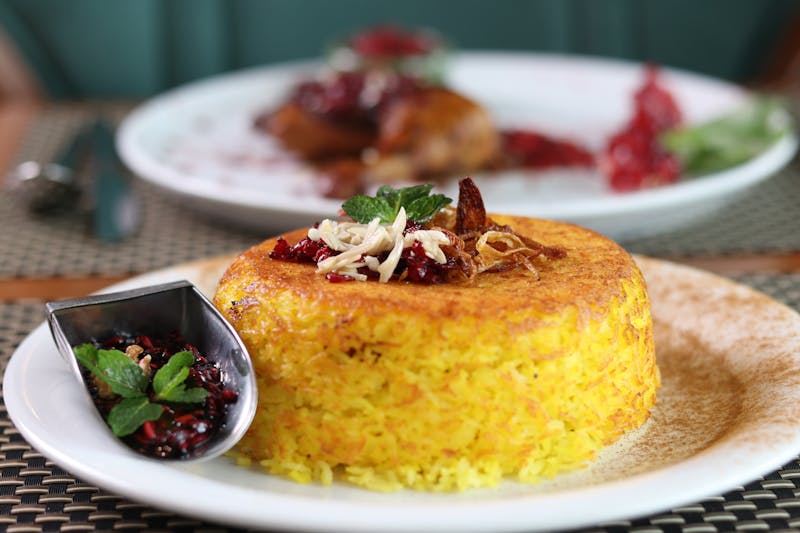
1. Tahdig — The Crispy Rice Crust
Flavor profile: Buttery, crispy, nutty | Best for: First-timers | Region: Nationwide
What is tahdig? Literally “bottom of the pot,” tahdig is the golden, crispy crust that forms beneath steamed rice. It’s widely considered the highest expression of skill in Persian home cooking — the dish every Iranian cook is judged by, and almost always the first thing to disappear from the table.
Tahdig can be made with plain rice, thin slices of flatbread (naan), or potato rounds layered beneath the rice before steaming. Each variation produces a different texture: rice tahdig is lacy and shatteringly crisp; bread tahdig is chewy at the edges and golden throughout; potato tahdig is dense, starchy, and deeply savory.
If you order one thing at a Persian restaurant, ask specifically for a generous portion of tahdig. Many restaurants will serve it without prompting — but it’s worth making sure.
Pro tip for making tahdig at home: Soak your rice for at least 30 minutes, use a non-stick pot, and keep heat at medium-low after adding the lid. Wrap a clean kitchen towel around the lid to absorb steam — this is the difference between a soggy crust and a perfectly crisp, evenly golden one.
2. Chelow — The Foundation Rice
Flavor profile: Floral, fragrant, fluffy | Best for: Understanding the baseline | Region: Nationwide
Chelow is long-grain rice steamed until each grain is separate, light, and perfectly cooked through — never sticky, never clumped. A bloom of saffron gives it its signature golden hue and faint floral warmth. Every other rice dish on this list builds on chelow as its foundation. Mastering it — or learning to recognize it done well — is the prerequisite for appreciating Persian rice culture.
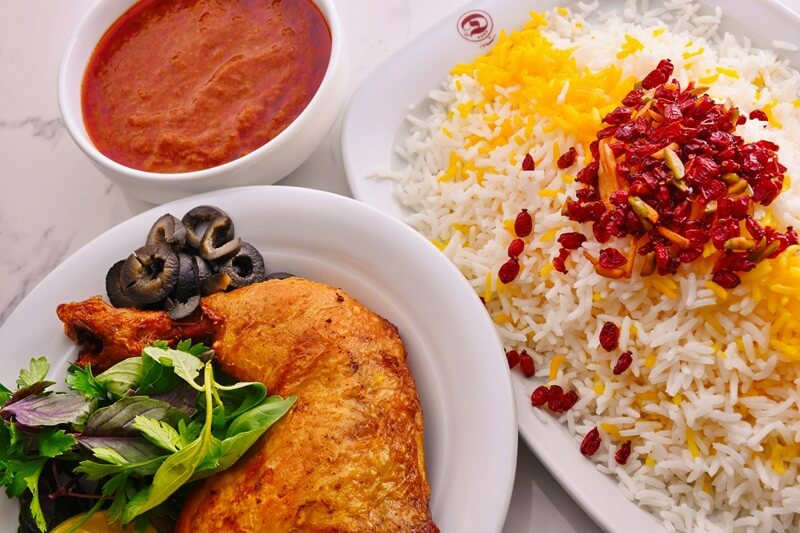
3. Zereshk Polo — Barberry Rice
Flavor profile: Sweet-sour, saffron-rich, jewel-bright | Best for: A perfect intro to Persian flavor balance | Region: Nationwide; often paired with chicken (morgh)
Saffron rice topped with a generous scattering of zereshk (barberries) — tiny, ruby-red fruits with a sharp tartness that cuts beautifully through the richness of the rice and the mildness of poached or roasted chicken. The interplay of sweet saffron and sour barberry is one of the clearest expressions of the sweet-sour balance that defines Persian cooking. If you want a single dish that teaches your palate how Persian flavors work, start here.
4. Baghali Polo — Dill and Fava Bean Rice
Flavor profile: Herby, fragrant, celebratory | Best for: Special occasions | Region: Nationwide; traditionally paired with lamb shank (mahiche)
Fresh dill and fava beans folded through saffron rice, traditionally served alongside slow-braised lamb shank. The herbs perfume the entire dish; the fava beans add an earthy sweetness. Baghali polo is a celebratory dish — the kind served at Nowruz (Persian New Year) and at family gatherings where the cook wants to show off. If you encounter it on a menu, order it.
5. Tahchin — Savory Saffron Rice Cake
Flavor profile: Rich, golden, savory-custardy | Best for: A showstopper dish | Region: Nationwide
Tahchin is built in layers — saffron-stained yogurt and egg beaten together, folded through rice, packed into a pot with chicken or lamb buried in the middle, then cooked low and slow until the bottom sets into a mahogany-crusted cake. When inverted onto a platter, it reveals a burnished, deeply golden top that looks almost too beautiful to cut. The interior is creamy and custardy; the crust is everything tahdig promises and more.
Section 2: Khoresht — The Stews That Give Rice Its Purpose
Khoresht (also spelled khoresh) are slow-cooked stews ladled generously over chelow. These aren’t quick sauces — they simmer for hours, developing a layered complexity that no shortcut can replicate. The stew and the rice together are the meal; one without the other is incomplete.
📷Photo by Ali Dashti on Pexels
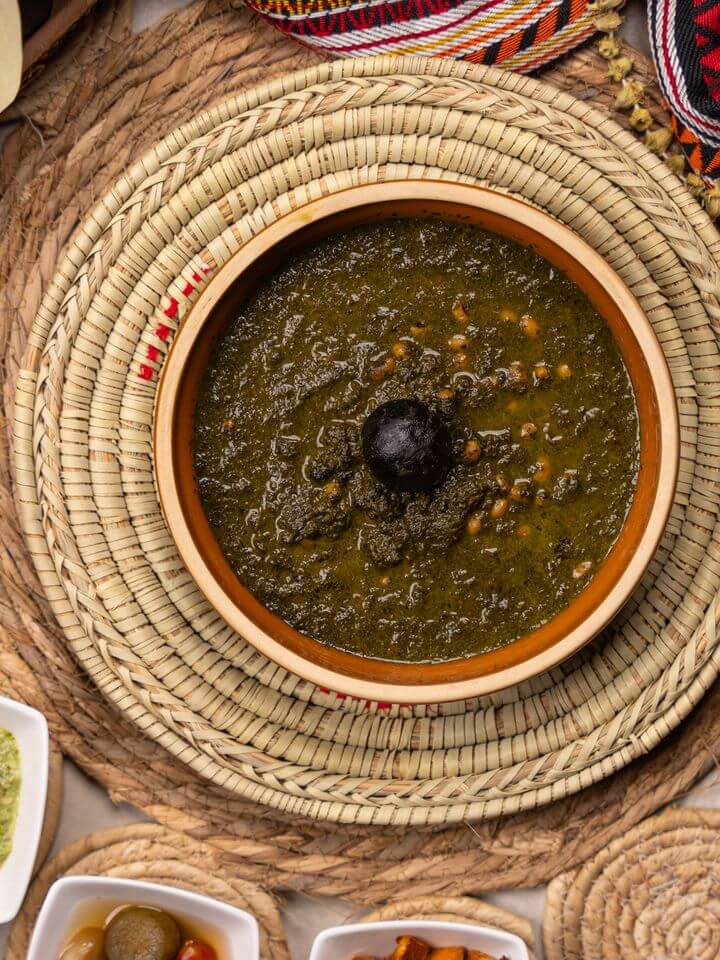
6. Ghormeh Sabzi — Iran’s National Dish
Flavor profile: Dark, earthy, deeply herbal | Best for: Your first Persian stew | Region: Nationwide
Ghormeh Sabzi is widely recognized as Iran’s national dish: a deeply colored herb stew of sautéed greens — typically fenugreek, parsley, and dried herbs — combined with kidney beans and whole dried Persian limes (limoo amani). The limes are left in the stew to slowly release their earthy, pungent citrus into the broth over several hours of simmering. The result is intensely dark, profoundly savory, and unlike anything in other cuisines. Start here if you want to understand how Persian stews work.
7. Fesenjan — Walnut and Pomegranate Stew
Flavor profile: Sweet, sour, nutty, luxurious | Best for: The most globally distinctive Persian dish | Region: Originally from Gilan (northern Iran); now nationwide
Fesenjan is arguably the most singular dish in Persian cuisine — nothing else quite like it exists in any other culinary tradition. Ground walnuts and pomegranate molasses form a thick, dark, deeply flavored sauce that slowly transforms during cooking: the initial sharp tartness mellows into something almost luxurious, simultaneously rich from the walnuts and bright from the pomegranate. Traditionally paired with duck or chicken. The sweet-sour-nutty balance is a masterclass in Persian flavor logic — rich, bright, and earthy all at once.
Regional note: Fesenjan originated in Gilan province in northern Iran, where pomegranates and walnuts grow abundantly. Northern versions tend to be more sour; central and southern versions are often adjusted sweeter.
8. Gheymeh — Split Pea and Tomato Stew
Flavor profile: Savory, tomato-rich, comforting | Best for: Everyday comfort food | Region: Nationwide; frequently served at religious ceremonies
A deeply comforting stew of split peas, lamb, and tomato, traditionally crowned with a tangle of crispy shoestring fries. Gheymeh is frequently served during religious ceremonies and as celebratory alms — which gives it a cultural weight that elevates it beyond its humble ingredients. The fries on top aren’t a garnish; they’re textural contrast, and essential.
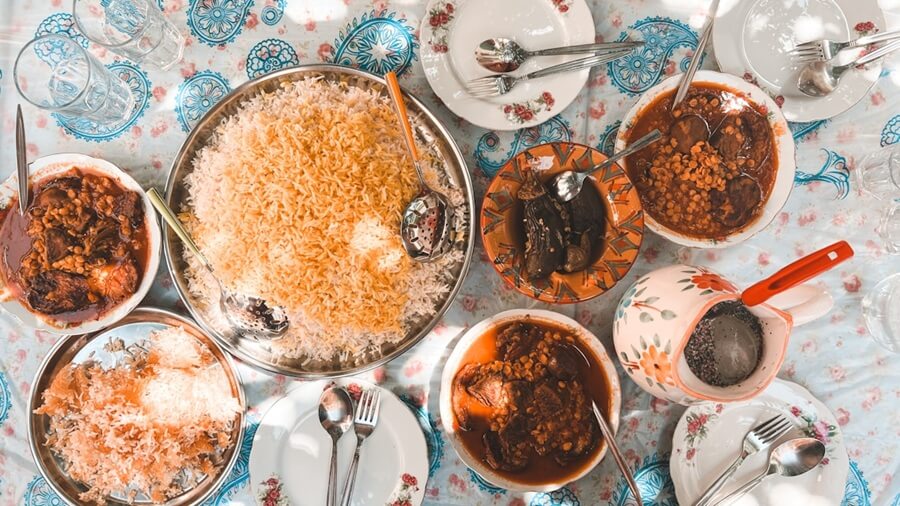
9. Khoresht-e Bademjan — Eggplant Stew
Flavor profile: Silky, aromatic, mildly tart | Best for: Eggplant lovers; vegetarian-friendly with adjustment | Region: Widely available; especially popular in Tabriz
Silky eggplant slowly stewed with tomato and a splash of verjuice (unfermented grape juice) for brightness. Turmeric gives it a warm golden hue and gentle earthiness. The eggplant breaks down into something almost creamy during the long cook. At its best, this is one of the most quietly elegant dishes in the Persian cuisine.
10. Khoresht-e Karafs — Celery and Herb Stew
Flavor profile: Fresh, herby, bright | Best for: A lighter alternative to richer stews | Region: Nationwide
The most refreshing member of the khoresht family. Celery is braised slowly with parsley, mint, and lamb until everything is tender and fragrant. It’s notably lighter than Ghormeh Sabzi or Fesenjan — a good entry point if rich stews feel like too much.
Section 3: Kebabs and Grilled Meat — The Chelow Kabab Tradition
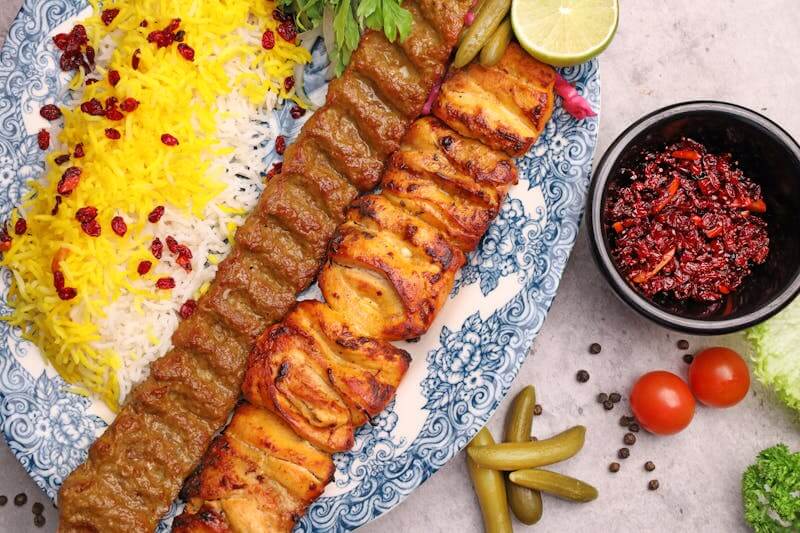
Walking into a chelow kabab house, you’re immediately met with the smell of charcoal smoke and saffron-lacquered meat — the sensory heartbeat of Persian grilling culture. These dishes are served almost universally with chelow rice, a knob of butter, grilled tomatoes, and raw onion.
📷 Photo by Shameel Mukkath on Pexels
11. Koobideh — Minced Meat Kebab
Flavor profile: Smoky, charred, deeply savory | Best for: The definitive Persian kebab experience | Region: Nationwide
The undisputed king of Persian kebabs. Seasoned minced lamb or beef — sometimes a blend — is hand-kneaded with grated onion until it becomes almost paste-like, then pressed onto wide, flat skewers and grilled over live coals. The edges char; the interior stays juicy and smoky. The technique of adhering minced meat to a flat skewer without it falling apart is a skill refined over generations. If you’ve never had a Persian kebab before, koobideh is where to start.
12. Joojeh — Saffron Chicken Kebab
Flavor profile: Floral, lemony, golden | Best for: The most approachable Persian kebab | Region: Nationwide
Chicken pieces marinated in saffron, lemon juice, and butter, then grilled to a golden, fragrant finish. The saffron gives each bite a floral warmth that makes it immediately recognizable as Persian. Joojeh is often the gateway kebab for those new to Iranian grilling — familiar enough in form, entirely distinct in flavor.
13. Barg — Fillet Kebab
Flavor profile: Buttery, tender, saffron-perfumed | Best for: Those who want refinement over char | Region: Nationwide; a staple of upscale chelow kabab restaurants
Thinly sliced beef or lamb fillet, tenderized and marinated in grated onion and saffron before going on the grill. Where koobideh is bold and smoky, barg is delicate and almost melt-in-your-mouth. The marinade does significant work here — the onion enzymes tenderize the meat; the saffron perfumes it throughout.
14. Shishlik — Grilled Lamb Chops
Flavor profile: Bold, smoky, rich | Best for: A regional specialty worth seeking out | Region: Northeastern Iran (Khorasan province); also popular in the Caspian region
Whole lamb chops skewered and grilled over high heat until charred outside and pink within. Shishlik is a celebrated specialty of northeastern Iran, where the lamb tends to be fattier and the grilling tradition older. The bold, smoky flavor is less refined than barg and more primal — which is exactly the point.
15. Dizi (Abgoosht) — The Two-Course Lamb Pot
Flavor profile: Rustic, brothy, deeply hearty | Best for: A uniquely interactive dining experience | Region: Nationwide; strongly associated with traditional sofrehkhaneh restaurants
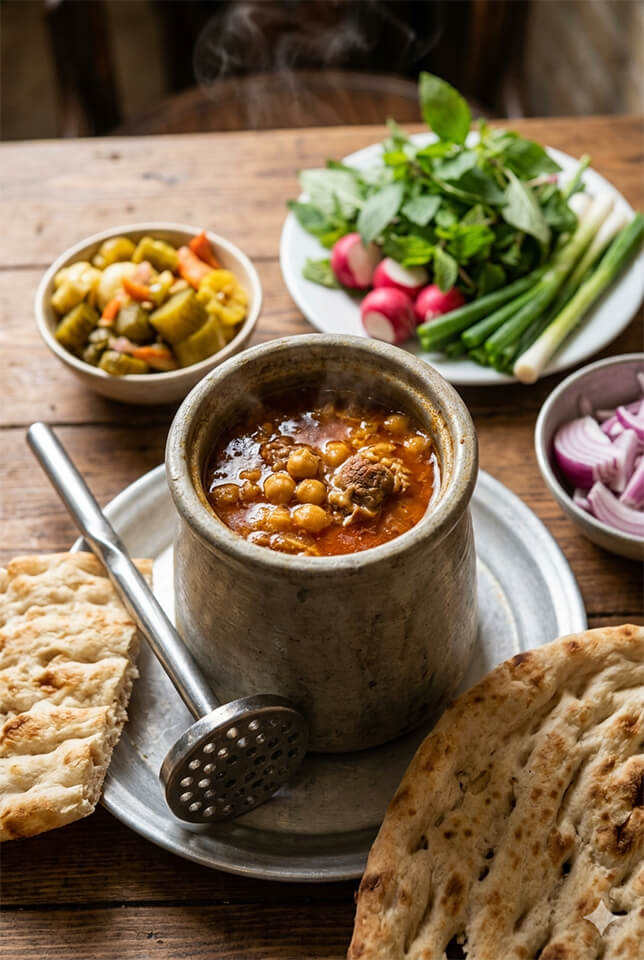
The outlier on this list — and one of the most interesting. Dizi is served in two parts: first, the thin, deeply flavored broth is poured off and sipped from a bowl, often with torn flatbread. Then the solids — lamb, chickpeas, potatoes, and dried limes — are mashed with a pestle into a thick paste called goosht-koobideh, eaten separately with flatbread and raw onion. It’s an ancient dish with a format unlike anything else in Persian cuisine, and eating it properly is an experience in itself.
Section 4: Soups, Sides, and the Art of the Persian Table
A Persian table is never just the main dish. It’s an ecosystem — yogurt dips, fresh herb platters, salads, and condiments that aren’t afterthoughts but structural elements of the meal. Every traditional table features Sabzi Khordan: a platter of fresh mint, basil, tarragon, radishes, walnuts, and feta that acts as a mandatory palate cleanser and digestive aid throughout the meal.
16. Ash Reshteh — Noodle and Herb Soup
Flavor profile: Thick, tangy, deeply nourishing | Best for: Nowruz and cold-weather comfort | Region: Nationwide; especially significant in Tehran and northern provinces
What is ash reshteh? A thick, substantial soup of noodles, legumes (chickpeas, kidney beans, lentils), spinach, and kashk (fermented whey) — tangy, creamy, and richly savory. According to tradition, the noodles (reshteh) symbolize the many paths one can take in life, making ash reshteh one of Iran’s most culturally loaded dishes. It’s a Nowruz staple eaten to bring good fortune for the year ahead. Topped with caramelized onion, dried mint oil, and an extra drizzle of kashk.
17. Salad Shirazi — Persian Cucumber and Tomato Salad
Flavor profile: Bright, citrusy, crisp | Best for: Essential palate cleanser alongside rich rice dishes | Region: Named for Shiraz; found on virtually every table across Iran
Finely diced cucumber, tomato, and white onion — cut much smaller than a typical salad — dressed simply with lime juice, dried mint, and a little olive oil. Crisp, bright, and acidic, it cuts through the richness of chelow and khoresht beautifully. If you’re in Shiraz or Yazd, you’ll find it on every restaurant table without needing to order it. Make it at home and you’ll understand why — it goes with almost everything.
18. Mast-o-Khiar — Yogurt and Cucumber Dip
Flavor profile: Cool, creamy, minty | Best for: Balancing richness across any Persian meal | Region: Nationwide
Thick yogurt folded with finely grated cucumber, dried mint, and sometimes walnuts or raisins. Cool and refreshing in a way that balances the warmth of spiced stews and the richness of buttered rice. Think of it as the Persian cousin of tzatziki — subtler, less garlicky, more herbal. It belongs on the table at every meal.
19. Kashk-e Bademjan — Smoky Eggplant Dip
Flavor profile: Smoky, savory, deeply umami | Best for: One of the great Persian appetizers | Region: Nationwide; particularly popular in Isfahan and Tehran
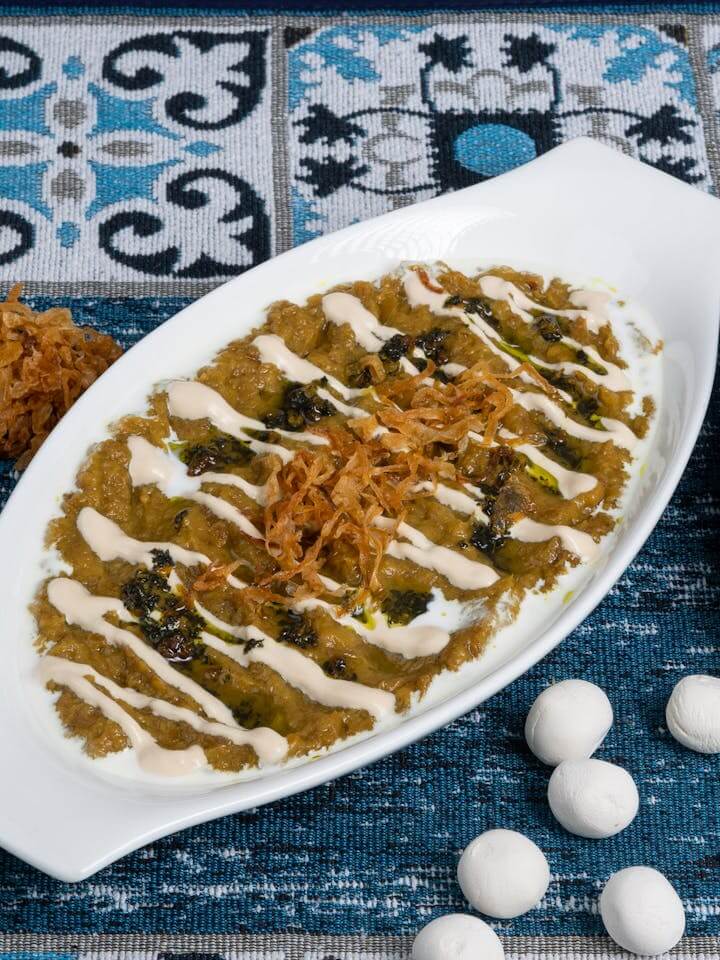
Fried eggplant, mashed and layered with caramelized onion, walnuts, saffron, and a dramatic drizzle of kashk (fermented whey) and mint oil. Rich, smoky, intensely savory, and textured in a way that makes it genuinely addictive. Served with flatbread as an appetizer or side. If you see it on a menu, order it without hesitation.
20. Zeytoon Parvardeh — Pomegranate-Marinated Olives
Flavor profile: Tangy, sweet, herbaceous | Best for: A regional gem; excellent as part of a spread | Region: Northern Iran (Gilan and Mazandaran provinces)
Olives marinated in pomegranate molasses, ground walnuts, and fresh herbs — a condiment unique to northern Iran, where pomegranates and walnuts grow in abundance. The tartness of the molasses transforms the olives into something more complex and more interesting than any plain-marinated olive you’ve encountered. Found in northern Iranian restaurants and specialty markets; worth seeking out.
📷Photo by Shameel Mukhath on Pexels
How to Order Confidently at a Persian Restaurant
What should I order if it’s my first time? Start with Zereshk Polo Morgh (barberry rice with chicken) or Ghormeh Sabzi. Both are widely available, representative of Persian flavor logic, and deeply satisfying. Always ask for tahdig.
Is Persian food vegetarian-friendly? More than most people expect. Ash Reshteh, Kashk-e Bademjan, Salad Shirazi, Mast-o-Khiar, Zeytoon Parvardeh, and Zereshk Polo (without chicken) are all vegetarian. Khoresht-e Bademjan can often be made without meat on request.
What is kashk? Fermented whey — thick, tangy, and intensely savory. It appears in Ash Reshteh and Kashk-e Bademjan, and is one of Persian cuisine’s most distinctive flavor ingredients.
Is Persian food the same as Arabic or Turkish food? No. Persian cuisine is a distinct culinary tradition with its own logic, ingredients, and techniques. While there are shared ingredients across the broader region, the flavor profile — saffron-forward, sour-leaning, herb-fragrant, rarely spicy — is uniquely Iranian.
Four principles for any Persian menu:
- Always ask for tahdig. It’s the most celebrated element of Persian cooking. Never skip it.
- Expect fragrance and sourness, not heat. Persian food is richly spiced but almost never fiery.
- Treat the sides as structural. Yogurt, fresh herbs, and flatbread aren’t garnishes — they complete every bite.
- Let stews like Fesenjan teach your palate. The walnut-pomegranate combination is unlike anything else in world cuisine — once you’ve tasted it, you’ll understand Persian flavor logic at a deep level.
Final Thought: The Enduring Legacy of the Iranian Table
Persian food 101 begins with one essential truth: this is a cuisine built on patience, intention, and love. Slow-braised stews simmer for hours, fragrant herb mixtures are layered with care, and rice is coaxed into golden-crusted perfection. None of it happens quickly — and that’s entirely the point. The time invested in every dish is a form of respect, both for the ingredients and for the people gathered at the table.
If you’re new to Iranian cooking, start where the culture starts — with Ghormeh Sabzi, Iran’s beloved national stew. Its deep, herbaceous complexity tells you everything you need to know about how Persian flavors work. From there, the rest of the menu opens up naturally, dish by dish.
What makes Iranian dining truly unforgettable, though, goes beyond the food itself. Taarof — the Iranian tradition of gracious hospitality — means guests are welcomed warmly, fed generously, and made to feel genuinely honored. That cultural warmth is inseparable from the Persian food experience.
Start with one dish — curiosity is the only ingredient you need to bring.
Ready to learn more about Persian Food?
FAQs About Best Persian Foods
1. What is the most famous Persian food?
Ghormeh Sabzi is widely recognized as Iran’s national dish — a dark, herbaceous stew of sautéed greens, kidney beans, red meat, and dried Persian limes that has been eaten across Iran for centuries. For rice, tahdig is the most celebrated preparation: the golden crispy crust that forms at the bottom of the pot and is almost always the first thing to disappear from the table.
2. What does Persian Food taste like?
Persian food is fragrant, subtly sour, and layered — not spicy. The dominant flavors come from saffron (floral and warm), dried limes (earthy and tart), fresh herbs, and pomegranate. Think complex and aromatic rather than fiery. First-time eaters are often surprised by how refined and balanced it is compared to other Middle Eastern cuisines.
3. What is the difference between Persian food and Middle Eastern food?
Persian cuisine is a distinct tradition, not a subset of Middle Eastern cooking. Where Arabic and Turkish cuisines lean on spice-heat, mezze spreads, and flatbreads as centerpieces, Persian food is built around a central rice dish accompanied by slow-cooked stews and grilled meats. The flavor logic — sour over spicy, fragrant over bold — is uniquely Iranian.
4. Is Persian food good for vegetarians?
More than most people expect. Ash Reshteh (noodle and herb soup), Kashk-e Bademjan (smoky eggplant dip), Salad Shirazi, Mast-o-Khiar, Zeytoon Parvardeh, and Zereshk Polo without chicken are all vegetarian. Khoresht-e Bademjan (eggplant stew) can usually be made meatless on request. Persian cuisine’s emphasis on herbs, legumes, and rice means vegetarians eat very well at an Iranian table.
5. What is tahdig and why is it so important in Persian culture?
Tahdig — literally “bottom of the pot” — is the golden, crispy crust of rice that forms at the base of the cooking pot. It’s widely considered the highest mark of skill in Persian home cooking, and almost always the first thing eaten at the table. A perfectly executed tahdig tells you everything about the cook. It can be made with plain rice, flatbread, or potato slices layered beneath the steamed rice.
6. Can you experience authentic Persian food in Iran?
Absolutely — and the experience goes far beyond the food itself. In cities like Shiraz, Isfahan, and Tehran, traditional restaurants called sofrehkhaneh serve dishes like Dizi, Ghormeh Sabzi, and fresh tahdig in settings that reflect centuries of Iranian hospitality culture. Iranian Food tours let you cook and eat alongside locals, which is the most direct way to understand Persian cuisine from the inside.
7. What is saffron and why does Persian cooking use so much of it?
Saffron is the dried stigma of the crocus flower, harvested entirely by hand — it takes around 150 flowers to produce just one gram. Iran is the world’s largest producer. In Persian cooking, saffron appears in rice, stews, marinades, and desserts, contributing a distinctive floral warmth and golden color. It’s not used for heat or sharpness; it’s the aromatic backbone of the entire cuisine.
8. What are the best Persian foods to try if you don’t eat meat?
Focus on the rice dishes and sides: Zereshk Polo (barberry rice), Tahdig, and Tahchin can all be made vegetarian. Among stews, Khoresht-e Bademjan works well without meat. For appetizers and sides, Kashk-e Bademjan, Mast-o-Khiar, Salad Shirazi, and Zeytoon Parvardeh are all naturally meat-free and among the most interesting dishes on any Persian table.
9. How is Persian rice different from regular rice?
Persian rice is cooked using a two-stage method — parboiled first, then steamed — that produces grains that are completely separate, fluffy, and never sticky. The process is fundamentally different from boiling or absorption methods used elsewhere. The most prized result is tahdig: the golden crust that forms at the bottom of the pot during the steam phase. Getting both the fluffy grain and the crispy crust right simultaneously is considered an art form.
0 Comment