


Table of Contents
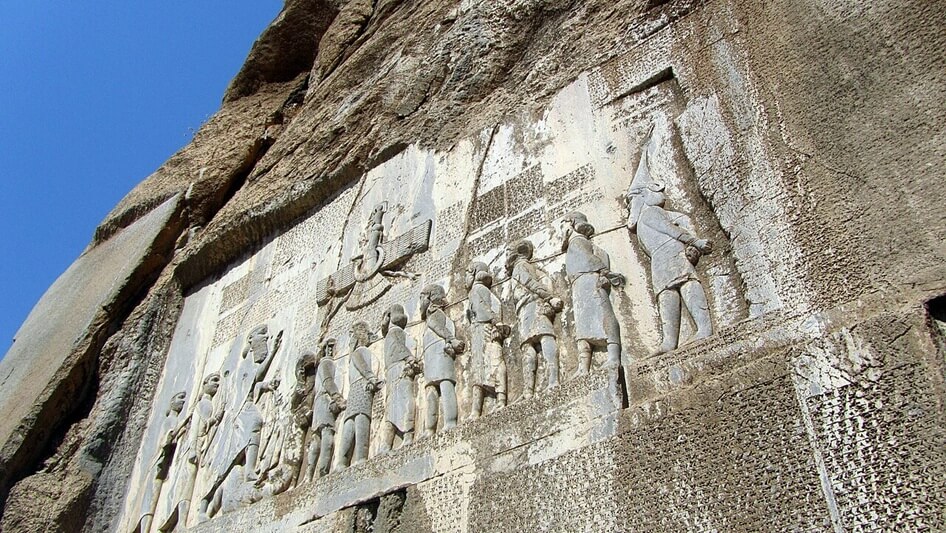
Sixty metres above the plains of western Iran, a cliff face holds one of the most consequential texts in human history. Bisotun is a UNESCO World Heritage Site in Kermanshah Province where, in 521 BC, King Darius I ordered his victory over a rival to the Persian throne carved into limestone in three ancient languages — an inscription that would later become the key to reading cuneiform script itself. Standing beneath it today, with the old Royal Road still traceable across the valley floor, the scale of the mountain and the intent behind the carving arrive together, before a single fact needs explaining.
There is a stillness to Bisotun that most visitors do not expect. Unlike Persepolis, there is no grand processional stair, no forest of columns to walk between. Here, the story is told from a distance — high on a rock face, meant to be seen rather than touched, by travelers moving along one of antiquity’s great trade corridors between the Iranian plateau and Mesopotamia. It is a place that rewards patience: the longer you look, the more the mountain reveals of the empires that passed beneath it.
What Is the Bisotun Inscription?
The Bisotun Inscription is a monumental rock relief and cuneiform inscription carved into a limestone cliff in Kermanshah Province during the reign of Darius I, around 521 BC. Created to commemorate the king’s victory over rival claimants following his rise to the Achaemenid throne, it combines striking royal imagery with a detailed historical account of one of ancient Persia’s most turbulent periods.
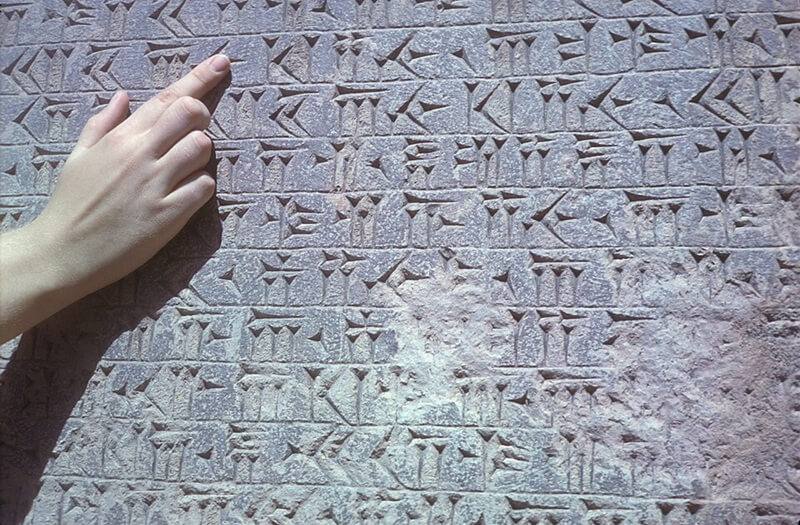
The inscription was carved in three languages—Old Persian, Elamite, and Babylonian—making it one of the most important texts for the modern decipherment of cuneiform. Much like Egypt’s Rosetta Stone helped unlock hieroglyphs, the Bisotun Inscription allowed scholars to read the written records of ancient Mesopotamia and Persia, transforming our understanding of the ancient Near East.
The relief depicts Darius I holding a bow as a symbol of royal authority, standing over the defeated usurper Gaumata, while nine captured rebel leaders are led before him in chains. Surrounding the scene are more than 1,200 lines of cuneiform text describing the rebellions Darius claimed to have crushed as he secured control of the Persian Empire.
Darius I and the Crisis of the Persian Empire
The Bisotun Inscription was created to explain and justify one of the most dramatic moments in the history of the Achaemenid Empire. After the death of Cambyses II, son of Cyrus the Great, the empire descended into political turmoil. Rebellions broke out across several provinces, and competing rulers claimed the Persian throne, threatening the unity of the empire.
Into this crisis stepped Darius I, a distant member of the Achaemenid royal family. After seizing power, he spent the next two years suppressing revolts throughout the empire before restoring central authority. To commemorate these victories—and reinforce the legitimacy of his rule—Darius commissioned the Bisotun Inscription, carving his account of the events high into a limestone cliff overlooking one of the empire’s most important roads.
📷Photo by KendallKDown on Wikicommons
Modern historians generally agree on the broad sequence of events: Darius came to power during a period of widespread rebellion and successfully reunited the empire. What remains debated is the identity of the man Darius claimed to have overthrown. In the inscription, he identifies him as Gaumata, whom he describes as an impostor pretending to be Bardiya, the brother of Cambyses II. Some historians accept this account, while others argue that Darius may have removed the real Bardiya and used the story of an impostor to legitimize his own claim to the throne. More than 2,500 years later, the Bisotun Inscription remains both one of history’s greatest archaeological treasures and one of its most fascinating political documents.
Before Darius — Bisotun’s Prehistoric Layers
Long before Darius I commissioned his famous inscription, Bisotun was already a place of human activity. The site’s ancient name—Bagastana, meaning “place of the gods” in Old Persian—suggests the mountain held religious or symbolic importance long before the Achaemenid period.
Archaeological discoveries at Hunter’s Cave on the Bisotun massif show that people lived in this area tens of thousands of years ago, making it one of the oldest continuously occupied landscapes in western Iran. Stone tools and other remains reveal that prehistoric communities were drawn here by the mountain’s natural shelter and reliable water sources.
Those same springs continued to shape Bisotun’s history. Situated along one of the main routes linking the Iranian Plateau with Mesopotamia, the mountain became a natural stopping point for travelers, traders, and armies long before the Persian Empire existed. By the time Darius selected the cliff for his inscription, Bisotun was already a landmark with a history stretching back thousands of years.
Three Languages, One Story
What makes the Bisotun Inscription extraordinary is not only what it says, but how it was written. Darius I ordered the same account to be carved in Old Persian, Elamite, and Babylonian—three of the principal languages of the Achaemenid Empire. While Elamite and Babylonian were long-established administrative languages, the Old Persian version is one of the earliest surviving examples of the script used for a monumental royal inscription.
This trilingual format proved invaluable more than 2,000 years later. By comparing the three versions of the same text, scholars—most famously Sir Henry Rawlinson—were able to decipher Old Persian cuneiform, which in turn helped unlock the much older Elamite and Babylonian cuneiform systems. For this reason, the Bisotun Inscription is regarded as one of the most important discoveries in the history of ancient Near Eastern archaeology and linguistics.
How Bisotun Became the Rosetta Stone of Cuneiform
The comparison between the Bisotun Inscription and the Rosetta Stone is more than a convenient analogy. Both monuments enabled scholars to decipher ancient writing systems that had been unreadable for centuries. Just as the Rosetta Stone helped unlock Egyptian hieroglyphs, Bisotun provided the key to reading cuneiform, opening the written history of ancient Persia and Mesopotamia.
A major breakthrough came in the 19th century when Sir Henry Rawlinson, a British army officer and scholar, painstakingly copied the inscription from the cliff face between 1835 and 1847. Working from ropes and narrow ledges, he successfully translated the Old Persian text, building on earlier work by scholars such as Georg Friedrich Grotefend. Once Old Persian could be read, researchers were able to compare it with the parallel Elamite and Babylonian versions, eventually deciphering those languages as well.
The impact was revolutionary. Thousands of cuneiform inscriptions from across the ancient Near East suddenly became readable, transforming the study of the Achaemenid Empire, Mesopotamia, and civilizations that had been silent for more than two millennia. Today, the Bisotun Inscription is regarded as one of the most important archaeological discoveries in the history of linguistics and ancient history.
📷Photo by Hamid Najafi on Flicker
Reading the Relief
The Bisotun Relief was designed to communicate a clear political message. Darius I stands taller than every other figure, holding a bow as a symbol of royal authority while placing his foot on the defeated Gaumata, the man he claimed had unlawfully seized the Persian throne. Behind Darius stand two attendants, while before him nine bound rebel leaders are led forward, each representing a rebellion he said he had defeated during his campaign to reunify the Achaemenid Empire.
Above the scene appears a winged figure, traditionally identified as Ahura Mazda, the supreme deity in Zoroastrianism, symbolizing divine approval of Darius’s rule. The composition follows a long artistic tradition found across the ancient Near East, where victorious rulers were depicted standing over defeated enemies. At Bisotun, however, this familiar imagery became one of the defining visual symbols of the Achaemenid Empire, reinforcing Darius’s legitimacy for everyone traveling the road below.
An Engineering Feat
Carving the Bisotun Inscription was an extraordinary engineering achievement. Positioned around 60 meters (197 feet) above the ancient road linking Mesopotamia with the Iranian Plateau, the relief was deliberately placed where it could be seen by travelers but was difficult to reach or damage.
Archaeologists believe the craftsmen used temporary scaffolding or carved footholds to complete the work, which were likely removed once the inscription was finished. Evidence also suggests that parts of the relief were coated with a protective layer to help preserve the carvings against centuries of weathering.
The result was exactly what Darius I intended: a permanent public declaration of his authority, carved into the mountainside for generations of travelers to witness. Today, visitors admire the inscription from below, preserving both the monument and the dramatic perspective its creators originally envisioned.
The Rest of the Bisotun Complex
While the Darius Relief is the highlight of Bisotun, the wider UNESCO World Heritage Site preserves monuments from more than 2,000 years of Iranian history. Exploring beyond the famous inscription reveals how successive empires left their mark on the same mountainside.
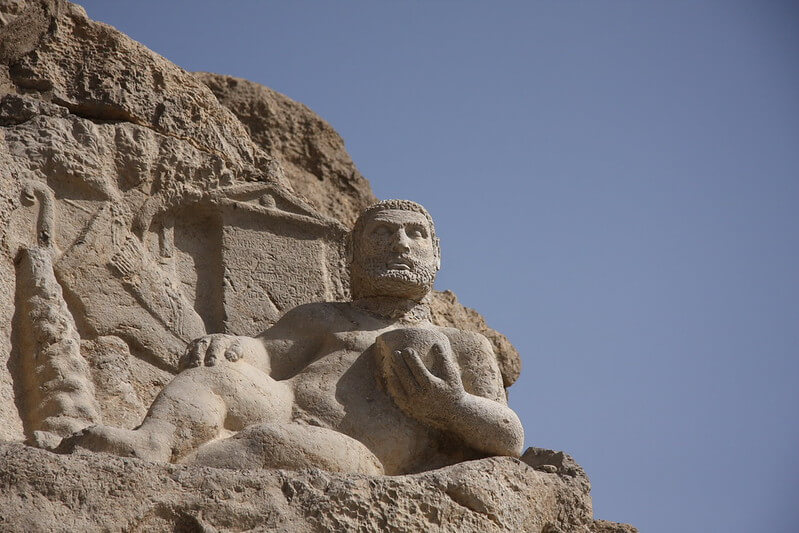
One of the site’s most distinctive monuments is the Statue of Hercules, carved during the Seleucid period in the 2nd century BC. Depicting the Greek hero reclining with a cup in his hand, it reflects the spread of Hellenistic culture into Persia following the conquests of Alexander.
The mountain also preserves several Parthian rock reliefs, including those associated with Mithridates II and Gotarzes II, showing that later rulers continued to use Bisotun as a place to commemorate their authority.
Nearby lies Farhad Tarash, an enormous unfinished rock face linked by Persian legend to the tragic love story of Farhad and Shirin. Although archaeologists believe the carving had a different historical purpose, the legend has made it one of the site’s most famous landmarks.
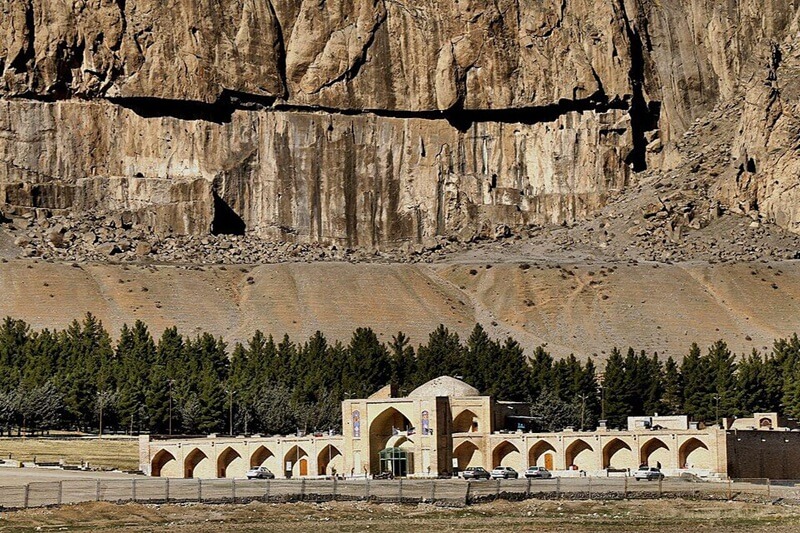
At the foot of the mountain stands a beautifully preserved Safavid caravanserai, built along the historic trade route that passed through Bisotun. Restored in recent years, it now operates as a traditional hotel, giving visitors the rare opportunity to spend the night in a building that has welcomed travelers for centuries.
📷Photo by IsoGFX on Wikicommons
Why UNESCO Inscribed Bisotun in 2006
Bisotun was added to the UNESCO World Heritage List of Iran in 2006, recognized under two cultural criteria that speak directly to why the site matters beyond Iran’s borders.
Criterion (ii) recognizes sites that demonstrate an important exchange of ideas across cultures or time periods. UNESCO’s assessment credits Bisotun with reflecting artistic traditions that trace back to ancient Egypt and the Middle East, adapted here into a new form of royal storytelling that would go on to shape monumental art across the Achaemenid Empire and beyond.
Criterion (iii) recognizes sites bearing exceptional testimony to a cultural tradition or civilization. Bisotun qualifies here as the only known Achaemenid monument to document a specific historical event in this much detail — the restoration of Darius’s empire — making it a uniquely direct record of a turning point in Persian history, rather than a symbolic or generalized commemoration.
UNESCO’s own assessment also flags an ongoing conservation concern worth knowing before you visit: water infiltration behind the bas-relief has been identified as a threat to the monument’s long-term stability, and Iranian heritage authorities have been working on permanent solutions rather than temporary fixes. It is a detail most travel guides leave out, but it is part of an honest picture of the site today. Full technical details are available on the official UNESCO World Heritage listing for Bisotun.
Planning Your Visit to Bisotun
Getting There
Bisotun lies about 30 km (19 miles) northeast of Kermanshah, directly on the highway connecting Kermanshah and Hamedan, making it an easy half-day trip from the city. From Tehran, the drive takes approximately 5 to 6 hours (around 500 km / 310 miles), depending on traffic and road conditions. The route follows modern highways for most of the journey, making Bisotun a convenient stop for travelers heading between Tehran, Kermanshah, and western Iran. If you prefer not to drive, regular buses and trains connect Tehran with Kermanshah, where taxis and private transfers are readily available for the short journey to the UNESCO site.
Best Time to Visit
Spring, from April through June, and autumn, from September through November, offer the clearest skies and most comfortable temperatures for time outdoors at the base of the cliff. Summer, particularly July and August, brings strong heat to the Kermanshah plain, so an early morning visit is the better choice if traveling in that season. Winter brings the possibility of snow across the surrounding Zagros peaks, which lends the site a quieter, more dramatic atmosphere, though outdoor exploration can be more limited.
Opening Hours and What to Expect
The site is generally open daily from around 8am to 6pm, with adjusted hours on major Iranian holidays. It is worth setting expectations before arriving: the inscription itself is no longer something visitors can climb close to, as was possible decades ago. Today it is viewed from a protected distance at ground level, sometimes framed by conservation scaffolding.
Recommended Visiting Order and Time Needed
Most visitors spend 1.5 to 2.5 hours exploring Bisotun, depending on how many of the surrounding monuments they choose to visit. A typical visit begins at the Bisotun Inscription viewing area before continuing to the nearby Statue of Hercules, the Parthian rock reliefs, Farhad Tarash, and the historic Safavid caravanserai at the foot of the mountain. The site is relatively easy to explore on foot, with short walking distances between the main attractions, making it a comfortable stop on a day trip from Kermanshah.
What You Won’t Find Here
Unlike major archaeological sites such as Persepolis, Bisotun has limited interpretive displays and relatively little English-language signage. If you’re interested in the stories behind the reliefs and the site’s many historical layers, hiring a knowledgeable guide will greatly enrich your visit. It’s also worth knowing that the Bisotun Inscription itself cannot be approached up close. Carved high into the cliff to protect it from damage, it is viewed from designated observation areas below—the same perspective travelers have admired for more than 2,500 years.
Nearby Pairings
Bisotun pairs naturally with Taq-e Bostan, a set of Sassanian-era rock reliefs just outside Kermanshah city, and with a broader exploration of Kermanshah’s Kurdish-influenced culture and cuisine. Travelers continuing east toward Hamedan can also visit the Ganjnameh inscriptions, a smaller but related example of Achaemenid rock carving in the same tradition.
Final Thought: A Cliff Face That Rewrote History
What makes Bisotun unusual among Iran’s ancient sites is that it was never built for an audience like today’s traveler. Darius carved his account for his own subjects and successors, in languages meant to be understood by the empires he ruled, and placed it deliberately out of reach. That it eventually became a gift to the modern understanding of the ancient world was never the intention — it was simply what happened when curiosity met patience, a century later, in the form of a man on a rope.
That accident of history is part of why Bisotun carries a different kind of weight than sites built for grandeur or worship. Its significance was assigned after the fact, by scholars rather than kings, which is a rarer kind of monument than it first appears. Few places make the distance between a ruler’s intentions and a place’s eventual meaning so visible in one glance upward.
Iran holds more of these layered stories than most travelers expect — moments where politics, belief, and chance intersect and leave something permanent behind. Bisotun is one entry point into that larger pattern, and one of the more rewarding ones to stand in front of.
See the inscription that gave scholars back an entire lost language.
FAQs about Bisotun World Heritage Site
1. What is Bisotun famous for?
Bisotun is famous for its cliffside inscription commissioned by Darius I around 521 BC, which recorded his suppression of rivals to the Persian throne in three ancient languages. Its trilingual structure later made it the key text scholars used to decipher cuneiform script.
2. Who carved the Bisotun inscription?
The inscription was commissioned by Darius I, the Achaemenid king, and carved by artisans under his direction around 521–520 BC. It was designed to be seen from the trade route below rather than approached directly.
3. What languages are on the Bisotun inscription?
The inscription appears in three cuneiform scripts: Old Persian, Elamite, and Babylonian. Each version tells the same account of Darius’s rise to power, which allowed 19th-century scholars to cross-reference the texts and decode the writing system.
4. Why is Bisotun compared to the Rosetta Stone?
Bisotun is compared to the Rosetta Stone because its parallel texts in three languages allowed scholars, most notably Henry Rawlinson, to decipher cuneiform script in the 19th century. This breakthrough had the same impact on Assyriology that the Rosetta Stone had on Egyptology.
5. How old is the Bisotun inscription?
The inscription dates to around 521–520 BC, commissioned shortly after Darius I secured the Achaemenid throne. Parts of the wider Bisotun site, including nearby caves, show evidence of human presence tens of thousands of years earlier.
6. Can I still see the Bisotun inscription up close?
No, the inscription is viewed from a protected distance at ground level rather than climbed or approached directly, a restriction in place to help preserve the carving. This differs from earlier decades, when limited climbing access was sometimes possible.
7. How much time do you need to visit Bisotun?
Most visitors spend between ninety minutes and two and a half hours at Bisotun, depending on whether they explore the full complex or focus on the main inscription. A guide can help make efficient use of that time given the limited on-site signage.
8. Is Bisotun worth visiting?
Bisotun is worth visiting for travelers interested in ancient history, epigraphy, or the story of how modern scholars decoded lost languages, offering a depth of significance that is easy to underestimate from photographs alone. It works particularly well paired with Kermanshah’s other historical sites.
9. How do you get to Bisotun from Tehran?
The easiest and most popular option is to travel by car, with the journey taking around 5 to 6 hours (approximately 500 km / 310 miles) via modern highways. Many travelers combine Bisotun with a visit to Kermanshah or include it as a stop on a wider western Iran itinerary. Alternatively, you can take a train from Tehran to Kermanshah (around 6–7 hours) and continue by taxi for about 30–40 minutes to the site.
10. What other monuments are at the Bisotun site?
Beyond the main inscription, Bisotun includes a Seleucid-era statue of Hercules, Parthian rock reliefs, the unfinished carving known as Farhad Tarash, and a Safavid caravanserai now operating as a hotel. Together they represent roughly two thousand years of continuous use along the same ancient route.
11. When was Bisotun added to the UNESCO list?
Bisotun was inscribed on the UNESCO World Heritage List in 2006, recognized under criteria (ii) and (iii) for its role in the exchange of artistic traditions and its unique testimony to a specific historical event in Achaemenid history.
0 Comment