


Table of Contents
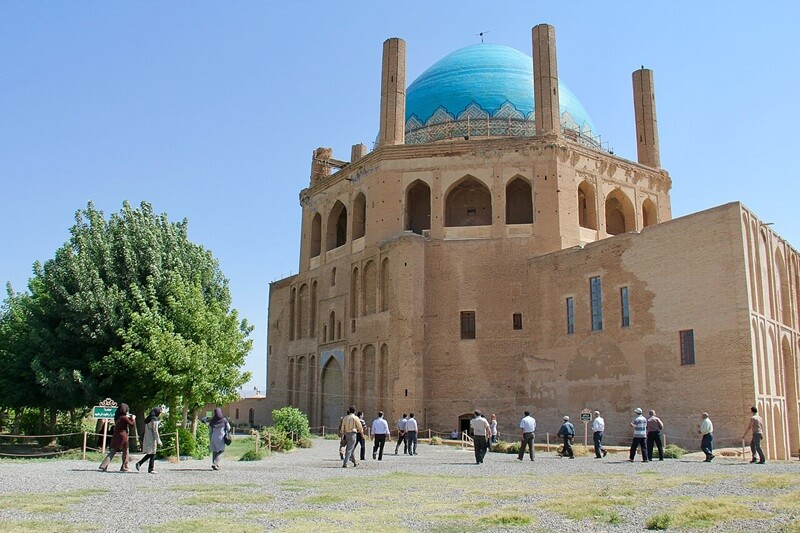
The Dome of Soltaniyeh is a fourteenth-century Ilkhanid mausoleum in Zanjan province, Iran, and one of the world’s oldest surviving double-shelled brick domes. It appears almost without warning: a plain of pasture and farmland stretching toward the Alborz foothills, and then, rising from the flatness, a turquoise crown that seems too large for the emptiness around it. There is no skyline to soften the effect, no competing structure to share the horizon. Just the dome, alone, the way it has stood since a Mongol king decided this quiet stretch of land should become the center of an empire. Approaching it on the road from Zanjan, travelers often describe the same sensation — the sense of arriving somewhere that used to matter far more than it does today, and understanding, almost instantly, why.
Soltaniyeh, Zanjan: A Capital Built on a Dream
In the early 14th century, the Ilkhanid ruler Öljaitu chose the plains of present-day Zanjan Province as the site of a new imperial capital. The area had long served as a seasonal residence for the Mongol court, but Öljaitu envisioned something far grander. Moving his capital from Tabriz, he founded Soltaniyeh, transforming the open plain into the political and cultural center of the Ilkhanid Empire for a brief but remarkable period.
At the heart of this new city, Öljaitu commissioned the magnificent Dome of Soltaniyeh as his mausoleum. Constructed over nearly a decade by thousands of craftsmen and laborers, the monument was far more than a royal tomb. It was a bold statement of imperial power, engineering skill, and artistic ambition—one that would become one of the greatest architectural achievements of medieval Iran.
The Oljaytu Mausoleum and a King’s Search for Faith
The story of the Dome of Soltaniyeh is closely tied to the life of its founder, the Ilkhanid ruler Öljaitu. Like many members of the Mongol elite, his religious beliefs evolved over time. Born into the traditional beliefs of his ancestors, he is known to have embraced Christianity for a period before converting to Islam—first as a Sunni and later as a Shia Muslim. These shifts reflected the diverse religious landscape of the Ilkhanid Empire and influenced both his court and the monuments he commissioned.
One enduring tradition claims that Öljaitu originally intended the mausoleum to house the remains of Imam Ali and Imam Hussain, relocating them from Najaf and Karbala to his new capital. Whether this plan was ever seriously pursued remains debated by historians, but it was ultimately abandoned. Instead, the magnificent monument became Öljaitu’s own mausoleum, where he was buried after his death in 1316.
The Rise and Decline of Soltaniyeh
For a brief period in the early 14th century, Soltaniyeh served as the ceremonial and administrative capital of the Ilkhanid Empire, attracting scholars, craftsmen, merchants, and officials from across the region. After Öljaitu’s death, however, the city gradually lost its political importance, and its population declined over the following centuries.
Today, little remains of the once-great capital beyond the mausoleum and the adjoining khanaqah, a building used for Sufi gatherings. The palaces, markets, mosques, and residential neighborhoods that once surrounded them have largely disappeared, surviving only through archaeological excavations. This is why UNESCO protects not only the famous dome but also the surrounding archaeological landscape, which preserves the buried remains of one of medieval Iran’s most ambitious cities.
Iran’s Earliest Double-Shelled Dome
The Dome of Soltaniyeh is celebrated not only for its immense size but also for its remarkable engineering. It is the earliest surviving large-scale double-shelled brick dome in Iran, consisting of two separate domes connected by a network of brick arches. This innovative design reduced the structure’s weight while increasing its height, stability, and durability.
Rather than relying on timber supports, Öljaitu’s architects demonstrated how brick alone could span enormous spaces with exceptional strength. Their achievement marked a turning point in Persian architecture and influenced later monuments across the Islamic world. Historians widely regard the Dome of Soltaniyeh as an important precursor to masterpieces such as the Mausoleum of Khoja Ahmed Yasawi in Kazakhstan and, centuries later, the Taj Mahal in India.
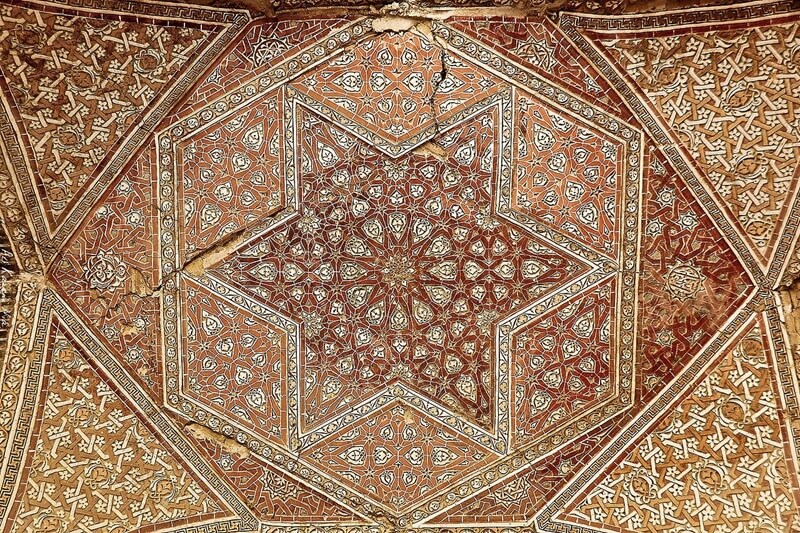
📷Photo by Ali Kazemi Nia on Wikicommons
Soltaniyeh Dome and Florence’s Duomo: An Unproven Link
One of the most fascinating debates surrounding the Dome of Soltaniyeh concerns its possible influence on Filippo Brunelleschi’s famous dome for Florence Cathedral, completed more than a century later. The similarities are striking. Both structures rise from an octagonal base, use a double-shelled dome, and employ herringbone brickwork to improve structural stability while reducing the need for extensive wooden centering during construction.
Because of these parallels, some architectural historians have suggested that engineering ideas may have traveled from Ilkhanid Iran to Renaissance Italy through diplomatic or commercial contacts. Others argue that Brunelleschi developed his solution independently, pointing out that no direct historical evidence links the two projects. While the question remains unresolved, the comparison highlights the remarkable sophistication of the engineering achieved at Soltaniyeh decades before the Renaissance transformed European architecture.
Inside the Soltaniyeh Dome
Although much of the monument’s exterior decoration has weathered over the centuries, its interior remains richly ornamented. Elegant Kufic and Thuluth calligraphy, intricate stucco decoration, and traces of blue tilework reflect the artistic achievements of the Ilkhanid period. Massive iwans, decorative brickwork, and finely carved inscriptions combine to create one of the finest surviving interiors of medieval Iranian architecture.
One of the building’s most significant spaces is the Torbat Khaneh, or “Chamber of Sacred Earth.” According to historical tradition, it once contained soil brought from Karbala, reflecting Öljaitu’s devotion to Shia Islam during the later years of his reign. Today, it remains one of the mausoleum’s most intriguing and symbolic spaces.
The Dome of Soltaniyeh’s Hidden Sundial
The architecture of the Dome of Soltaniyeh makes remarkable use of natural light. Large windows around the drum and upper levels illuminate the vast interior throughout the day, changing the atmosphere of the monument as the sun moves across the sky. Some researchers have suggested that the placement of these openings may also have helped indicate the passage of time or the timing of daily prayers, although this interpretation remains debated. Whether intentional or not, the careful relationship between light, space, and architecture is one of the building’s most distinctive features.
Soltaniyeh Dome Facts: How Large Is It, Really?
The Dome of Soltaniyeh is one of the largest brick domes ever built. It rises to approximately 50 meters (164 feet) and spans about 25.5 meters (84 feet) across the interior, making it one of the greatest engineering achievements of the medieval Islamic world.
Its true significance, however, lies beyond its size. UNESCO recognizes the monument as the earliest surviving example of a double-shelled dome in Iran, an innovative structural design that became a milestone in the development of Persian and Islamic architecture. The dome’s engineering and construction techniques later influenced monumental architecture across Central Asia and the wider Islamic world, earning Soltaniyeh a place among the most important architectural landmarks of the 14th century.
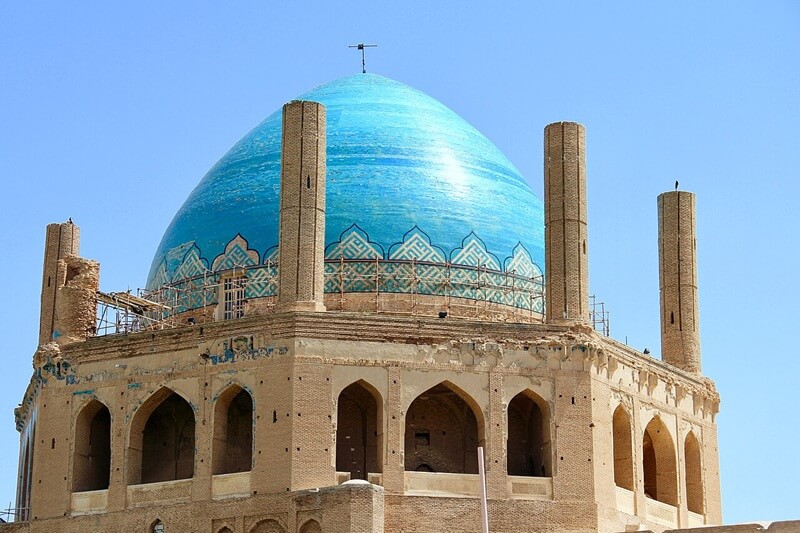
📷Photo by Milad Afshari on Wikicommons
Why the Soltaniyeh UNESCO Site Was Inscribed
Soltaniyeh was added to the Iran’s UNESCO World Heritage List in 2005, meeting three of the cultural criteria UNESCO uses to evaluate sites of outstanding universal value.
Criterion (ii) recognizes the mausoleum as an essential link in the development of Islamic architecture across central and western Asia, connecting the classical Seljuk period to the later Timurid era — a distinction owed largely to its double-shell structure and the richness of its decorative techniques.
Criterion (iii) acknowledges Soltaniyeh, as the former Ilkhanid capital, as exceptional testimony to the history of thirteenth and fourteenth-century Iran, a period defined by Mongol rule and its complex fusion with existing Persian and Islamic culture.
Criterion (iv) identifies the mausoleum as an outstanding architectural achievement of the Ilkhanid period specifically, distinguished by its structural engineering, spatial proportions, and decorative craftsmanship.
Together, these criteria frame Soltaniyeh not as an isolated curiosity but as a documented turning point — a building that both closed one architectural chapter and opened another. Full details of the inscription are available through the official UNESCO World Heritage listing.
Planning Your Visit to the Dome of Soltaniyeh
Location. The mausoleum stands in the town of Soltaniyeh, roughly 40 kilometers from the city of Zanjan and about 240 kilometers northwest of Tehran, just off the Zanjan–Qazvin road.
Getting there. Most visitors base themselves in Zanjan and travel to Soltaniyeh by car, private transfer, or shared minibus — public minivans run regularly from Honarestan Square (sometimes signposted as Janbazan Square) on the edge of Zanjan, with the trip taking under an hour. Soltaniyeh is also a natural stop for travelers moving between Tehran and Tabriz, since it sits close to the main highway connecting the two.
Opening hours. The site is open to visitors daily, though hours can shift seasonally, so it’s worth confirming locally or with your guide on the day.
Best time to visit. Spring and autumn bring the most comfortable weather for exploring the surrounding plain on foot. There’s one detail worth building a visit around if timing allows: the mausoleum’s main entrance is aligned with the sunrise on the first day of spring, a small but deliberate piece of architectural intention that rewards an early arrival around the Nowruz new year.
Time required and recommended order. Plan for one to two hours at the mausoleum itself, including time to climb to the upper galleries — the staircases are steep and narrow, so comfortable footwear matters. Afterward, the nearby khanaqah, about 500 meters south, and the tomb of the mystic Molla Hassan Kāshi make worthwhile short additions if time allows.
What to expect honestly. The Dome of Soltaniyeh has been undergoing conservation and restoration for many years, so don’t be surprised if parts of the monument are covered by scaffolding during your visit. This is part of a long-term effort to preserve one of Iran’s most important UNESCO World Heritage Sites, and the areas affected can vary over time.
Another intriguing detail is that, despite decades of archaeological research, no confirmed tomb or burial remains of Öljaitü have been identified within the mausoleum. Although the monument was built as his final resting place, exactly where he was buried—or whether his remains still rest within the complex—remains one of Soltaniyeh’s enduring historical mysteries.
Nearby. Zanjan itself offers a traditional bazaar, a small museum, and easy access to Katale Khor Cave for travelers with an extra day to spend in the province.
Final Thought: Ilkhanid Architecture’s Quiet Masterpiece
Iran’s UNESCO list is crowded with sites that announce their importance the moment you arrive — vast squares, soaring iwans, cities built to be seen. Soltaniyeh works differently. Its significance sits almost entirely in engineering choices and quiet decisions made seven centuries ago, the kind of details a visitor could easily miss without knowing to look for them. That’s exactly why it rewards the traveler willing to slow down.
This is also what makes the Ilkhanid period one of the more overlooked chapters in Persian history for most travelers — a dynasty of outside rulers who ended up shaping Iranian architecture as profoundly as any native one, precisely because they had something to prove. Soltaniyeh is where that ambition is easiest to see, standing largely alone on its plain rather than folded into a busier historical narrative.
None of this is easy to feel from a screen. The scale of the dome, the emptiness of the surrounding land, the particular quality of light through those upper windows — these are things that ask to be experienced rather than described. Soltaniyeh rarely makes it onto a first-time visitor’s itinerary, which is part of its appeal for travelers who’ve already seen Iran’s better-known sites and are looking for something quieter and more considered.
Want to Get Lost in the Glory of Soltaniyeh?
FAQs about Soltaniyeh Dome
1. What is the Dome of Soltaniyeh?
The Dome of Soltaniyeh is a fourteenth-century mausoleum built for the Ilkhanid ruler Öljaitu in Zanjan province, Iran. It is recognized as one of the world’s oldest surviving double-shelled brick domes and has been a UNESCO World Heritage Site since 2005.
2. Why is the Soltaniyeh Dome famous?
It’s famous for introducing the double-shelled dome to Iranian architecture, an engineering approach that later influenced structures across the Persianate world and, according to some scholars, may share architectural ideas with Brunelleschi’s dome in Florence. It’s also one of the few surviving remnants of the Ilkhanid dynasty’s short-lived capital.
3. When was the Dome of Soltaniyeh built?
Construction took place between roughly 1302 and 1312 CE, commissioned by the Ilkhanid ruler Öljaitu.
4. Who is buried in the Dome of Soltaniyeh?
The mausoleum was built as the tomb of Öljaitu, the eighth ruler of the Ilkhanid dynasty. Despite this, archaeological excavations have never located a confirmed grave or burial chamber beneath the structure, leaving the exact location of his remains an open historical question.
5. Is the Dome of Soltaniyeh the largest brick dome in the world?
Sources vary, but it is most commonly described as the third-largest dome in the world, after Florence’s Santa Maria del Fiore and Istanbul’s Hagia Sophia. Its measurements are consistently cited at roughly 25 meters in diameter and about 49 to 50 meters in height.
6. What UNESCO criteria does Soltaniyeh meet?
Soltaniyeh was inscribed under criteria (ii), (iii), and (iv), recognizing its role linking Seljuk and Timurid architectural traditions, its testimony to Ilkhanid-era history, and its outstanding engineering and decorative achievement.
7. How do you get to the Dome of Soltaniyeh from Zanjan?
Soltaniyeh is about 40 kilometers from Zanjan and easily reached by car, private transfer, or shared minibus from Honarestan Square, with the journey taking under an hour.
8. Is the Dome of Soltaniyeh connected to Florence’s Duomo?
Some architectural historians have noted striking structural similarities between the two domes, including their octagonal bases and double-shell construction, and have proposed that building knowledge may have traveled from Iran to Italy. This remains a debated hypothesis rather than a documented historical fact.
9. What is a double-shelled dome?
A double-shelled dome consists of two domes built one inside the other, separated by a hollow cavity and connected by an internal brick structure. This design reduces weight, improves earthquake resistance, and allows for a taller, more refined exterior profile than a single-shell dome.
10. How long does it take to visit the Dome of Soltaniyeh?
Most visitors spend one to two hours exploring the mausoleum, including the climb to its upper galleries, with additional time recommended for the nearby khanaqah and surrounding archaeological area.
11. Is the Dome of Soltaniyeh currently under restoration?
Yes. The site has undergone restoration work for a number of years, and visitors frequently encounter scaffolding within the main dome chamber. This is part of ongoing conservation rather than a sign of disrepair.
0 Comment