

Table of Contents
In the far northwest corner of Iran, where the Zagros foothills fold into the borderlands of Turkey, Armenia, and Nakhchivan, three Armenian churches have watched over the same mountain passes for well over a thousand years. The Armenian Monastic Ensembles of Iran — St Thaddeus, St Stepanos, and the Chapel of Dzordzor — were inscribed together as a single UNESCO World Heritage Site in 2008, recognized as an outstanding testimony to Armenian architectural and decorative tradition and its long exchange with Persian, Byzantine, and Orthodox cultures. Reaching them means driving for hours through high plateau and volcanic rock, past shepherds and border checkpoints, into a landscape that feels closer to the Caucasus than to the Persia most travelers imagine. What waits at the end of that drive is not a ruin behind glass, but a living corner of Christian Iran that few visitors ever see.
A Christian Heritage at the Crossroads of Empires
Armenian communities have lived in northwestern Iran for nearly two millennia, long before modern borders separated the historic Armenian world into present-day Armenia, Nakhchivan, and Iran. Positioned between the Iranian Plateau, the Caucasus, and Anatolia, this frontier became a meeting point of civilizations where Christian traditions developed alongside successive Persian empires.
Rather than being isolated monuments, the three UNESCO-listed monasteries represent centuries of cultural exchange between Armenian Christianity and the Persian world. They served not only as places of worship, but also as centers of learning, pilgrimage, manuscript production, and regional administration, preserving Armenian religious and artistic traditions through changing dynasties and political borders.
Today, the monasteries are spread across East and West Azerbaijan provinces, following historic trade and pilgrimage routes that once connected Persia with Armenia and the wider Caucasus. Although they receive far fewer visitors than Iran’s better-known UNESCO sites, that relative quiet is part of their appeal. Visiting them offers a different perspective on Iran’s history—one that reveals the country’s long-standing religious diversity and its role as a crossroads between cultures.
Each monastery also tells a distinct chapter of that shared story, making the ensemble far more rewarding than viewing any single monument in isolation.
📷Photo by Mohsenbz92 on Wikicommons
St. Thaddeus Monastery: Armenian Pilgrimage Site
The oldest and most celebrated of the three monasteries, St. Thaddeus Monastery is better known locally as Qara Kelisa, or the Black Church, named for the dark volcanic stone used in its earliest surviving sections. According to Armenian tradition, the Apostle Thaddeus (also known as Jude), one of Christ’s twelve disciples, preached Christianity in this region during the first century AD before being martyred alongside many of his converts, including the daughter of the local ruler. A church is believed to have been built over his burial site soon afterward, making it one of the world’s oldest Christian pilgrimage destinations.
As with many traditions from the earliest centuries of Christianity, the apostolic foundation belongs to ecclesiastical tradition rather than contemporary historical documentation. The oldest surviving architectural remains date to the 7th century, while much of the monastery visible today reflects major rebuilding campaigns between the 14th and 19th centuries, following repeated invasions and earthquakes.
Rather than weakening the site’s significance, those successive layers are part of what make St. Thaddeus remarkable. The monastery combines centuries of continuous religious tradition, medieval Armenian architecture, and later Persian-era reconstruction into a single living monument that has remained a place of pilgrimage for generations. Every summer, thousands of Armenian pilgrims from Iran, Armenia, and across the diaspora gather here for the annual Badarak (Divine Liturgy)—a tradition recognized by UNESCO as part of the site’s outstanding cultural value.
Destruction, Reconstruction, and a Shared History
Like much of northwestern Iran, St. Thaddeus Monastery has endured repeated invasions and earthquakes over the centuries. The most significant damage came during the Mongol campaigns of the 13th century, when large parts of the complex were destroyed.
According to Armenian and Persian historical traditions, the monastery was later rebuilt under the patronage of the Ilkhanid rulers, with the renowned Persian scholar and polymath Nasir al-Din al-Tusi playing a role in its restoration while serving at the court of Hulagu Khan. Although the extent of his personal involvement remains uncertain, the tradition reflects something important about the period: despite conquest and political upheaval, Armenia’s Christian communities continued to receive support under the Ilkhanid administration, allowing one of their most sacred monasteries to survive and flourish.
The monastery’s architecture also reveals that survival was never taken for granted. High defensive walls, watchtowers, and a fortress-like layout surround the church, reminding visitors that this was not only a place of worship but also a refuge for the surrounding community during times of conflict. Those defensive features remain one of the monastery’s defining characteristics today, giving it the appearance of a small medieval fortress rising from the surrounding plains.
Saint Stepanos Monastery: Rebuilt Through the Centuries
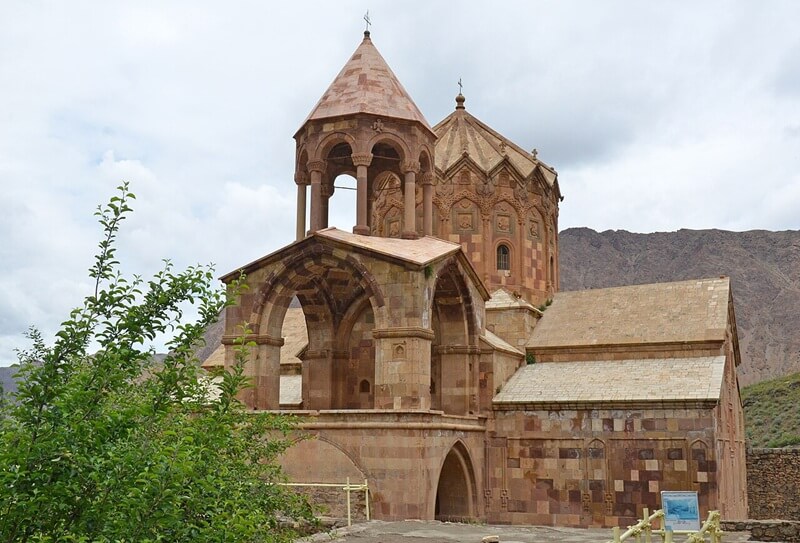
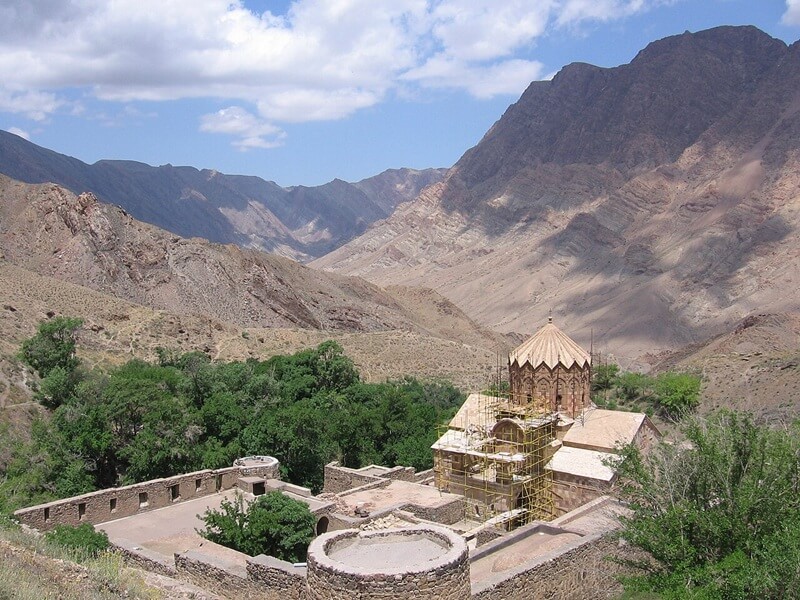
About 15 kilometers northwest of Jolfa, overlooking a wooded canyon above the Aras River, Saint Stepanos Monastery occupies one of the most dramatic settings of any religious monument in Iran. Its exact foundation date remains uncertain, although historical references place the monastery by the 9th century, and much of its architectural character reflects major construction and rebuilding between the 10th and 12th centuries.
Standing close to the historic frontier between Persia and the Caucasus, the monastery experienced repeated cycles of destruction and renewal. Earthquakes damaged the complex several times, while centuries of political change reshaped the surrounding region. Much of what visitors see today is the result of extensive restoration during the Safavid period, when the Persian state supported Armenia’s Christian communities and the monastery once again became an important religious and pilgrimage center. Further repairs followed during the Qajar era under Crown Prince Abbas Mirza, helping preserve the complex for future generations.
The architecture reflects those many layers of history. Built primarily from warm pink and cream stone, the monastery combines traditional Armenian church design with Byzantine influences and Persian decorative details, creating one of the finest surviving examples of medieval Armenian architecture outside modern Armenia. Rather than representing a single moment in history, Saint Stepanos is a monument shaped by centuries of rebuilding—each generation choosing to preserve what the previous one had left behind.
📷Photo by Zahra Bakhtari on Wikicommons
The Chapel of Dzordzor and Its Unusual Rescue
The smallest and least-visited of the three monasteries has arguably the most remarkable modern story. The 14th-century Chapel of Dzordzor once stood directly in the path of the Barun Dam reservoir on the Zangmar River. Rather than allowing it to disappear beneath the rising water, Iranian conservation specialists carefully dismantled the chapel and rebuilt it, stone by stone, on higher ground nearby—a rare example of an entire medieval monument being relocated to ensure its survival.
Moving a historic building is generally considered a last resort in heritage conservation, yet UNESCO concluded that the relocation preserved the chapel’s authenticity, allowing it to be inscribed alongside St. Thaddeus and Saint Stepanos as part of the Armenian Monastic Ensembles of Iran.
Architecturally, Dzordzor is far more modest than its two larger neighbors, but that’s part of its appeal. It offers a glimpse into the smaller rural monasteries that once served Armenia’s Christian communities across this frontier landscape.
It’s the kind of place many travelers overlook in favor of the better-known monasteries. Those who make the extra effort, however, come away with a fuller understanding of why UNESCO recognized the ensemble as a whole rather than any single monument.
Armenian Architecture Meets Persian Craftsmanship
One of the defining features of the Armenian Monastic Ensembles of Iran is that they don’t read as purely Armenian or purely Persian. Their construction techniques, decorative reliefs, and structural forms draw on Armenian, Byzantine, Orthodox, and Persian traditions, reflecting centuries of cultural exchange rather than isolated architectural development.
That blend is visible throughout the three monasteries. At St. Thaddeus, the older black volcanic stone contrasts sharply with the lighter, intricately carved additions from later rebuilding campaigns, making the site’s long architectural evolution easy to read. At Saint Stepanos, richly carved façades, geometric ornament, and stone reliefs showcase one of the finest surviving examples of medieval Armenian craftsmanship in Iran, while incorporating decorative elements shaped by the monastery’s Persian setting.
For travelers, these details tell a larger story. The monasteries are not simply Armenian buildings standing in Iran—they are the product of centuries of interaction between Armenian Christian communities and successive Persian dynasties. Their architecture could only have emerged at this cultural crossroads, where different artistic traditions met, influenced one another, and created something distinct from either alone.
Reading the Reliefs — Symbols Carved in Stone
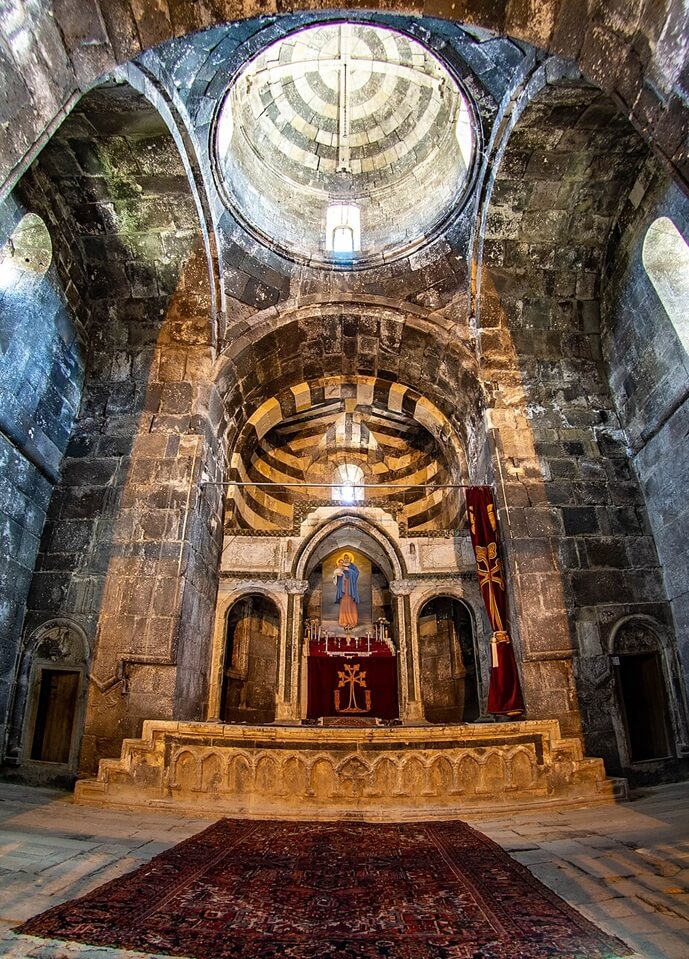
At Saint Stepanos Monastery, the exterior carvings are more than decoration—they were designed to teach. Reliefs depicting the Virgin Mary, the Nativity, the Crucifixion, and the martyrdom of Saint Stepanos allowed pilgrims to follow key moments of the Christian story long before most people could read.
Rather than viewing each carving in isolation, take a slow walk around the church and read them as a sequence. What first appears to be ornamental stonework becomes a visual narrative, revealing how medieval monasteries used architecture not only to inspire worship but also to communicate faith.
📷Photo by Shervin Afshar on Wikicommons
Why UNESCO Listed the Armenian Monastic Ensembles
The Armenian Monastic Ensembles of Iran were inscribed on the UNESCO World Heritage List in 2008 under three cultural criteria, each worth understanding in plain terms rather than as bureaucratic shorthand.
Criterion (ii) recognizes a significant interchange of human values across a span of time or within a cultural area, reflected in developments in architecture or technology, monumental arts, town planning, or landscape design. Here, that means the visible blending of Armenian, Byzantine, Orthodox, and Persian building traditions in one place — physical proof of centuries of cultural dialogue rather than isolated development.
Criterion (iii) recognizes a unique or at least exceptional testimony to a cultural tradition or civilization, whether living or vanished. The ensemble stands as the last well-preserved regional remnant of a broader Armenian cultural sphere that once extended further into what is now Nakhchivan, much of which has since been lost or destroyed.
Criterion (vi) recognizes direct or tangible association with events, living traditions, ideas, or beliefs of outstanding universal significance. In practice, that’s the ongoing pilgrimage tradition tied to St Thaddeus — a living devotional practice, not a historical footnote.
For the full nomination details and official documentation, the UNESCO World Heritage Centre maintains the complete listing for the site.
What Else to See Near the Armenian Monastic Ensembles
Because the three sites are spread across a wide stretch of Iranian Azerbaijan, most visits naturally combine them with other regional attractions rather than treating them as a single isolated stop.
Near St Thaddeus, in the Maku and Chaldiran area: the Maku Basalt Columns are a striking natural rock formation worth a short detour for anyone interested in geology, and the Chaldiran Plains carry their own historical weight as the site of the pivotal 1514 battle between the Ottoman and Safavid empires. Travelers continuing north toward the Turkish frontier will also pass through Bazargan, Iran’s principal land border crossing in this direction.
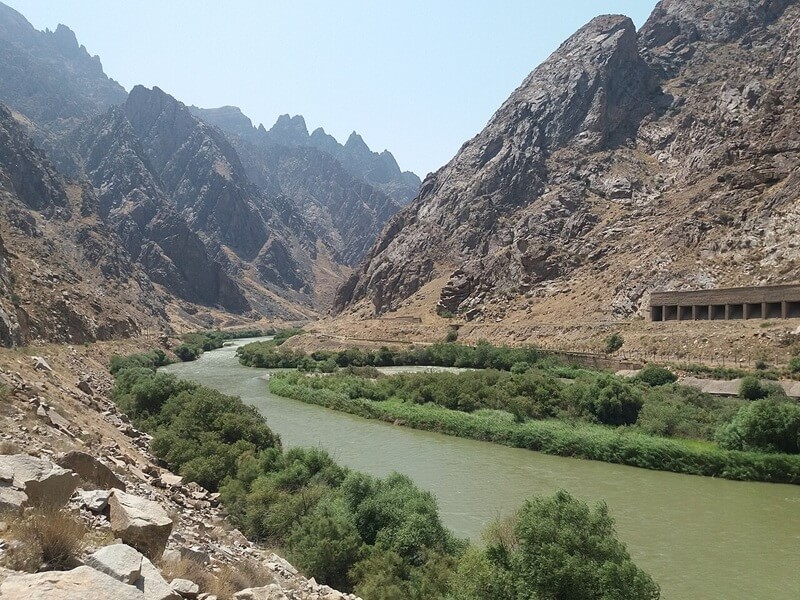
Near Saint Stepanos, in the Jolfa area: the Aras River valley forms a scenic natural border with Nakhchivan and rewards a slow walk along its banks, particularly for birdwatchers during migration season. Just outside Jolfa, the Safavid-era Khajehnazar Caravanserai is an easy add-on for travelers interested in the region’s trade history, and the smaller, lesser-known Chupan Chapel sits a short drive from the monastery for those willing to go slightly further off the main route.
The practical regional anchor for all three sites is Tabriz, one of the handful of major cities most Iran itineraries build around. Most itineraries use the city as a base, whether arriving by air, by the Tabriz–Jolfa train line, or by road. Travelers building a longer northwestern Iran itinerary often pair a visit here with time to explore Tabriz highlights — its centuries-old bazaar is a UNESCO site in its own right, covered in depth in our guide to the Tabriz Historic Bazaar’s Silk Road legacy — or with a stop in the stone-and-earth village architecture of Kandovan nearby.
Visiting St Thaddeus, St Stepanos, and Dzordzor
The three UNESCO sites are spread across East and West Azerbaijan provinces, so visiting all of them requires some planning. St. Thaddeus Monastery (Qara Kelisa) lies about 20 kilometers southwest of Chaldiran and around 1 to 1.5 hours from Maku, in West Azerbaijan Province. Saint Stepanos Monastery sits about 16 kilometers northwest of Jolfa in East Azerbaijan Province and is most easily reached by road from Tabriz or Jolfa, although a train to Jolfa followed by a short taxi ride is also possible. The Chapel of Dzordzor, near Maku, is much closer to St. Thaddeus than to Saint Stepanos, making it an easy addition for travelers exploring the western part of the UNESCO ensemble.
Are These Still Active Churches?
Yes. All three remain consecrated Armenian Apostolic churches, although their religious activity differs. St. Thaddeus Monastery is by far the most active. Each year, during the annual pilgrimage in late July (the first week of Mordad in the Iranian calendar), thousands of Armenian Christians from Iran and abroad gather to commemorate the martyrdom traditionally associated with Saint Thaddeus. The pilgrimage is recognized by UNESCO as part of the region’s living cultural heritage, and local Muslim communities have long played a role in welcoming pilgrims.
Saint Stepanos Monastery and the Chapel of Dzordzor also host religious ceremonies on important feast days, but for most of the year all three sites primarily welcome visitors as historic monuments rather than places with regular weekly services.
📷Photo by Yann Forget on Wikicommons
Best Time to Visit
Spring (April–May) and early autumn (September–October) generally offer the most comfortable weather, with mild temperatures and clear skies. Summer remains a good time to visit, especially since the higher elevation keeps temperatures noticeably cooler than much of Iran, although the stone buildings can feel surprisingly chilly inside. Winters bring snow and occasionally difficult road conditions, particularly around St. Thaddeus.
If you visit during the late-July pilgrimage, expect much larger crowds at St. Thaddeus, along with the rare opportunity to experience the monastery as a living place of worship. Travelers seeking quieter conditions should avoid that week.
Getting There
The three monasteries are spread across East and West Azerbaijan provinces, and public transportation between them is very limited. Long-distance buses serve cities such as Tabriz, Maku, and Jolfa, but reaching the monasteries almost always requires a private car, taxi, or organized tour. Renting a vehicle or arranging a driver in advance is the most practical option, especially if you plan to visit more than one site.
Practical Information
As active religious sites, modest clothing is expected. Visitors should keep shoulders and knees covered and behave respectfully inside the churches.
Tickets are usually purchased at the entrance, and individual visitors do not need advance reservations. Visitor facilities are relatively basic, reflecting the monasteries’ remote mountain setting rather than a lack of conservation.
Because the monasteries lie close to Iran’s borders with Armenia, Azerbaijan (Nakhchivan), and Turkey, it’s also worth making sure your travel documents are in order before your trip.
Final Thought: Living Thread Between Two Faiths
What stays with most visitors to the Armenian Monastic Ensembles isn’t just the isolation of the setting or the age of the stone — it’s the realization that these three churches were never meant to be relics. They were built, destroyed, rebuilt, relocated, and rebuilt again by people who kept deciding, generation after generation, that this particular thread of Armenian Christian life in Persia was worth preserving. A Mongol invasion couldn’t end it. An earthquake couldn’t end it. Even a dam couldn’t end it — the builders simply moved the chapel out of the water’s path and kept going.
That persistence is really the story of Iran’s Armenian community as a whole: a minority faith that has coexisted, argued, borrowed from, and been protected by the Persian world around it for well over a thousand years, leaving behind architecture that could only have been created at exactly this crossroads. Visiting all three sites, rather than just the most famous one, is what turns a scenic drive through the mountains into an actual understanding of that history.
For travelers piecing together a broader picture of the country’s heritage, this ensemble fits naturally alongside the rest of Iran’s UNESCO-listed sites — our guide to Iran’s World Heritage collection is a useful starting point for planning which others to prioritize.
Northwestern Iran rarely makes it onto a first-time visitor’s itinerary, and that’s exactly its appeal — remote roads, working churches, and a story most travelers never hear.
If Iran’s Armenian heritage sites are on your list, Jolfa is the easiest place to start.
FAQs about Armenian Monastic Ensembles of Iran
1. What are the Armenian Monastic Ensembles of Iran?
The Armenian Monastic Ensembles of Iran are three historic Armenian Christian sites in northwestern Iran — St. Thaddeus Monastery, Saint Stepanos Monastery, and the Chapel of Dzordzor — inscribed together as a single UNESCO World Heritage Site in 2008. Together, they showcase centuries of Armenian architectural tradition and its exchange with Persian and Byzantine artistic influences.
2. Is St. Thaddeus Monastery the same as Qara Kelisa?
Yes. Qara Kelisa, meaning Black Church, is the local name for St. Thaddeus Monastery, referring to the dark volcanic stone used in its oldest sections. Both names describe the same monastery near Chaldiran in West Azerbaijan Province.
3. How old is St. Thaddeus Monastery?
The monastery’s oldest surviving sections date to the 7th century, although Armenian tradition traces the site’s origins to a 1st-century chapel built over the grave of the apostle Thaddeus. Much of the present structure was rebuilt between the 14th and 19th centuries following invasions and earthquakes.
4. Why did UNESCO list these three sites together?
UNESCO inscribed the monasteries as a single World Heritage Site because, together, they represent a continuous testimony to the history, architecture, and religious traditions of the Armenian community in the region. The ensemble was recognized under criteria (ii), (iii), and (vi) for cultural interchange, exceptional testimony to a living tradition, and its religious significance.
5. Can non-Christian travelers visit these sites?
Yes. All three monasteries welcome visitors regardless of their faith. Since they remain active Armenian Apostolic churches, modest dress covering the shoulders and knees is expected, and visitors should behave respectfully while exploring the sites.
6. What is the annual pilgrimage at Qara Kelisa?
Each year in late July (typically during the first week of Mordad in the Iranian calendar), thousands of Armenian Christians from Iran and abroad gather at St. Thaddeus Monastery for a pilgrimage commemorating the martyrdom traditionally associated with Saint Thaddeus. Local Muslim communities have long welcomed pilgrims during the event, making it one of the region’s best-known examples of interfaith hospitality.
7. How do you get to St. Thaddeus Monastery from Tabriz or Urmia?
There is no direct public bus route to the monastery. Most travelers hire a private driver or join a guided tour from Tabriz or Urmia. Long-distance buses reach nearby towns such as Maku and Chaldiran, from where taxis can complete the final stretch.
8. Is Saint Stepanos Monastery open to tourists?
Yes. The monastery is generally open to visitors, with tickets purchased on arrival. It stands about 16 kilometers northwest of Jolfa in East Azerbaijan Province and is easiest to reach by road, although travelers can also take the Tabriz–Jolfa train and continue by taxi.
9. What happened to the Chapel of Dzordzor?
The 14th-century chapel originally stood in the path of a dam project on the Zangmar River. To save it from flooding, it was carefully dismantled and rebuilt stone by stone at a nearby location. UNESCO considers the relocation a successful conservation effort that preserved the chapel’s authenticity.
10. What should visitors wear?
Modest clothing is expected at all three monasteries, with shoulders and knees covered for all visitors. It’s also worth bringing a light jacket, as mountain temperatures—especially around St. Thaddeus—can feel surprisingly cool, even in summer.
11. How much time do you need to visit all three monasteries?
It’s possible to visit all three in a long day from Tabriz, but the schedule is tight. Allowing two days, with an overnight stay in Maku or Jolfa, gives you enough time to explore each monastery without rushing.
12. Are the Armenian Monastic Ensembles safe to visit?
Yes. The monasteries are located in a generally stable part of northwestern Iran. The main challenge is their remote location and limited public transportation rather than personal safety. For broader travel advice, see our guide to travel safety in Iran.
13. Which Armenian monasteries in Iran are UNESCO World Heritage Sites?
Three monasteries are included in the UNESCO inscription: St. Thaddeus Monastery (Qara Kelisa), Saint Stepanos Monastery, and the Chapel of Dzordzor. Together they form the Armenian Monastic Ensembles of Iran, recognized in 2008 for their outstanding architectural, historical, and religious significance.
0 Comment