

Table of Contents
The Tabriz Historic Bazaar Complex does not announce itself the way a palace or a mosque does. It does not demand your gaze from across a square. It pulls you inward — corridor by corridor, turning by turning, the sound of hammered copper somewhere ahead — until you are fully inside it, inside its logic and its rhythm, and the world outside has receded entirely.
In 1271 CE, a young Venetian merchant named Marco Polo passed through Tabriz on his journey east. He wrote of a city where merchants came from India, Mosul, Baghdad, and Hormuz to conduct their business; where Latin merchants from across Europe arrived regularly; where the bazaar itself was “one of the finest in the world.” He was the first foreign visitor to write it down. He was not the last to be struck by it.
The Tabriz Historic Bazaar Complex is one of the oldest bazaars in the Middle East and the largest covered bazaar in the world. It covers approximately 7 square kilometres, contains around 5,500 commercial units across 40 trade categories, and holds within its brick structure 35 caravanserais, 25 domed trading halls (timchehs), 30 mosques, and 12 schools. In July 2010, it was inscribed as a UNESCO World Heritage Site — the first bazaar complex in the world ever to receive that recognition.
Tabriz and the Silk Road
Before you can understand the Tabriz Bazaar, you need to understand where Tabriz sits.
Tabriz lies in the northwest of Iran, in the province of East Azerbaijan, at the intersection of the two great axes of premodern Eurasian commerce. The east-west axis connected China and Central Asia to the markets of Anatolia and the Mediterranean. The north-south axis connected the Caucasus, Russia, and the Black Sea ports to the Persian Gulf and the Indian Ocean trade routes. Tabriz sits at the precise crossing point of these two corridors — a geographic position that made the emergence of a great market here not a matter of ambition but of inevitability.
Tabriz has been a place of cultural exchange since antiquity, and its historic bazaar complex is one of the most important commercial centres on the Silk Road. A bazaar has existed on this site since the early periods of Islamic urbanism in Iran. By the 13th century, it was already famous enough for Marco Polo to record it, and for Ibn Battuta to visit a century later, and for the Venetian diplomat Ambrogio Contarini to describe it admiringly in 1474, and for the French traveller Jean Chardin to write about it at length in the 17th century. That chain of witnesses spanning four centuries tells you something essential:
This was not a local market that occasionally attracted foreign traders. It was a fixture on the global commercial map.
The Ilkhanid Golden Era
The bazaar’s true historical zenith came during the Ilkhanid period, when the Mongol rulers of Iran made Tabriz their imperial capital in the 13th and 14th centuries. Under Hulagu Khan and his successors, Tabriz grew into one of the largest cities in the world. Foreign merchants from Venice, Genoa, China, India, and across the Islamic world maintained permanent trading posts and residential quarters in the city. The bazaar became not merely a marketplace but a cosmopolitan institution — a place where the goods, languages, religions, and artistic traditions of the known world met and exchanged.
This is the period that UNESCO’s inscription most directly recognizes: the bazaar as a point of civilizational encounter, where East and West traded not only goods but ideas, techniques, and cultural forms.
The great Ilkhanid workshops of Tabriz produced illustrated manuscripts, metalwork, and textiles that combined Persian, Mongol, and Chinese visual languages — and the bazaar was the commercial infrastructure that supported and distributed all of it.
The Safavid Capital Years
Tabriz and its bazaar were at their most prosperous in the 16th century, when the town became the capital city of Safavid Iran. When Shah Ismail I declared himself Shah in Tabriz in 1501 and made the city the first Safavid capital, the bazaar expanded and formalized. New caravanserais were built. Trade corridors were reorganized. The commercial relationship with Ottoman Anatolia to the west — sometimes hostile, sometimes pragmatic — gave the bazaar its particular character as a frontier market, where the boundary between empires was negotiated as much through commerce as through warfare.
When Shah Abbas I moved the Safavid capital to Isfahan in 1598, Tabriz did not cease to matter. It remained the empire’s northwestern commercial gateway — the point where goods entering from the Ottoman west, the Caucasus north, and the Russian territories beyond were processed and distributed into the Persian interior. At the height of this role, an estimated 30% of Iran’s total trade passed through the Tabriz Bazaar. That proportion of a national economy flowing through a single commercial complex is a figure with no parallel in Iranian history.
The 1780 Earthquake and the Qajar Reconstruction
An important honesty about what you see when you visit the Tabriz Bazaar today: the physical fabric you walk through is largely not Silk Road-era or Safavid-era in its current form. A catastrophic earthquake in 1780 destroyed much of Tabriz, and the bazaar was extensively rebuilt during the Qajar dynasty in the 18th and 19th centuries. The urban skeleton — the street plan, the spatial organization, the relationships between different sections — follows a much older logic. But the domes, the brick vaults, the caravanserai facades, and the great timches that give the complex its visual character are predominantly Qajar constructions.
This matters not as a diminishment but as a context. UNESCO inscribed a Qajar-era physical fabric that sits on a Silk Road-era spatial structure — and found in that combination an outstanding example of commercial urban heritage whose significance spans both periods. What survived the earthquakes, the fires, the political upheavals, and the eventual displacement of Tabriz from the center of Iranian trade is not simply a building. It is a pattern — a way of organizing commercial life — that proved durable enough to be rebuilt, every time, in essentially the same form.
📷Photo by Mohadeseh N.de on Wikicommons
Architecture: How to Read a Bazaar
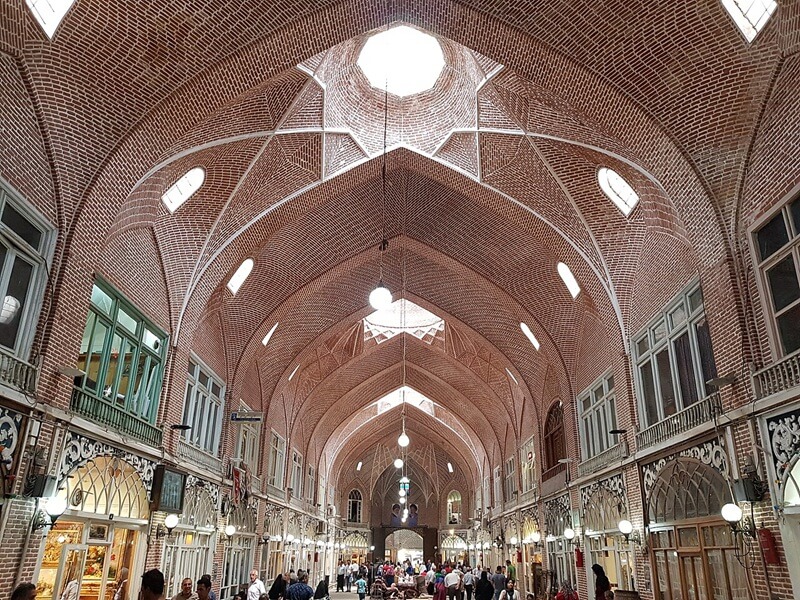
The Tabriz Historic Bazaar Complex confuses first-time visitors in a particular way. From a satellite image it looks like a district — a dense urban quarter of irregular blocks and covered passages that sprawls across the historic center of the city. From the inside it feels like a building — a continuous, covered, climate-controlled environment with its own internal logic of corridors, halls, and courtyards.
UNESCO’s criterion iv recognized Tabriz Historic Bazaar as an outstanding example of an integrated multi-functional urban complex in which interconnected architectural structures and spaces have been shaped by commercial activities and related necessities. The key word is integrated. The bazaar is neither a city district nor a single building in the conventional sense — it is something that Persian urbanism developed over centuries as its own distinct typology, and Tabriz is the largest and most complete surviving example of it.
To navigate it, it helps to know its vocabulary.
The Rasteh — the Artery
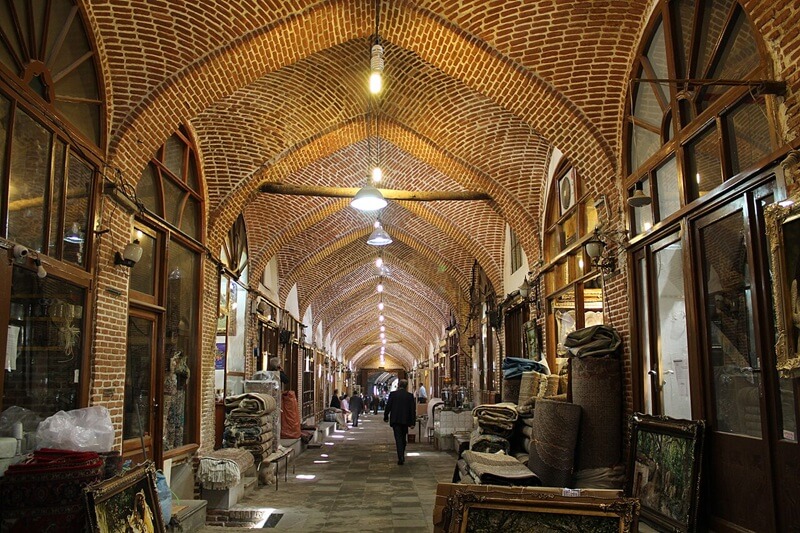
A rasteh is a covered corridor, typically vaulted in brick, where shops of the same trade line both sides of a continuous passage. The guild organization of labour is made physically legible here: the shoemakers’ rasteh, the coppersmiths’ rasteh, the fabric merchants’ rasteh — each community of practice occupying its own spatial lane, where the sound and smell of the craft announces the section before you arrive at it. The main rastehs of the Tabriz Bazaar are its arterial streets, connecting the perimeter entrances to the central timchehs and caravanserais.
The Timcheh — the Jewel
A timcheh is a domed trading hall, typically two storys, with a brick dome overhead pierced by skylights, and galleries running around the upper level. Timchhes were built for high-value goods that required display space, natural light, and a degree of calm: carpets, jewelery, fine textiles. The bazaar contains 22 impressive timchehs — domed halls and covered passageways with shops — and they range in scale from intimate single-dome spaces to multi-bay halls of considerable architectural ambition.
The Serai and Caravanserai — the Node
A serai (or caravanserai) is a courtyard compound providing lodging, storage, and transaction space for long-distance merchants. The bazaar contains more than 20 caravanserais — sets of rooms arranged around a courtyard. Many are now converted to clusters of modern shops while retaining their original courtyard structure; walking into one unexpectedly, through an unmarked doorway from a busy rasteh, is one of the bazaar’s most rewarding discoveries.
📷Photo by Alireza Abbasiyan on Wikicommons
The Chahar Suq — the Crossroads
Where two rastehs intersect, the covered corridor opens upward into a dome or a raised vault — the chahar suq (four-market crossing). These intersections are the most architecturally complex points in the bazaar, where the structural challenge of covering a crossroads in brick was resolved with particular ingenuity. They also function as orientation points: the light quality changes at each crossing, and experienced visitors navigate by them.
Passive Climate Engineering
One of the most quietly remarkable qualities of the bazaar is the temperature. Step inside from a summer street in Tabriz and the difference is immediate — the thick brick walls, the vaulted ceilings that trap cool air, and the strategic placement of openings that allow convection without direct sunlight create a naturally conditioned environment of considerable effectiveness. This was not incidental. Persian bazaar builders understood the physics of brick mass and vault geometry well enough to engineer comfort into the structure itself — a pre-modern climate solution whose intelligence becomes more apparent the more you understand how it was achieved.
Tour guides often point out the impressive brickwork, domed ceilings, and the ingenious design that offers ventilation and cool air circulation, making it a comfortable place for trade during the hot summer months.
Three Floors of Commerce
Most stores and houses in the bazaar have three floors: the lower floor is for warehouses, the second floor is for businesses and workplaces, and the third floor is designed as a resting area. This vertical organization of commercial life — storage below, transaction in the middle, hospitality and rest above — is a spatial logic that repeats across the entire complex, giving the bazaar a consistent internal language even as its individual sections vary enormously in character.
In 2013, the Tabriz Bazaar Renovation Project was selected as one of five finalists for the Aga Khan Architecture Award — an international recognition of the quality of conservation work being carried out on the complex, and a mark of architectural significance that places it in the same conversation as the most important heritage projects in the Islamic world.
Section by Section: The Essential Spaces
Timcheh Mozaffariyeh — the Carpet Hall
If the bazaar has a heart, this is it.
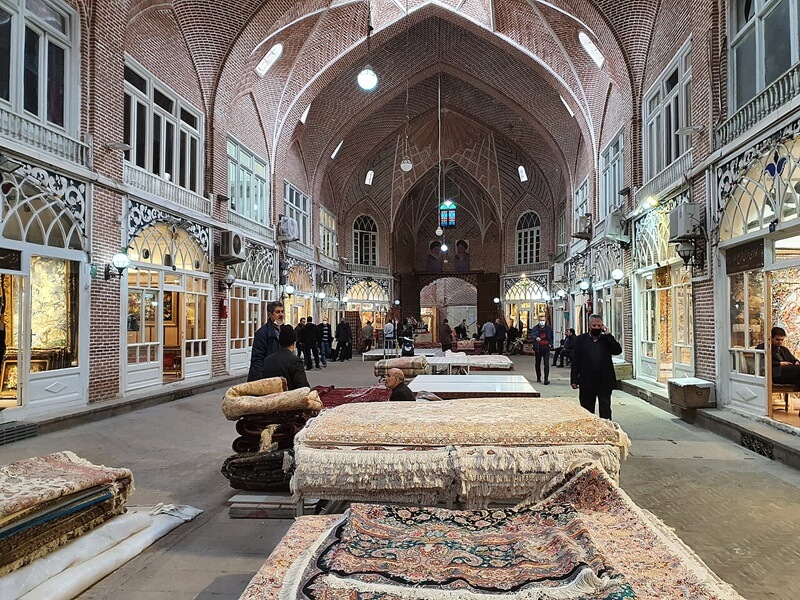
Timcheh Mozaffariyeh is arguably the most famous and exquisite section of the Tabriz Grand Bazaar — the center of Iran’s world-renowned carpet trade. Built in 1888 during the late Qajar period, its origin story is one of the bazaar’s most charming. The merchant Haj Sheikh Jafar Qazvini constructed the hall at his own expense. When Crown Prince Mozaffar ad-Din Mirza visited and was so visibly moved by its beauty that he could not stop admiring it, Qazvini — understanding the moment with the instincts of a master merchant — dedicated the entire hall to the Prince. It was named Mozaffariyeh in his honour, and Qazvini retained his privileges within it. Commerce and courtly grace, performed simultaneously.
The hall has two floors, 26 shops on each level, a brick dome rising nine meters overhead, and colored skylight glass that filters the daylight into shifting patterns across the carpet surfaces below. The first floor holds handwoven carpet sellers; the second floor is occupied by carpet restorers, designers, and fiber specialists. The earthy, slightly lanolin-warm smell of wool and natural dye fills the space. The atmosphere, as one visitor described it, is quiet and majestic — the antithesis of a market in any ordinary sense.
This is where traders and collectors from around the world come to acquire authentic Persian carpets. Tabriz carpets are among the most technically precise handwoven carpets produced anywhere — characterised by high knot density, medallion compositions, and a palette that includes the deep reds, navies, and ivories for which the Tabriz school is internationally recognised.
Timcheh Amir — the Gold Hall
The largest dome in the entire bazaar complex covers the Timcheh Amir — the gold and jewelry quarter. The scale of the dome overhead contrasts strikingly with the intimacy of the jewelry displayed in the shops below. Built during the Qajar period, it remains the most active precious metal trading hall in northwest Iran.
Rasteh Misgarha — the Coppersmiths’ Alley
You hear the coppersmiths before you see them. The ringing of hammers on copper — a sound that has filled this section of the bazaar for centuries — announces the rasteh before you turn the corner into it. Trays, samovars, jugs, decorative panels, and household vessels are being made and sold simultaneously, in workshops that open directly onto the corridor. This is the bazaar at its most viscerally alive — craft as both production and performance, conducted in public, in the same physical space where it has always been conducted.
Bazaar-e Kolahdozan — the Hatmakers’ Quarter
Traditional Azerbaijani woollen hat workshops occupy this section, producing and selling the distinctive felt hats that have been made in Tabriz for as long as anyone has written about the city. It is one of the most tangible examples of living craft tradition in the entire complex — a trade that has survived not as a heritage performance but as a functioning commercial practice with a genuine local market.
📷Photo by Yeowatzup on Wikicommons
The Spice Market
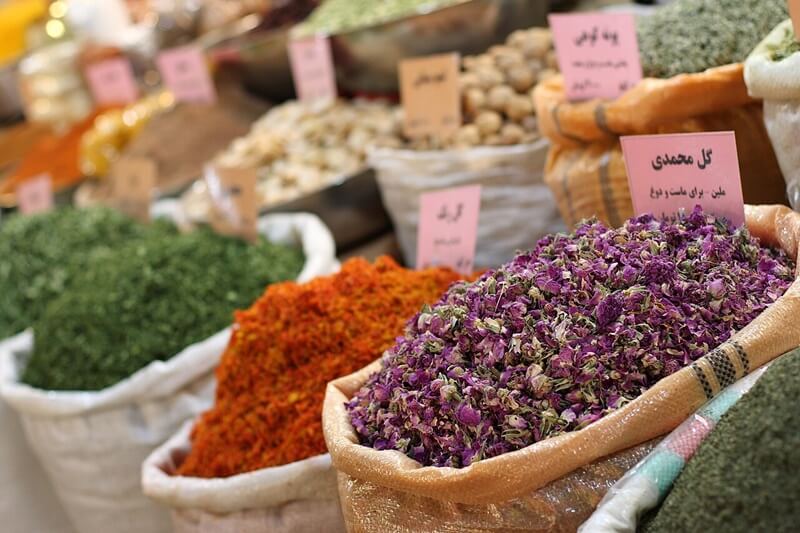
The spice section is the sensory peak of the bazaar for most first-time visitors. Saffron in quantities that make even seasoned travelers pause — Tabriz has been a node in the saffron trade between Iran and the markets of the Middle East and Europe since medieval times. Dried herbs, sumac, barberries, rosebuds, and a rotating selection of medicinal plants are arranged in open sacks and low wooden bins, their colors and fragrances creating the kind of concentrated sensory experience that stays in the memory long after the visual details have blurred.
The Jame Mosque
At the western edge of the bazaar, connected to it by a covered corridor, stands the Jame Mosque of Tabriz — the congregational mosque whose spatial relationship with the market makes visible one of the organizing principles of the traditional Islamic city: the mosque and the market as inseparable institutions, the sacred and the commercial sharing not merely a neighborhood but a building fabric. The mosque remains in active use. Its presence inside the bazaar complex is a reminder that the 12 schools also embedded within these walls were never incidental — they were part of the same urban logic, the same understanding that commerce, faith, and education belong together in one place.
The Teahouses
No exploration of the Tabriz Bazaar is complete without time in one of its teahouses. Dim, unhurried, and packed with local merchants who have been conducting business over tea in these spaces for generations, they offer something no other part of the bazaar provides: the experience of its social life rather than its commercial life. Order a glass of strong black tea with a sugar cube. Watch the room. The deals being made here are being made the same way they have been made for centuries — through relationship, patience, and the accumulated trust of long acquaintance.
Tabriz Bazaar: Trade and Revolution
There is a dimension of the Tabriz Bazaar that no architectural description adequately captures: its role as one of the most consequential political institutions in Iranian history.
The merchants of the Tabriz Bazaar have never been merely traders. Closely interwoven with the architectural fabric is the social and professional organisation of the bazaar, which has allowed it to function over the centuries and has made it into a single integrated entity. That social organisation had political weight. The bazaari merchant class — controlling, at its peak, nearly a third of Iran’s total commercial activity — wielded economic power that translated directly into political leverage whenever it chose to exercise it.
The Tobacco Boycott of 1891
In 1891, the Qajar Shah granted a monopoly on all tobacco production and sales in Iran to a British company. The decision directly threatened the livelihoods of bazaar merchants across the country — but in Tabriz, the response was immediate and coordinated. The unity of the bazaar with the clergy and intellectuals forced the Shah to cancel the concession — at great cost to himself — and encouraged a belief among Persian reformers that change might be possible.
It was one of the first times in modern Iranian history that a popular economic protest had successfully reversed a royal decision. The bazaar’s closure — the withdrawal of commerce as a political act — proved a more effective instrument than any military opposition could have been. The lesson was not forgotten.
The Constitutional Revolution (1905–1911)
Tabriz was the beating heart of the Constitutional Revolution — the movement that forced the Qajar Shah to accept Iran’s first constitution and parliament in 1906 and transformed the country’s political landscape permanently.
The coalition that drove the revolution was precisely described by scholar Reza Aslan: it required the educated middle class, the clergy, and “most crucially, the business class — the merchant class — the bazaari merchants.” The revolutionaries argued that Iran’s economy was being destroyed by foreign concessions and tax breaks on imports that undermined the domestic market the bazaar depended on, and that the Shah was selling the country’s assets to pay the interest on foreign debt.
The bazaar’s closure was the revolution’s most powerful lever. When the merchants of Tabriz shut their shops, the city’s commercial life stopped entirely — and with it, the tax revenues and trade flows that the Qajar state depended on. The bazaar did not simply participate in the revolution. It funded it, organised it, and provided it with its most effective instrument of pressure.
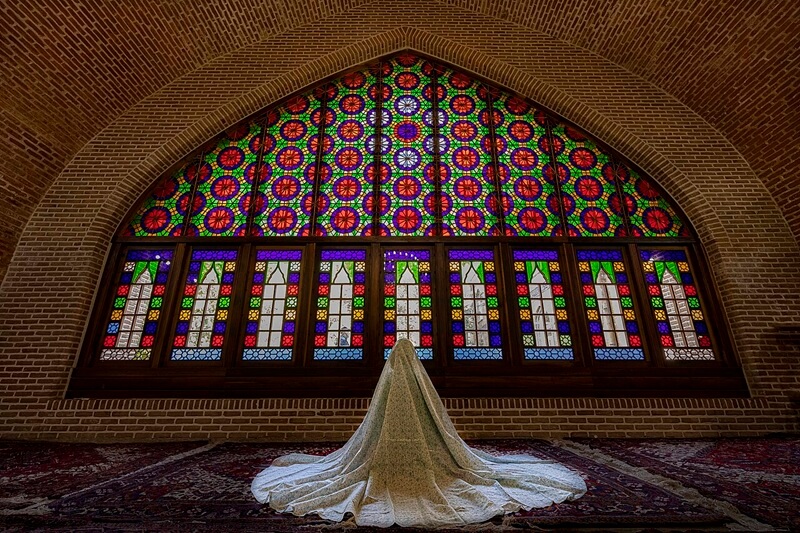
The 12 schools embedded in the bazaar complex were not incidental to this political capacity. They were its infrastructure. A merchant class that controlled its own educational institutions could reproduce itself culturally and intellectually across generations, and that continuity of identity and purpose is what gave the bazaari class its particular political durability.
📷Photo by Mahdieshaghi58 on Wikicommons
Survival Through the Centuries
Tabriz sits in one of the most seismically active zones in Iran. Catastrophic earthquakes struck the city in 858, 1042, 1721, and 1780 — the last of these essentially levelling much of the urban fabric and triggering the Qajar reconstruction that shaped the bazaar’s current appearance. Each time, the city and its market were rebuilt on the same footprint, by the same community, serving the same commercial functions.
The Tabriz Historic Bazaar Complex has faced several earthquakes, floods, and fire accidents throughout its history, but has survived each time and still serves as the most important commercial part of the city. Periodic flooding from the Mehranrood River, which runs along the southern edge of the complex, has added to the structural challenges the bazaar has faced across its history.
In 2024, a significant fire broke out in the bazaar, damaging approximately 150 shops and injuring several people. The fire was contained and the affected sections were subsequently closed for repair — a reminder that “living heritage” is not merely a poetic description but a statement about ongoing vulnerability. A structure that is still in daily commercial use faces risks that a monument preserved behind glass does not. The bazaar’s continued operation is both its greatest strength, as UNESCO recognised, and its most pressing conservation challenge.
What the pattern of destruction and reconstruction reveals is something important about the relationship between the bazaar and the people of Tabriz. The building has been rebuilt because the community could not imagine the city without it. That is a different kind of heritage significance from the kind that attaches to a monument — it is the significance of a structure that people need, not merely admire.
UNESCO World Heritage Status: The First Bazaar in the World
The Tabriz Historic Bazaar was inscribed as a World Heritage Site by UNESCO in July 2010. Its inscription carries a significance beyond the recognition of the bazaar itself: it was the first bazaar complex ever to be added to the UNESCO World Heritage List.
Before 2010, UNESCO’s recognition criteria had implicitly favored monuments — palaces, temples, religious complexes, city walls — over living commercial spaces. The Tabriz inscription marked a meaningful shift: an acknowledgement that a functioning marketplace, still doing what it was built to do, could embody outstanding universal value in ways that a preserved-but-inactive monument could not.
UNESCO recognised the bazaar under two specific criteria:
Criterion (ii): Tabriz Historic Bazaar Complex has been one of the most important international places for commercial and cultural interchange, thanks to the centuries-old east-west trading connections and routes. The bazaar was a node of civilizational encounter — where the goods, ideas, and artistic traditions of China, Central Asia, Persia, the Arab world, and Europe met, exchanged, and influenced one another across centuries.
Criterion (iv): Tabriz Historic Bazaar is an outstanding example of an integrated multi-functional urban complex in which interconnected architectural structures and spaces have been shaped by commercial activities and related necessities. A large number of specialized buildings and structures are concentrated and reciprocally connected in a relatively compact area to form what is almost a single integrated structure.
The integrity of the 18th century Tabriz Bazaar is well preserved and its architecture conserves a rich repertoire of commercial buildings; the connection between the physical structure and its functioning is still clearly legible, and in many cases alive.
The bazaar had been under national protection since 1975 — 35 years before its UNESCO inscription — with a formal management framework integrating conservation objectives with urban planning instruments for the wider city. That sustained institutional commitment to its preservation was part of what made the UNESCO case compelling.
For the official UNESCO listing, visit whc.unesco.org/en/list/1346.
Tabriz Historic Bazaar: Practical Visitor Guide
The bazaar occupies the historic centre of Tabriz, bounded roughly by the Jame Mosque to the west, the Aali Qapu gateway to the east, and the Mehranrood River to the south. There are multiple entry points from the surrounding streets, but the most meaningful entrance is through the main Qeysariyeh Gate on the northern face — the historic grand entrance whose tiled portal sets the appropriate tone before you step inside.
A Recommended Route
Enter through the main gate and follow the central rasteh southward. Allow yourself to be drawn toward the Timcheh Mozaffariyeh — follow the signs, or simply follow anyone carrying a rolled carpet. Spend real time in the carpet hall: look at the domed ceiling, understand the two-floor structure, engage with the traders if you are considering a purchase. Continue from there to the gold quarter (Timcheh Amir), where the scale of the dome overhead is the main event. Find the coppersmiths’ section by ear — turn toward the ringing. End in one of the teahouses near the Jame Mosque, where the pace of the bazaar becomes clear in a different way.
Opening Hours
The bazaar is generally open Saturday through Thursday, from approximately 10 AM to 5 PM. It is closed on Fridays.
One important detail for travellers that almost no guide mentions: the bazaar also closes for 5 days during Muharram, the Islamic month of mourning. During this period, the Timcheh Mozaffariyeh becomes the main center of mourning gatherings for the city, most shops close, and the commercial functions of the complex are set aside entirely. If your visit coincides with Muharram, expect a very different experience from the one described in any standard travel guide — and plan accordingly.
Practical Details
Time required: A minimum of two hours for a highlights circuit. Half a day for a thorough exploration. A full day for anyone intending to look seriously at carpets, engage with individual craftspeople, or simply allow the bazaar’s logic to become familiar.
Getting lost: Download an offline map before you enter — the bazaar’s labyrinthine quality is genuine and GPS signal inside the covered sections is unreliable. That said, getting lost is not a problem to be avoided. Some of the most interesting sections of the complex are found by accident, through doorways that do not announce themselves.
What to buy: Tabriz carpets are the obvious answer — and the correct one. If you are considering a carpet purchase anywhere in Iran, buying in Tabriz, where the craft originates and where the full range of quality and price is represented, is the logical place to do it. Beyond carpets: saffron in the spice section (available in superior quality and at lower prices than almost anywhere else), hand-hammered copperwork, traditional Azerbaijani textiles, and dried fruits and nuts of the region.
Dress code: As with all public spaces in Iran, modest dress is appropriate. There is no specific dress code enforced for the bazaar beyond general social convention.
Nearby: The Blue Mosque (Masjed-e Kabud), one of the finest examples of Timurid-influenced tilework in Iran, is a short walk from the bazaar’s western edge. The Tabriz Citadel (Arg-e Tabriz), a massive 14th-century brick structure, is visible from the bazaar’s northern perimeter. El Gölü Park and the Tabriz Museum of History are both within easy walking distance.
Final Thought: Tabriz Bazaar, Where the Silk Road Lives
There is a particular kind of place that does not feel historical so much as continuous—where the past is not preserved behind glass but is simply still happening, in the sounds, scents, and everyday exchanges of daily life.
The Tabriz Historic Bazaar Complex is one of those rare places.
The carpet trader in Timcheh Mozaffariyeh continues a tradition that stretches back to the merchants of the Silk Road. The coppersmith’s hammer still echoes through vaulted corridors that have survived Ilkhanid rulers, Safavid shahs, Qajar princes, earthquakes, fires, and revolutions. Here, commerce has always been built on trust, relationships, and generations of shared experience.
When UNESCO inscribed the Tabriz Bazaar in 2010, it recognized more than an extraordinary market. It honored a living system of trade, culture, faith, and community that has endured for over a thousand years. The Silk Road was never just a road—it was a network of people. In Tabriz, beneath its magnificent brick vaults, that network is still alive.
To truly appreciate the stories hidden behind every caravanserai, workshop, and marketplace, exploring Tabriz with a knowledgeable local guide makes all the difference. At Compassimo, we can arrange guided experiences that bring the bazaar’s history to life, whether as part of one of our carefully designed Tabriz tours or a fully tailor-made itinerary created around your interests.
Ready to experience the living Silk Road for yourself? Explore our Tabriz tours or get in touch to start planning your own personalized journey through one of Iran’s most fascinating cities.
Ready to experience the living Silk Road for yourself?
Let’s Turn Your Visit into an Unforgettable Journey
FAQs about Tabriz Historic Bazaar Complex
1. Is the Tabriz Bazaar the largest covered bazaar in the world?
By most measures, yes — though the claim deserves a degree of care. The Tabriz Historic Bazaar Complex covers approximately 7 square kilometers of covered and semi-covered commercial space, making it the largest covered brick bazaar in the world and one of the largest roofed commercial complexes anywhere. The Grand Bazaar of Istanbul is sometimes cited as a competing claimant, though it is significantly smaller by area. UNESCO’s inscription refers to it as one of the most complete examples of a traditional commercial and cultural system in Iran, rather than making a specific size ranking.
2. Why is the Tabriz Historic Bazaar Complex a UNESCO World Heritage Site?
UNESCO inscribed the bazaar in July 2010 under two criteria: as an outstanding example of cultural interchange on the Silk Road (Criterion ii), and as an outstanding integrated multi-functional urban complex whose architecture and commercial functions have remained continuously legible across centuries (Criterion iv). It was the first bazaar complex ever to be inscribed on the World Heritage List — a recognition that living commercial heritage can embody outstanding universal value as powerfully as any monument.
3. Did Marco Polo visit the Tabriz Bazaar?
Marco Polo passed through Tabriz in 1271 CE and wrote about its bazaar, describing merchants arriving from India, Baghdad, Mosul, Hormuz, and across the Latin Christian world. His account is the most famous in a long series of foreign traveller testimonies that also includes Ibn Battuta (c. 1330), Ambrogio Contarini (1474), and Jean Chardin (17th century). Whether Polo visited the precise site of the current bazaar complex is impossible to verify, given that the present physical fabric dates largely to the Qajar period after the 1780 earthquake — but the commercial centre he described occupied the same urban location.
4. What is a timcheh in the Tabriz Bazaar?
A timcheh is a domed trading hall within the bazaar complex, typically two storys in height, with a brick dome overhead and gallery-level shops running around the upper floor. Timchehs were designed for high-value goods requiring display space and natural light. The Tabriz Bazaar contains 25 timchehs, ranging from intimate single-dome spaces to the monumental Timcheh Mozaffariyeh. Each timcheh is associated with a specific trade category.
5. What is the Timcheh Mozaffariyeh?
The Timcheh Mozaffariyeh is the most celebrated section of the Tabriz Bazaar — a two-story domed carpet trading hall built in 1888, named after Crown Prince Mozaffar ad-Din Mirza of the Qajar dynasty. It is the most important single carpet trading hall in Iran, where collectors and traders from across the world come to buy handwoven Persian carpets. Its nine-meter brick dome, colored skylight glass, and the quality of light it creates make it an architectural experience as much as a commercial one.
6. How old is the Tabriz Bazaar?
A bazaar has existed on this site since the early periods of Islamic urbanism in Iran — certainly since the early centuries of the Islamic era, and possibly building on pre-Islamic commercial foundations. The bazaar is mentioned in historical sources from the 10th century onward. However, the physical fabric that visitors experience today dates primarily to the Qajar dynasty reconstruction following the 1780 earthquake. The urban skeleton is ancient; the visible architecture is predominantly 18th and 19th century.
7. What can you buy at the Tabriz Bazaar?
Handwoven carpets and rugs (the bazaar is one of the world’s finest places to buy a Tabriz carpet), saffron and spices, copper and silverwork, traditional Azerbaijani textiles and felt hats, leather goods, dried fruits and nuts, and a wide range of everyday goods serving the local market. The bazaar is a functioning commercial centre serving the people of Tabriz as much as its visitors — which means much of what is sold is practical rather than touristic, and the authenticity of that is part of its appeal.
8. What is the best time to visit the Tabriz Bazaar?
Weekday mornings between 10 AM and 1 PM offer the most active trading atmosphere and the best light in the carpet hall. Spring (April to June) and autumn (September to October) offer the most comfortable temperatures for extended exploration. Avoid the first ten days of Muharram, when most of the bazaar closes for mourning ceremonies.
0 Comment