


Visa rules and travel advisories change frequently — always verify with official sources before booking.
Table of Contents
For most European citizens, travelling to Iran remains more accessible than the headlines suggest. If you hold a passport from an EU member state, the EEA, Switzerland, or most other European countries, you can usually apply for an Iranian e-Visa or obtain a visa on arrival—and, unlike travellers from the United States, United Kingdom, or Canada, you do not need a pre-arranged guided tour to explore the country independently.
“More accessible” does not mean effortless. Iran’s visa rules have shifted repeatedly in recent years, and entry requirements can change with little public notice. Before booking flights, confirm the rules that apply to your specific nationality through Iran’s official e-Visa portal or a licensed Iranian tour operator.
The most reliable route, however, is not simply filling in the form yourself. For most European travelers, applying through a local licensed Iranian tour operator is the best option. A licensed operator reviews the file before it reaches the Ministry of Foreign Affairs, corrects common errors, follows up on delays, and can usually obtain a Visa Grant Notice faster than a direct application through the MFA website. Direct applications are free, but they commonly take longer and carry a higher risk of rejection.
Important current-status warning: Iran’s entry policy for foreign visitors can change quickly, particularly during periods of regional tension. At times, visa-eligible nationalities—including Europeans—have been required to travel with a licensed guide and a pre-approved itinerary; those restrictions were later lifted for most European nationals. Before booking flights, confirm the requirements for your nationality through a licensed Iranian tour operator, the official MFA e-Visa portal, or your airline.
In short: most European citizens need a visa for mainland Iran. The safest sequence is to apply through a licensed local tour operator, receive a Visa Grant Notice before flying, and use visa on arrival only as a fallback where your nationality and airline clearly permit it.
Do European Citizens Need a Visa for Iran?
Yes—most European citizens need a visa to enter mainland Iran. Iran maintains visa-waiver arrangements with a limited set of countries, but these are nationality-specific and should never be assumed to cover every European passport. The official e-Visa portal identifies certain nationalities as subject to visa-waiver rules, while most other eligible travelers must obtain a visa.
For the majority of EU, EEA, and Swiss citizens, the practical choice is between:
- A licensed Iranian tour operator: the recommended route for most travelers, because the operator checks documents, submits through an established channel, and follows up with the authorities.
- The official MFA e-Visa portal: free and official, but often slower and more vulnerable to rejection caused by mismatched details, non-compliant photographs, or incomplete itineraries.
- Visa on arrival: a contingency option for eligible nationalities, not the preferred plan.
- An embassy or consulate visa: appropriate where an applicant is ineligible for e-Visa or VOA, or prefers to collect a visa before departure.
A crucial distinction: British citizens are not treated as ordinary European travelers. The United Kingdom is grouped with the United States and Canada among nationalities subject to more restrictive Iranian visa procedures, including arranging travel through an authorized tour operator. UK passport holders should follow a separate process.
Best Route: Apply via a Local Tour Operator
For European citizens who want the least stressful and most predictable process, a local licensed Iranian tour operator is the first recommendation. This does not mean you must join a guided tour; it means using an authorized Iranian agency to prepare and submit your visa file.
A licensed operator can:
- Check that your name, passport number, photo, itinerary, and accommodation details match the application exactly.
- Identify problems before submission—such as an unsuitable photo, unclear accommodation, or an itinerary that may raise questions.
- Submit through an established channel and follow up directly with the Ministry of Foreign Affairs.
- Help correct and resubmit an application if further documents or clarifications are requested.
- Usually obtain a Visa Grant Notice more quickly than a direct self-application.
Recent agency guidance commonly describes direct MFA applications as taking anywhere from two to eight weeks, while applications handled by licensed operators are often processed in roughly three to seven business days, depending on nationality, season, and workload. These figures are indicative rather than guaranteed, but they explain why the operator route is generally preferred by travelers with fixed flights or limited time.
The most common reasons for rejection are avoidable: mismatched personal information, non-compliant photographs, incomplete travel plans, or accommodation that is not a registered hotel or guesthouse. A licensed operator’s principal value is catching these issues before the file reaches the Ministry.
Compassimo’s Iran visa support follows this operator-first approach: eligibility is checked, documents are reviewed, and the application is submitted with a Visa Grant Notice as the goal.
MFA Application: Official but Slower and Riskier
It is possible to apply directly through Iran’s official Ministry of Foreign Affairs e-Visa portal. For some travelers with flexible dates, straightforward circumstances, and time to spare, this can work. But it should not be treated as the default best option.
Direct applications have three practical disadvantages:
- Longer processing times. Published agency guidance commonly cites two to eight weeks for direct applications, with limited ability to expedite a file once submitted.
- Higher rejection risk. There is no specialist reviewing the file before submission, so small inconsistencies—a name format, photograph, accommodation entry, or itinerary gap—can lead to rejection.
- Less support after a problem arises. If the application is refused or delayed, an independent applicant generally has to identify and resolve the issue alone; a licensed agency may be able to clarify the issue and reapply.
If you do apply directly, submit well in advance, use exactly the same personal details as your passport, provide a clear itinerary with registered accommodation, and retain copies of every document. Even then, obtaining a Visa Grant Notice before flying remains the safer objective.
Iran VOA: Possible but Not Recommended
Iran Visa on arrival, or VOA, is available at selected Iranian international airports for many European nationalities. Commonly cited entry points include Tehran Imam Khomeini International Airport, Tehran Mehrabad Airport, Isfahan, Shiraz, Mashhad, Tabriz, Kish, Qeshm, Kerman, Bandar Abbas, and Orumiyeh. Availability and procedure should still be confirmed for your specific airport, airline, and nationality.
VOA is best understood as a risky fallback, not a reliable entry strategy:
- Airlines may refuse boarding. Some carriers require proof of a pre-approved visa or Visa Grant Notice before allowing passengers to fly to Iran.
- Border approval is not guaranteed. Iranian border officials retain the right to refuse entry, and a refusal on arrival can mean being sent back on the next available flight.
- Airport processing can be slow. Walk-up processing is commonly described as taking two to six hours, depending on queues and documentation checks.
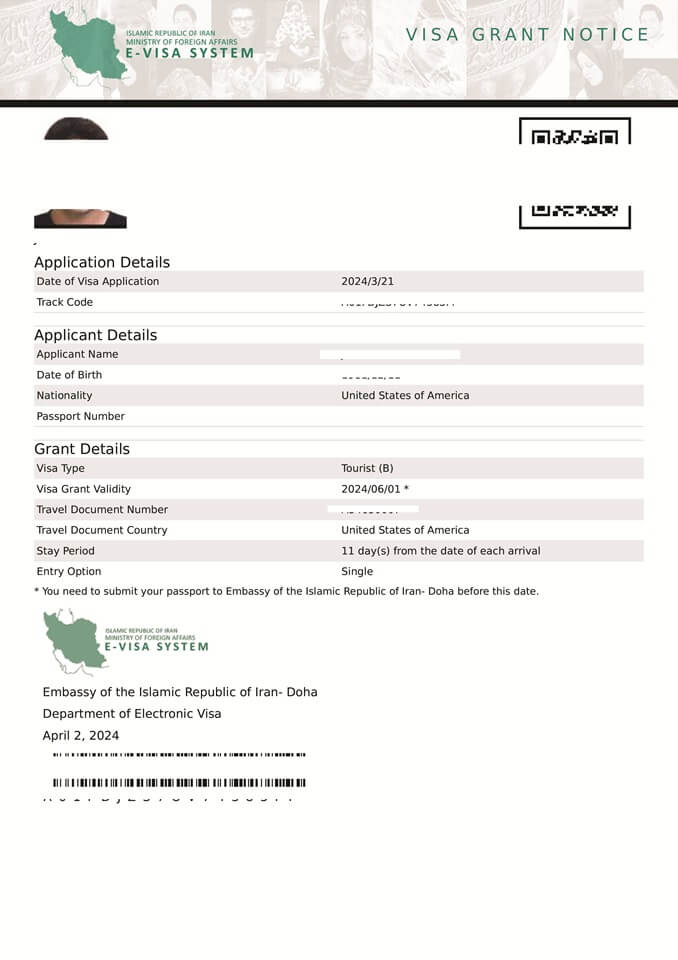
- A printed Grant Notice is required for the pre-approved VOA route. The official MFA visa-on-arrival page states that applicants must submit a hard copy of the Grant Notice at the airport counter.
For these reasons, travelers should not arrive in Iran expecting to sort out the visa at the counter. Even travelers who are eligible for VOA should first obtain a Visa Grant Notice through a licensed operator or the official portal, print it, and carry it to the airport.
Nationalities Excluded from VOA
Iran excludes a number of nationalities from visa on arrival, including Afghanistan, Bangladesh, Canada, Colombia, Jordan, Pakistan, Somalia, the United Kingdom, and the United States. Published lists can vary and change, so European travelers—especially dual nationals—should verify their exact passport nationality before relying on VOA.
How to Apply Through a Licensed Tour Operator
This route is particularly sensible for travelers with non-refundable flights, tight schedules, complex itineraries, or previous visa refusals. It also reduces the chance of discovering an avoidable documentation problem after arrival at the airport. The general Iran visa application process is as below:
- Contact a licensed Iranian operator early, ideally four to six weeks before departure.
- Confirm eligibility for your exact passport nationality, including any dual-national complications.
- Send clear copies of your passport and a compliant photograph, plus filling out the visa application form.
- Provide a realistic itinerary, including arrival airport, cities, dates, and registered accommodation.
- Let the operator review and submit the file to the Ministry of Foreign Affairs.
- Receive the Visa Grant Notice, print it, and carry the hard copy when flying.
- Arrange travel insurance that explicitly covers Iran.
- Collect the visa at the airport or embassy, according to the instructions attached to your Grant Notice.
Iran Visa for EU Citizens: Requirements Checklist
Whether you apply through a licensed operator or directly through the MFA portal, Iran visa requirements for Europeans are:
- A passport valid for at least six months beyond your planned stay.
- A recent colour passport-style photograph that meets Iranian specifications.
- A clear scan of the passport biographical page.
- Travel insurance that explicitly covers Iran.
- A plausible itinerary, including cities and registered accommodation.
- A Letter of Invitation only if staying with an Iranian host, subject to current accommodation rules.
- A printed Visa Grant Notice before departure, even if you are eligible for visa on arrival.
Travel insurance is the requirement most often underestimated. Many standard European policies exclude Iran, so travellers should obtain a policy that names Iran as covered rather than assuming their existing cover applies.
Independent Travel: What Europeans Can Do
For most European citizens, Iran’s visa system permits independent travel: no mandatory guide, no fixed escorted itinerary, and no requirement to remain with a tour group. This is a meaningful difference from the rules applied to US, UK, and Canadian passport holders.
Using a licensed operator for the visa does not remove that independence. Once the Visa Grant Notice is secured, most European travelers can move freely through the country, choose their own hotels, and adjust their route as they go.
Independent travel still requires compliance with local rules:
- Stay in registered hotels, guesthouses, or traditional houses.
- Keep accommodation details available for immigration or police procedures.
- Carry printed and digital copies of the Visa Grant Notice, passport, insurance, and itinerary.
- Avoid assuming that a friend’s home or unregistered short-term rental is an acceptable substitute for registered accommodation.
For travelers planning the wider journey after the visa is secured, Compassimo’s guide to planning a visit to Iran is a useful next step for routes, timing, and regional logistics.
Visa Extensions and Length of Stay
A standard Iranian tourist visa is commonly issued for 30 days and is single entry. Eligible travelers may usually extend their stay twice, potentially reaching a total of 90 days in Iran.
Extensions are handled inside Iran through the Immigration and Passport Police, often called the Police Department for Foreign Nationals or Aliens Affairs. They are not arranged through an embassy before travel. Travelers should apply before their current visa expires—commonly in the final days of validity—and should not assume that every office offers the same processing experience.
If a longer journey is part of your plan, build extension time into your itinerary. Major Iranian cities such as Tehran, Isfahan, Shiraz, Yazd, Mashhad, and Kerman are more practical places to handle the process than smaller towns.
Practical Travel Tips for European Visitors
- Use a licensed Iranian tour operator first. It is the most reliable way to reduce delays, documentation errors, and avoidable rejections.
- Do not depend on visa on arrival. Even eligible travelers should hold a printed Visa Grant Notice before flying.
- Apply early. Begin the process several weeks before departure, particularly around Nowruz or during periods of regional tension.
- Buy Iran-specific travel insurance. Confirm in writing that Iran is covered, including medical treatment and repatriation.
- Carry documentation. Keep your passport, printed Visa Grant Notice, insurance policy, accommodation confirmations, and itinerary accessible during travel.
- Check dual-national implications. Travelers with more than one passport should apply using the nationality they intend to enter Iran with and should seek advice if one of their nationalities is subject to restrictions.
- Respect local rules. Dress codes, photography restrictions, alcohol prohibitions, and gender-segregated spaces can differ substantially from European norms.
For travelers who prefer a guided introduction to the country, Compassimo’s pre-planned Iran tours can be combined with visa assistance, while independent travelers can still use the agency route solely for visa support.
Final Thoughts: A Grant Notice Before the Blue Tiles
For most European citizens, the practical path to Iran is clear: apply through a licensed local tour operator, secure a Visa Grant Notice before departure, arrange insurance that covers Iran, book registered accommodation, and avoid treating visa on arrival as a guaranteed entry route. The direct MFA portal remains an official alternative, but its longer timelines and higher exposure to rejection make it better suited to travelers with flexible dates than to those with flights already booked.
What the visa formality cannot convey is the country waiting beyond it: Isfahan’s tiled courtyards at dusk, the silence of the desert outside Yazd, the layered bazaars of Tabriz, and the everyday hospitality that often becomes the lasting memory of a journey. The visa is the administrative threshold; Iran itself is the reason to cross it.
Ready to Move From Paperwork to Planning?
.
FAQs for Iran Visa for European Citizens
1. What is the best way for European citizens to get an Iran visa?
The best route for most European citizens is to apply through a local licensed Iranian tour operator. The operator reviews documents, submits the file through an established channel, follows up on delays, and helps secure a Visa Grant Notice before departure.
2. Can I apply directly through Iran’s MFA e-Visa website?
Yes. The MFA portal is official, but direct applications commonly take longer—often cited at two to eight weeks—and may be rejected because of small errors that no one reviews before submission. It is best suited to travellers with flexible dates.
3. Is visa on arrival a good option for Europeans?
It can be an option for eligible nationalities, but it is risky. Airlines may deny boarding without prior visa approval, border officials may refuse entry, and airport processing can take several hours. A pre-approved Visa Grant Notice is much safer.
4. Do European citizens need a visa to visit Iran?
Yes. Most European citizens need a visa for mainland Iran, either through a licensed operator, the official e-Visa portal, visa on arrival where eligible, or an embassy/consulate application. Visa-waiver arrangements are limited and nationality-specific.
5. Can EU citizens get an Iran visa on arrival?
Many EU citizens are eligible for visa on arrival at designated Iranian international airports, including Tehran, Isfahan, Shiraz, Mashhad, and Tabriz. However, eligibility is nationality-specific and airlines may require evidence of a pre-approved Visa Grant Notice before boarding.
6. How much does an Iran visa cost for European citizens?
Government visa fees vary by nationality and are set by Iranian authorities. A licensed operator may also charge a service fee for document review, submission, and follow-up. Check the current total during the application process.
7. How long does an Iran visa take to process for Europeans?
Direct MFA applications are commonly described as taking two to eight weeks, while licensed-operator applications are often processed in roughly three to seven business days. Actual timing depends on nationality, season, and current workload.
8. Do Europeans need a guide to travel in Iran?
Currently, most European citizens do not need a mandatory guide and can travel independently. UK, US, and Canadian citizens are subject to different, more restrictive procedures.
9. Is the UK citizens’ visa process the same as the EU process?
No. British citizens are grouped with US and Canadian citizens under Iran’s restricted-visa arrangements and generally need to arrange their visit through an authorized tour operator.
10. Can I extend my Iran tourist visa as a European traveler?
Yes. A standard 30-day tourist visa can usually be extended twice, allowing a total stay of up to 90 days. Extensions are handled in person through Iran’s Immigration and Passport Police.
11. What documents do I need for an Iran visa application?
You will normally need a valid passport, a recent passport-style photo, a passport scan, travel insurance covering Iran, and itinerary or registered-accommodation details. A printed Visa Grant Notice should also be carried before departure.
12. Can I stay with friends or family in Iran instead of a hotel?
Generally, foreign visitors should stay in registered accommodation. Private or unregistered stays can create complications, regardless of whether a traveler is otherwise permitted to travel independently.
13. Does Iran require travel insurance for European visitors?
Yes. Travel insurance covering Iran is a standard visa requirement. Many ordinary European policies exclude Iran, so travelers should secure a policy that explicitly includes the country.
0 Comment