



Table of Contents
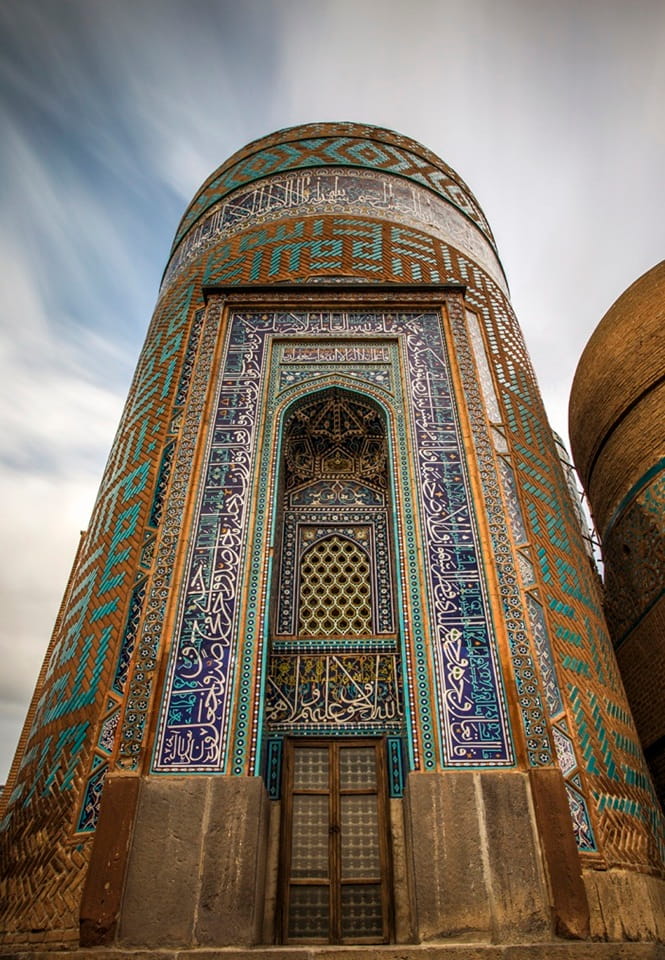
Step inside on a clear morning and the first thing you notice is the cold. Ardabil sits on a high plateau, about 1,500 meters above sea level, with the snow line of Mount Sabalan on the horizon, and the air has that thin, bright edge you only get at altitude. Then the courtyard opens. A brick tower rises ahead, its blue-glazed bricks laid in diagonals that repeat a single word, Allah, until the whole surface seems to hum.
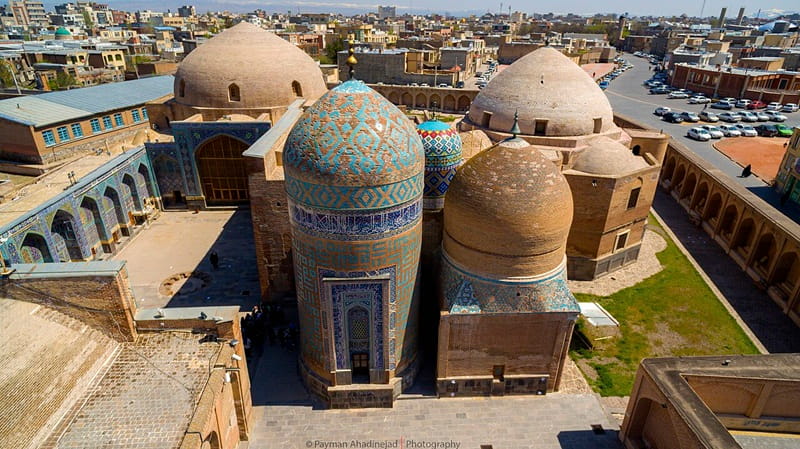
The Sheikh Safi al-Din Shrine is Ardabil’s essential sight: a UNESCO-listed Sufi lodge and Safavid dynastic shrine known for the Allah-Allah tomb tower, Shah Ismail I’s mausoleum, the Chini-khaneh porcelain hall, the Jannatsara and its connection with the Ardabil Carpets. UNESCO inscribed the ensemble in 2010 under criteria (i), (ii) and (iv).
There is no parade ground here, and no throne room. What you find instead is a place built for slow arrival: gardens, thresholds, and a path that asks you to pause at each step. It is also where the story of modern Iran quietly begins, because the dynasty that took power in 1501 grew out of this lodge, among dervishes, Qur’an reciters and the cooks and bakers who fed the pilgrims.
Sheikh Safi al-Din Shrine: Essential UNESCO Site
The Sheikh Safi al-Din Shrine is the reason many travelers make the journey to Ardabil. It is not simply a beautiful building or a dignified tomb. It is a place where Sufi devotion, dynastic politics, courtly art and Iranian identity meet in one carefully composed ensemble.
UNESCO describes the site as a “miniature city” — a working religious complex that brought together a library, school, kitchens, bakery, cistern, hospital and offices, all arranged to guide the visitor toward the sheikh’s tomb. The architecture serves an idea: you do not enter the holiest space directly. You move through gardens and courts, each one narrower and more intimate than the last, until the tomb tower finally comes into view.
For travelers used to the imperial scale of Naqsh-e Jahan Square in Isfahan or the ornate Qajar rooms of Golestan Palace in Tehran, Ardabil offers something different. It shows how a spiritual movement became the foundation of a state, and how a family lodge turned into the symbolic center of the Safavid dynasty.
If you are planning a heritage-focused trip, Ardabil belongs on any serious itinerary of Iran’s UNESCO World Heritage Sites. It adds a northern, Sufi-inflected dimension to the more familiar Achaemenid, Seljuk and Safavid monuments of the central plateau.
📷Photo by Peyman Ahadinejad on Wikicommons
Sheikh Safi al-Din: The Sufi Behind a Dynasty
Sheikh Safi al-Din Ardabili was a Sufi master whose order emerged in Ardabil around 1300. The Safavids began as this mystical movement, centered on the founder’s hometown and burial place, long before they became Iran’s ruling dynasty.
Safi is usually dated to about 1252–1334. After studying with Sheikh Zahed Gilani in Gilan, he succeeded him and developed the Safaviyya order in Ardabil — a spiritual network that later acquired political and military force. He was known for hospitality and humility; one of his titles, Khalil-e Ajam, compared him to Abraham, the model host in Iranian tradition.
Sunni Roots, Later Recasting
The site is more complicated than the familiar shorthand of “a Shia Safavid shrine.” The early Safaviyya appears to have held Sunni convictions, while its later descendants moved toward Shiism as the order’s social and political base changed. Modern historians, including those cited by Britannica, treat the later claim that Safi was a Shia sayyid descended from the Prophet’s family as a dynastic construction rather than an early fact.
That distinction matters on the ground. Visitors are walking through a medieval Sufi institution later enlarged, reinterpreted and endowed by the rulers who transformed Twelver Shiism into the state religion of Safavid Iran.
From Spiritual Order to Imperial House
Over the next century and a half, the Safavi order grew far beyond Ardabil. By the late 1400s its leaders were military commanders as well as spiritual guides. Sultan Haydar, a descendant of Safi, died in battle in 1488. His young son, Ismail, returned to Ardabil in 1499–1500, challenged the ruling Aq Qoyunlu, and by 1501 held Tabriz and proclaimed himself shah. He made Twelver Shiism the state religion, and with that decision, the Sunni lodge of Ardabil became the dynastic shrine of a Shia empire.
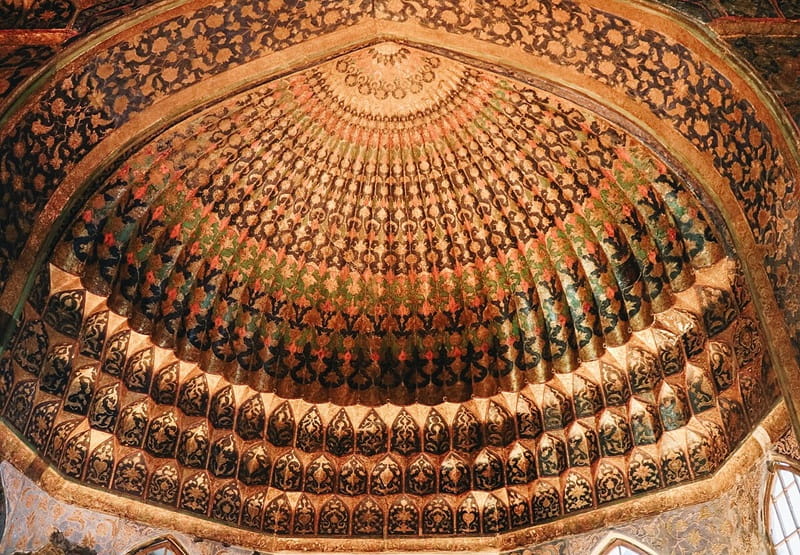
Shah Ismail I’s tomb stands beside the tower of the ancestor whose name his dynasty carried. According to the art historian Kishwar Rizvi, his mausoleum was commissioned by his wife, Tajlu Khanum. For the next two centuries, shahs treated Ardabil as a place to ask for legitimacy, and the shrine’s endowments grew accordingly.
📷Photo by Ghazal Kohandel on Wikicommons
Walking the Shrine: Courtyards, Tiles and Tombs
UNESCO describes the ensemble as an outstanding expression of Sufi principles, with its component spaces organized to make arrival gradual rather than immediate. Its route is traditionally understood through seven segments and eight gates, reflecting spiritual stages and attitudes in Sufi thought. The key experience is not simply seeing a tomb; it is moving through a carefully measured sequence of courtyards, halls and thresholds before reaching it.
The Approach: Gardens, Courts and Thresholds
A caveat worth knowing: the sequence you walk today is not exactly the original one. The damaged monumental gate that the German scholar Friedrich Sarre saw in 1897 was demolished in 1942, and the main entrance is now a 1926 building with shops and offices, followed by a walled garden court, a paved soffa court and then the main courtyard. UNESCO notes that the Iranian authorities have taken steps to restore the original access.
Even with this altered approach, the design principle remains readable. You do not enter the holiest space directly. You move through gardens and courts, each one narrower and more intimate than the last, until the tomb tower finally comes into view.
Allah-Allah Tower: Brick and Invocation
The tomb tower of Sheikh Safi is the ensemble’s visual center. It is a cylindrical brick shaft on a polygonal stone base, topped by a slightly bulbous dome and standing about 17 meters high. Diagonal bands of blue-glazed brick on a red background repeat the word “Allah,” which is why it is often called the Allah-Allah dome. Above them runs an inscription band of polychrome tile mosaic.
The tower has been restored many times, particularly in 1949, so treat the surface as a layered record rather than an untouched medieval skin. Inside are the grave covers of Sheikh Safi, his son Sadr al-Din Musa, his great-grandson Ibrahim (d. 1447) and Sultan Haydar (d. 1488). Next to it stands the domed mausoleum of Shah Ismail I.
The tower’s ornament is also a continuous act of dhikr — remembrance through repeated divine names. In that sense, the architecture itself becomes a form of devotion, not merely a container for a tomb.
📷Photo by Fatemeh Mohammadi Azar on Wikicommons
Dar al-Huffaz and Jannatsara: Ritual and Recitation
Around the main courtyard, three other buildings explain how the lodge functioned. The Jannatsara, an octagonal hall built around 1540, was most probably designed for dervish rituals; its large dome collapsed in the early 17th century. The Dar al-Huffaz, also called Qandil-khaneh, was a hall where reciters read the Qur’an at the sheikh’s tomb, with a tiled façade and silver-covered doors from the age of Abbas. The Haram-khaneh next door is often described as a burial place for Safavid women. In fact, an inscription names it as the resting place of Muhiyy al-Din Muhammad, Safi’s eldest son, who died in 1324.
Beyond the courtyards lies the Shahidgah, a cemetery where excavations in 1971 uncovered graves from the 13th or 14th century. The remains of the shrine’s bath were discovered in 2006.
Chini-khaneh: A Porcelain Chamber
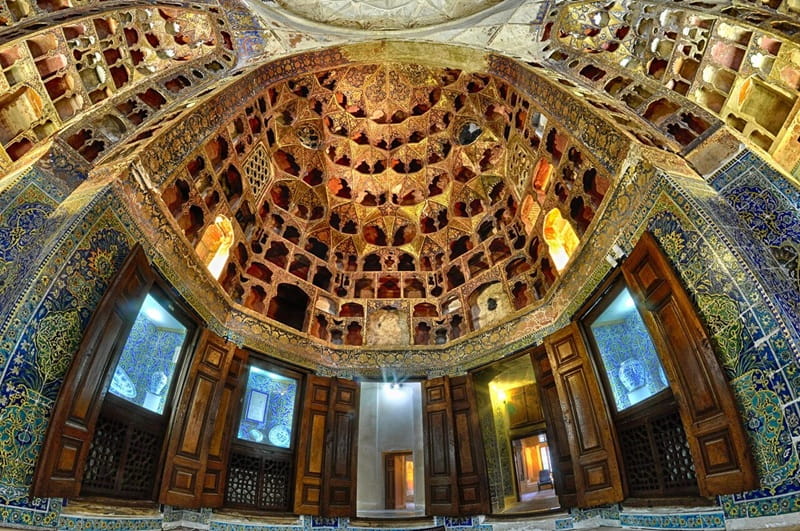
The Chini-khaneh — literally “house of porcelain” — is an octagonal domed hall whose rich interior niches once displayed Safavid collections of Chinese ceramics. It remains one of the ensemble’s most memorable interiors even though much of its historic porcelain is no longer displayed there.
Its importance lies in the idea behind it: imported ceramic objects were turned into part of the shrine’s architectural fabric, merging collection, diplomacy, devotion and spectacle.
Chini-khaneh and Ardabil Carpet: Treasures That Left
The Chini-khaneh and Ardabil Carpet deserve one focused section because together they answer a question many visitors will have: why does this shrine seem to contain so many spaces made for objects that are not here?
Shah Abbas’s Porcelain Treasury
Under Shah Abbas I, the shrine became a repository for luxury objects as well as a place of pilgrimage. Between about 1607 and 1611, he endowed it with a large collection of Chinese porcelain, jade and manuscripts, and he had the hall that would hold them redecorated. Pilgrims arrived in large numbers and were fed free of charge from the shrine’s kitchens, an arrangement that survived until the 18th century.
The Encyclopaedia Iranica notes that the building already existed before Abbas, probably from the 14th century, and that a crypt with burials lies beneath it. Only the decorated interior dates from the porcelain era. The porcelain itself tells a bigger story. Rather than a single gift from a Chinese emperor, as many travel pages say, the collection was assembled through diplomatic gifts and trade. More than 90 pieces carry the mark of Qarachaqay, a loyal servant of Abbas who contributed to the endowment, and the scholar John Alexander Pope catalogued the whole group in 1956. Most of the porcelain, 805 pieces, was moved to Tehran in 1935, so the niches today hold only a small part of what they once displayed.
📷Photo by Ali Aali Aboozar on Wikicommons
The Ardabil Carpets: Commission, Debate and Absence
The Ardabil Carpet is the shrine’s best-known object, though the carpet itself is no longer in Ardabil. The Victoria and Albert Museum identifies its example as one of a pair commissioned by Shah Tahmasp for the shrine of his ancestor, Sheikh Safi al-Din.
The carpets’ woven inscription gives the Islamic date 946 AH — equivalent to 1539–40 — and names Maqsud Kashani as the person responsible for their production. The V&A records that British visitors still saw a carpet in the shrine in 1843. After an earthquake damaged the complex, the carpets were sold around 1888 to the Manchester firm Ziegler & Co., who restored one using parts of the other. The museum bought the restored carpet in 1893 for £2,000, following the advice of William Morris. The second carpet went to an American collector and is now at the Los Angeles County Museum of Art. Only a modern replica remains in the shrine’s museum.
A note of honesty: some specialists question whether the carpets were ever displayed at Ardabil, or whether the traditional story grew in the dealers’ sales pitch. The date, the signature and the royal commission are well documented. The shrine connection, while supported by the V&A, is one of the points scholars still debate.
Why UNESCO Recognised Ardabil
UNESCO inscribed the ensemble in 2010, and its official listing cites three criteria. In plain language:
- Criterion (i): The conception of the entire ensemble layout, the proportions of the internal and external spaces and of the buildings, their design and refined decoration come together as a single work in which aesthetics and spirituality are in dialogue.
- Criterion (ii): The architecture blends Ilkhanid and Timurid traditions with Sufi ideas, creating new spatial and decorative forms.
- Criterion (iv): It is an outstanding example of a 16th-century religious complex that combined social, charitable, cultural and educational roles, and it contains the elements that later defined Safavid architecture.
UNESCO is also candid about the property’s condition. It describes the site as authentic and well preserved, but cautions that it is important to reduce the tendency to go too far in conservation work. The Encyclopaedia Iranica makes the same point about some of the tile restoration, noting that it was done with more enthusiasm than accuracy.
One detail confuses many visitors: UNESCO’s short description dates the complex to the 16th–18th centuries, while its longer statement and the scholarly record trace the core buildings to the 14th century. Both are true. The tomb tower is 14th-century in origin, and most of the surrounding architecture is Safavid.
Beyond the Shrine: Ardabil’s Best Additions
Ardabil rewards more than a short stop at its UNESCO shrine. Add one or two nearby places to understand the region’s older religious landscapes, market life and mountain geography.
Sheikh Jebra’il Tomb: The Safavid Family Landscape
The Tomb of Sheikh Jebra’il at Kalkhoran, north of Ardabil, is associated with Sheikh Safi’s father. Its setting provides useful family and spiritual context before or after the main shrine visit. The present building is largely 17th-century, with a blue-glazed dome drum repeating the name of God.
Ardabil Bazaar: Carpets, Food and Daily Life
Ardabil Bazaar offers a working contrast to the formal architecture of the shrine. It is a good place to look for regional food, wool textiles, carpets and small-scale handicrafts without expecting a polished museum experience.

📷Photo by Mehrdad Sarhangi on Wikicommons
Sarein Springs: A Mountain Interlude
Sarein’s mineral springs sit within easy reach of Ardabil and make a practical overnight extension. They suit travelers looking to balance architecture-heavy touring with time in a highland setting.
Sabalan: Ardabil Landscapes
Mount Sabalan defines Ardabil’s skyline and gives the region its cooler climate. At 4,811 meters, it is Iran’s third-highest peak, and its summit holds a permanent crater lake at roughly 4,784–4,811 meters — one of the highest lakes in the country.
For adventure seekers, reaching the lake is a serious but achievable climb. The most popular route starts from the Shabil hot-spring area near Lahrud, proceeds to the East Shelter around 3,670 meters, then continues to the summit over 4–6 hours depending on fitness and conditions. The best window is from late June to early September, when snow has largely melted from the lower and mid-slopes. Even in summer, temperatures at altitude can be low and weather can change quickly, so proper clothing, good boots and an early start are essential.
Most travelers pair Ardabil with Tabriz city tour and visiting the rock-cut houses of Kandovan, to have a deeper understanding of northwestern Iran culture and history.
Visiting the Shrine: What to Know
Cool Highland Seasons
Late spring through early autumn is usually the most comfortable period for visiting Ardabil. Pack a warm layer even in warmer months, as mornings and evenings can feel markedly cooler than in Tehran, Isfahan or Shiraz. For countrywide seasonal planning, see the best time to visit Iran and the guide to autumn in Iran.
Confirm Hours Locally
Published opening hours and weekly closing days vary by source and season. Confirm the day before with your hotel, guide or local tour operator, and aim to arrive between 9:00 and 11:00 for a quieter visit.
Respectful Shrine Etiquette
- Dress modestly; women should carry a headscarf and wear loose, covering clothing.
- Men should avoid shorts and sleeveless tops.
- Remove shoes where requested before entering tomb chambers.
- Keep voices low around devotional spaces.
- Ask before photographing people, attendants or areas marked as restricted.
Final Thoughts: The Dynasty’s Quiet Beginning
The Sheikh Safi al-Din Shrine is compelling because it makes Iran’s history feel unusually intimate. A Sufi lodge built around prayer, charity and disciplined arrival became the ancestral core of a dynasty that changed the country’s religion, art and political map.
The carpets have gone, much of the porcelain has gone, and repair has altered parts of the fabric. Yet the essential idea remains readable: a sacred path that slows the visitor down before it allows an encounter with the tomb at its end.
Planning to visit Ardabil’s UNESCO shrine? We can arrange the route from Tabriz, a private guide, timings and a wider northwest Iran itinerary.
Want to walk the path to Sheikh Safi’s tomb with a local guide?
FAQs about Sheikh Safi al-Din Shrine
1. Where is the Sheikh Safi al-Din Shrine?
The shrine is in Ardabil, in northwest Iran and around 400 km from Tehran. It stands in the city’s Ali Qapu quarter near Sheikh Safi Street.
2. Why is the shrine a UNESCO World Heritage Site?
UNESCO inscribed it in 2010 under criteria (i), (ii) and (iv), recognizing its artistic design, its fusion of Ilkhanid and Timurid influences with Sufi ideas, and its role as a prototype of a Safavid religious complex with social and charitable functions.
3. Who was Sheikh Safi al-Din Ardabili?
Sheikh Safi al-Din Ardabili was a Sufi master, usually dated to c. 1252–1334, who founded the Safaviyya order in Ardabil. His descendants established the Safavid dynasty.
4. Was Sheikh Safi Sunni or Shia?
The early Safaviyya appears to have been Sunni, while the order’s descendants later moved toward Shiism. The Safavids ultimately established Twelver Shiism as Iran’s state religion after Shah Ismail I took power.
5. Where is the Ardabil Carpet now?
One Ardabil Carpet is in the Victoria and Albert Museum in London, and the related carpet is in Los Angeles. Both date to 1539–40 and are associated with Shah Tahmasp’s patronage for the Ardabil shrine.
6. How long do you need at the Sheikh Safi al-Din Shrine?
Plan about two to two-and-a-half hours to see the principal courtyards, tomb tower, Shah Ismail I mausoleum, Chini-khaneh and museum at an unhurried pace.
7. What is a khānegāh?
A khānegāh is a Sufi lodge used for communal worship, teaching, retreat, hospitality and charitable activity. Ardabil’s ensemble brought those functions together with tombs, courts, service spaces and ceremonial halls.
8. Who is buried at the shrine?
Sheikh Safi al-Din is buried in the tomb tower at the center of the complex. Shah Ismail I, founder of the Safavid state, lies in an adjoining mausoleum.
9. How do I get from Tabriz or Tehran to Ardabil?
From Tabriz, the road to Ardabil is about 220 kilometers and takes roughly three to three and a half hours by car. From Tehran, the road is about 600 kilometers, so many travelers fly to Tabriz first; Ardabil Airport handles domestic flights, but schedules change.
0 Comment