

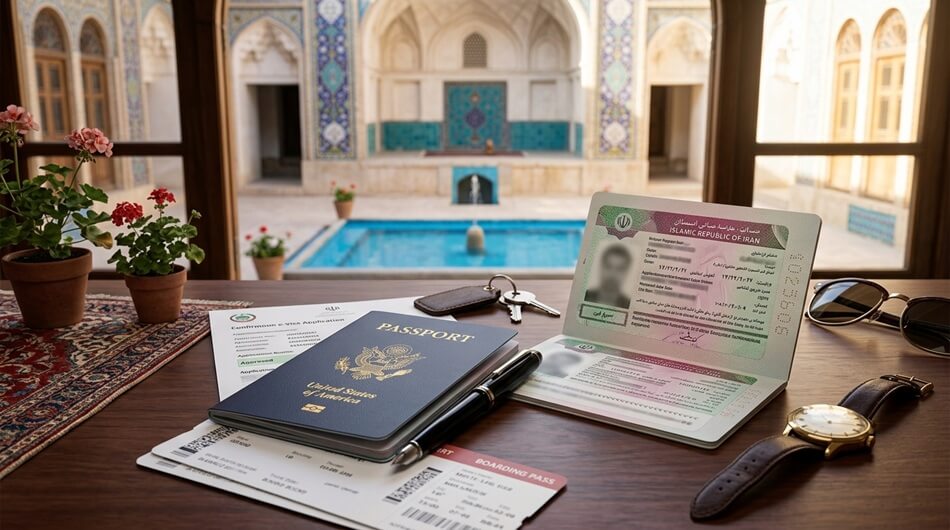

Visa rules and travel advisories change frequently — always verify with official sources before booking.
Table of Contents
Somewhere between the immigration hall and the insurance counter at Imam Khomeini International Airport, most travelers to Iran pause for the first time — not because anything has gone wrong, but because this is where paperwork becomes a place, and a printed form becomes a passport stamp. Indian ordinary passport holders are currently required to obtain a visa before traveling to Iran, following the suspension of the country’s 15-day visa-free arrangement on November 22, 2025 (NDTV). For a nation so often approached with a mixture of curiosity and caution, this is, in its own quiet way, one of the more reassuring parts of the journey: a clear process, followed in order, that ends in the same place it always did — a stamp-free entry slip, a waiting guide, and a country that has spent centuries perfecting the art of welcome.
| Question | Answer |
|---|---|
| Visa required? | Yes, for all Indian ordinary passport holders |
| Applies to transit? | Yes — transit visas are also required |
| How to apply | Trough a licensed agency or online via evisa.mfa.ir |
| Processing time | 3–10 business days (agency) or 2–8 weeks (direct MFA) |
| Insurance required? | Yes — Iran-specific travel insurance needed for visa issuance and entry |
| Current MEA advisory | Postpone non-essential travel (advisory dated July 19, 2026) |
This guide walks through exactly what changed, what today’s process looks like in practice, and what an Indian traveler needs to have in hand before departure. Whether you’re planning a cultural trip through Iran’s major cities, a pilgrimage to Mashhad, or simply transiting through Tehran, the information below reflects the current rules as of 2026.
Quick Answer: Do Indian Citizens Need a Visa for Iran?
Yes. Since November 22, 2025, Indian ordinary passport holders must obtain a visa before entering or transiting through Iran. The previous 15-day visa-free facility, introduced in February 2024, has been suspended indefinitely. There is no walk-up visa on arrival available to Indian citizens under the current system. Applications are submitted online through Iran’s official e-visa portal (evisa.mfa.ir) or through a licensed Iranian travel agency, with processing typically taking 3 to 14 business days.
A Note on the Current Situation
Before the practical details — a few things worth knowing honestly, in keeping with how we approach every destination.
The Visa Suspension
Iran’s visa-free facility for Indian ordinary passport holders, introduced in February 2024, was suspended by the Iranian government from November 22, 2025, following a rise in fraud and trafficking cases in which travelers were misled by fake job offers. According to the Iranian Embassy in India, the suspension was enacted to “prevent further misuse of the facility by criminal elements” (NDTV). A visa is now required for entry or transit, regardless of the length of stay or mode of arrival.
The Current Travel Advisory
India’s Ministry of External Affairs has been issuing periodic advisories for Iran since the beginning of 2026 amid regional tensions. The first advisory was issued on January 5, 2026, with subsequent updates on January 14 and February 23, 2026. The most recent advisory, dated July 19, 2026, advises that Indian nationals intending to travel to Iran for any purpose should postpone travel for the time being, until the security environment improves, and that Indians already in Iran should consider temporarily exiting the country (MEA Advisory).
This is worth checking directly before finalizing any trip — our companion piece, Is Iran Safe? A Local’s Honest Answer, goes into this in more depth, and we’d encourage reading it alongside this guide rather than instead of it.
Neither of these things means a trip to Iran is off the table — they mean it’s worth planning with current, accurate information rather than what circulated a year or two ago. That’s what the rest of this guide is for.
How the Iran e-Visa Process Works for Indian Citizens
The process itself is more straightforward than its reputation suggests — particularly when you have a licensed Iranian travel agency handling it on your behalf. While applications can technically be submitted directly through Iran’s official e-visa portal (evisa.mfa.ir), the recommended route for Indian citizens is through a licensed agency, which acts as your sponsor and liaison with the Iranian Ministry of Foreign Affairs (MFA).
The reason matters: Iranian authorities prefer applications associated with a recognized entity inside Iran — a licensed travel agency or an authorized host. When you apply directly through the MFA portal without this sponsorship, the rejection rate is significantly higher, and processing can take anywhere from two to eight weeks. Applications submitted through a licensed agency, by contrast, benefit from pre-screened documents, established MFA channels, and the agency’s sponsorship — bringing rejection rates to under 2% and processing times down to 3–10 business days. Following recent policy changes in 2026, direct individual applications through the portal are, in many cases, no longer reviewed to completion — many are rejected outright with a note to resubmit through a licensed travel agency.
Applying Through a Licensed Travel Agency (Recommended)
When you apply through a licensed agency, the process looks like this:
Step 1: Share your travel details and documents. You provide your passport bio page, a passport-style photograph meeting Iranian visa photo specifications, your return or onward flight itinerary, and your accommodation details for at least the first few nights of your trip. All passport details must match your passport exactly — discrepancies are a common cause of delays.
Step 2: The agency reviews and submits your application. The agency checks your documents for completeness and common errors, then files the application through its licensed channel with the MFA. Because the agency acts as your sponsor and is known to the MFA, the application is associated with a verified entity in Iran — the factor that Iranian authorities weigh most heavily in approval decisions.
Step 3: The agency tracks your application. While the MFA reviews your file, the agency monitors its progress and follows up directly if additional documents are requested. This is something individual applicants through the portal cannot easily do — direct applications that are delayed or require follow-up often go unanswered.
Step 4: Receive your authorization code. Once approved, you receive a reference or authorization number (sometimes called a visa grant notice) by email. This is not the visa itself — it’s a pre-approval reference that confirms the MFA has cleared your application. The authorization code is generally valid for two months from the date of issue.
Step 5: Collect your visa. With the authorization code in hand, you collect the physical visa either at an Iranian consulate in advance (the Embassy of Iran in New Delhi or the Consulate in Mumbai), or at the airport visa counter on arrival at Imam Khomeini International Airport. The agency will advise which collection point is appropriate based on how your application was processed.
Step 6: Arrange your travel insurance. Iran-specific travel insurance is required to collect your visa and clear entry. Iranian travel agencies can arrange this as part of your trip planning so it’s sorted before you land — see our travel insurance for Iran guide for what a valid policy needs to cover. For a full breakdown of visa fees by nationality and visa type, see our Iran visa fee guide.
Applying Directly Through the MFA Portal
It is technically possible to apply directly through the official e-visa portal at evisa.mfa.ir. We don’t recommend this route for most Indian travelers, for three reasons:
- Higher rejection rate. Direct MFA applications face an average rejection rate of around 20%, primarily because they lack a sponsoring entity in Iran. The MFA prefers applications associated with a licensed agency or authorized host — without one, your application is more likely to be declined, often without a detailed explanation.
- Longer processing time. Direct applications through the MFA portal typically take two to eight weeks, compared to 3–10 business days through a licensed agency. During peak seasons or periods of heightened review, direct applications can take even longer, and there’s no intermediary to follow up on your behalf.
- Limited support if issues arise. If the MFA requests additional documents or your application is delayed, there’s no one to advocate for you. Travel forums are full of applicants who submitted directly and waited weeks for a response — or received none at all. A licensed agency has established channels with the MFA and can resolve issues quickly.
If you do choose to apply directly, be prepared to provide all the same documents, follow the same steps, and accept a longer timeline with no guarantee of approval. The portal itself is straightforward to use — the challenge is getting the application approved without an Iranian sponsor.
Reference numbers, not stamped visas, are what most applicants receive at this stage — the physical visa or entry authorization is typically finalized at the airport or consulate. The authorization code is generally valid for two months from the date of issue, while a visa collected from an embassy.

Documents Required for an Indian Applicant
Before applying, it’s worth having the following ready:
- Passport valid for at least six months beyond the intended stay, with at least one blank page
- A recent passport-style photograph, meeting Iranian visa photo specifications (typically 3×4 cm, white background, taken within the last six months)
- Proof of onward or return travel, such as a confirmed flight itinerary
- Accommodation details for at least the first few nights (a hotel booking or host invitation letter)
- Completed online application form, submitted through the official portal or a licensed agency
- Iran-specific travel insurance — required for visa issuance and entry (more on this below)
What’s not required at the application stage, despite what some visa agencies imply, is a formal Indian government NOC or additional embassy attestation — the process is simpler than many intermediaries suggest. For a broader overview of the entire Iran travel planning process, our complete guide to traveling to Iran covers everything from visas to accommodation and transportation.
Iran Visa Fees for Indian Citizens
Visa fees vary depending on visa type, duration, and whether the application is processed independently or through a travel agency. Based on current information from visa processing services and the Iranian Embassy in India, here’s what Indian applicants can generally expect. Note that fees are adjusted periodically and the figures below are based on recent estimates:
| Visa Type | Embassy/Consulate Fee (est.) | Airport (VOA) Fee (est.) | Agency Service Fee (est.) |
|---|---|---|---|
| Tourist visa (30 days) | ~€60 | ~€90 | ~€19–€30 |
| Business visa (30 days) | ~€60 | ~€90 | ~€30–€35 |
| Transit visa (up to 15 days) | ~€20–€30 | Not available | ~€15–€20 |
| Student visa | ~€40–€50 | Not available | ~€25–€30 |
In addition to the visa fee, the Iranian Embassy in India notes that applicants must have a health insurance certificate, with insurance costs ranging from €10 for a single or double entry visa to €15 for a one-year multiple entry visa.
Because fees are adjusted periodically and can vary by processing route, we’d recommend confirming the current fee directly on the official portal, or with a trusted operator, before paying anything to a third party. For a comprehensive breakdown by nationality, see our dedicated Iran visa fee guide.
Mandatory Travel Insurance for Indian Applicants
This is one of the more commonly misunderstood parts of the process, so it’s worth being precise about it.
Travel insurance is required for visa issuance and entry into Iran. Current Embassy guidance indicates that a health insurance certificate may be routed through the e-visa system itself, so it’s worth checking the portal at the time of application for the current process (Iranian Embassy in India – Visa Fees). In practice, many travelers still arrange insurance separately — either at the airport or in advance through a local operator. Because most international insurance policies explicitly exclude Iran due to sanctions, travelers need a policy specifically valid for Iran — most commonly an Iranian-issued policy such as Saman Insurance.
In practice, there are three ways Indian travelers typically handle this:
- Buy it at the airport — an Iran-specific insurance counter is available at major airports like Imam Khomeini International, usually costing the equivalent of about €15–€25 for a standard stay. However, kiosks may be closed for late-night arrivals, and the queue adds friction to an already busy arrival process.
- Arrange it in advance through a local tour operator — Iranian local tour operators and travel agencies can arrange valid Iranian travel insurance as part of your trip planning, so it’s already sorted before you land, rather than something to queue for at an unfamiliar counter.
- Purchase it independently in advance through an Iran-specialist insurance provider — this gives you the most control over coverage details but requires more research upfront.
None of these routes is wrong — it largely comes down to whether you’d rather handle one more thing in an unfamiliar airport, or have it arranged before you leave home. For more on what a valid policy needs to cover, see our guide to travel insurance for Iran and what it actually needs to cover.
Iran Visa Processing Time — What to Expect
Processing times for Indian e-visa applications typically range from 3 to 14 business days, though this can extend during peak travel seasons or periods of high application volume. Based on data from multiple visa processing services:
| Application Method | Typical Processing Time | Authorization Validity |
|---|---|---|
| E-visa (direct portal) | 3–14 calendar days | 2 months from issue |
| E-visa (through agency) | 3–7 business days | 2 months from issue |
| Embassy/consulate issuance | 7–14 working days | 3 months from issuance |
| Express processing (if available) | 2–3 business days | Same as standard |
Unlike some visa systems, there’s no officially guaranteed turnaround — applying at least two to three weeks before travel gives a reasonable buffer, and applying at the very last minute is one of the more avoidable risks in the whole process. Some sources recommend allowing four to six weeks in particularly complex cases or during periods of heightened security review.
If you’re planning your trip around the best time to visit Iran, factor in visa processing when choosing your travel dates — peak seasons like Nowruz (late March) can see longer processing times due to higher application volumes.
Common Mistakes Indian Applicants Make
A few patterns show up often enough to be worth flagging directly:
- Assuming the old visa-free rule still applies — it doesn’t, and this is the single most common error among Indian travelers researching Iran right now. The suspension took effect November 22, 2025, and applies to all ordinary passport holders regardless of trip purpose.
- Assuming any travel insurance policy will do — most standard international policies exclude Iran outright due to sanctions. You need an Iran-specific policy, whether arranged through the e-visa portal, a local tour operator, or purchased at the airport.
- Applying too close to the travel date, leaving no buffer if additional documents are requested or if security clearance takes longer than expected. Aim for at least three weeks of lead time.
- Mismatching passport details on the application form — all information must match your passport exactly. Even minor discrepancies in name spelling or date of birth can cause delays or rejection.

Visa Extensions for Indian Citizens
Iran does permit visa extensions for many tourist e-visas, processed in person at designated police offices (Edareh Amaken) in cities such as Tehran, Isfahan, or Shiraz, generally for a modest fee and a short waiting period. Extensions are typically granted for an additional 30 days, and can sometimes be renewed for a total stay of up to 90 days.
This is separate from the now-suspended visa-free allowance, which was explicitly non-extendable — the extension process applies to those who entered on a standard e-visa, not the old exemption. If you’re planning an extended trip through Isfahan’s architectural wonders, Shiraz’s gardens and poetry, or Yazd’s desert old city, it’s worth knowing this option exists — though it should never be relied upon as a substitute for planning your visa duration correctly from the start.
What to Expect on Arrival in Iran
Once your visa is approved and your flight lands, the arrival process at Imam Khomeini International Airport (IKA) is generally smooth if you’re prepared. After disembarking, you’ll proceed through immigration, where your visa authorization and passport will be checked. If you haven’t pre-arranged insurance, this is where you’ll visit the insurance counter before or after immigration.
Have the following documents ready in your carry-on, not checked luggage:
- Your passport (with at least six months validity remaining)
- Your printed visa authorization number or grant notice
- Your return or onward flight itinerary
- Proof of accommodation for your first nights
- Your Iran-specific travel insurance policy (if pre-arranged)
Once through immigration, you’ll receive a stamped entry slip rather than a passport stamp — Iran no longer stamps passports directly for most travelers, which is a relief for those concerned about future travel to countries with restrictive entry policies regarding Iran visits.
For practical tips on navigating your first days in the country — from currency exchange to cultural etiquette — our complete Iran travel guide covers the essentials.
Final Thought: A Clear Process, Even in an Uncertain Season
What strikes most travelers, once they’ve been through it, is how little drama the actual paperwork contains. A visa-free window closed, a new process took its place, and for those willing to read past the outdated blog posts and forum threads, that process is entirely navigable — a form, a set of documents, an insurance policy, and a wait measured in days rather than weeks.
Iran remains, underneath the headlines and the policy shifts, a country built on the details this guide has just walked through mattering far less than what’s on the other side of them: turquoise domes catching afternoon light in Isfahan, the hush of the desert at dusk near Yazd, the ancient grandeur of Persepolis, tea poured by someone who has spent a lifetime perfecting the pour. The visa is simply the door. What’s behind it hasn’t changed.
For Indian travelers watching the current situation closely — and we’d encourage that watchfulness — the right approach is patience paired with preparation. Have the paperwork ready. Know what the advisory landscape looks like the week you plan to travel, not the month you first researched it. And when the timing feels right, the process itself will no longer be the obstacle it might currently seem.
Every stamp begins with an application.
FAQs about Iran Visa for Indian Citizens
Can Indian citizens still travel to Iran without a visa?
No. Iran suspended visa-free entry for Indian ordinary passport holders from November 22, 2025, following a rise in fraud and trafficking cases (NDTV). A visa is now required for entry or transit, regardless of trip length or purpose.
How do Indian citizens apply for an Iran e-visa?
Applications are submitted through a licensed Iranian travel agency (the recommended route, which acts as your sponsor and significantly reduces rejection risk) or directly through Iran’s official e-visa portal (evisa.mfa.ir). The agency handles document submission, MFA follow-up, and sends you a reference or authorization number once approved, with the physical visa collected at the airport or a consulate.
What documents are required for an Iran visa for Indian citizens?
Applicants need a passport valid for at least six months, a passport-style photo, proof of return or onward travel, and accommodation details for the first nights of the trip. Iran-specific travel insurance is required for visa issuance and entry.
Is travel insurance mandatory for Indian travelers to Iran?
Yes, insurance is required for visa issuance and entry. Current Embassy guidance indicates it may be routed through the e-visa system itself. It can also be purchased at the airport (typically €15–€25), arranged in advance through a local tour operator, or bought independently from an Iran-specialist insurer. See our Iran travel insurance guide for full details.
How long does it take to get an Iran visa for Indian citizens?
Processing typically takes 3 to 14 business days, though this can extend during busy periods or when additional security review is needed. Applying at least two to three weeks before travel is generally a safer margin, with some sources recommending four to six weeks for complex cases.
How much does an Iran visa cost for Indian citizens?
The tourist visa fee is approximately €60 when collected from an embassy or consulate, and €90 when collected at the airport, based on recent third-party estimates. An additional e-visa service fee of approximately €19–€30 may apply. For a complete fee breakdown by visa type, see our Iran visa fee guide.
Can Indian citizens get an Iran visa on arrival?
No. Indian citizens are not eligible for a walk-up visa on arrival under the current system. While some elements of the process, such as collecting the physical visa and arranging insurance, happen at the airport, the underlying application should be submitted online in advance. See our guide to Iran visa on arrival for which nationalities still qualify.
Is it safe for Indian citizens to travel to Iran right now?
India’s Ministry of External Affairs has been advising against non-essential travel to Iran since early 2026 amid regional tensions. The most recent advisory, dated July 19, 2026, advises Indian nationals to postpone travel until the security environment improves (MEA Advisory). This is worth checking close to your travel dates, alongside the practical visa information in this guide. Our companion piece on whether Iran is safe to travel to goes into more depth.
Can Indian citizens extend their Iran visa once inside the country?
Yes, standard tourist e-visas can generally be extended in person at designated police offices (Edareh Amaken) in major cities such as Tehran, Isfahan, or Shiraz, typically for an additional 30 days. This differs from the now-suspended visa-free allowance, which was explicitly non-extendable.
What happens if an Indian traveler already booked a trip assuming visa-free entry?
Anyone who booked travel before the November 2025 suspension will now need to apply for a visa before departure, ideally with several weeks of lead time. Contacting a licensed agency or tour operator can help navigate this if the travel date is close.
Do Indian citizens need a visa to transit through Iran?
Yes. The suspended visa-free facility applied to transit as well as entry, so Indian citizens passing through Iran to a third country now need a transit visa in advance. The transit visa is typically valid for up to 15 days and costs approximately €20–€30.
0 Comment