



Table of Contents
In the middle of a wide, silent plain in Fars province, a simple limestone tomb has stood for 2,500 years. No grand gates, no soaring columns — just six stone steps rising to a small chamber, and the remains of the man who built the world’s first multicultural empire inside. This is Pasargadae, and that quiet simplicity is precisely the point.
Most visitors to the region spend their time at Persepolis and barely glance at the signs for Pasargadae on the way back. But the travelers who do stop here tend to say it was the most affecting moment of their entire Iran trip — because this is where the Achaemenid story began, not where it peaked.
In this guide, we cover everything you need to know about Pasargadae as an Iranian UNESCO World Heritage Site — its history and inscription criteria, what you will actually see on the ground, how to get there, when to visit, and which nearby attractions pair best with it for a full day in ancient Persia.
What Is Pasargadae? History and UNESCO Inscription
Pasargadae is an archaeological complex in the Fars province of Iran, about 130 km northeast of Shiraz. Founded by Cyrus the Great in the 6th century BCE, it served as the first dynastic capital of the Achaemenid Empire — the world’s first truly multicultural superpower, stretching from Egypt and the Aegean Sea to Central Asia and the borders of India. The site covers a core area of 160 hectares, surrounded by a buffer zone of over 7,000 hectares, at an elevation of 1,900 metres in the fertile Dasht-e Murghab plain.
UNESCO inscribed Pasargadae on its World Heritage List in 2004, during its 28th session, under four cultural criteria:
- Criterion I: Pasargadae represents the first and most outstanding expression of Achaemenid royal architecture, blending Anatolian, Mesopotamian, and indigenous Persian traditions into something genuinely new.
- Criterion II: Its design — particularly its garden layouts and palace complexes — exerted a profound influence on later Persian, Islamic, and Mughal architecture and garden design across Asia.
- Criterion III: As the earliest major settlement of the Persian people and the resting place of Cyrus the Great, the site is an exceptional testimony to the Persian civilization that shaped much of the ancient world.
- Criterion IV: Pasargadae stands as an outstanding example of the early phase of Achaemenid art, representing a civilizational model that would define empires for centuries.
The site’s global significance received renewed international recognition in November 2025, when UNESCO’s 43rd General Conference in Samarkand formally recognized the Cyrus Cylinder — the clay document inscribed under Cyrus’s authority — as the world’s first written declaration of human rights, predating the Magna Carta by nearly 1,700 years.
Key Structures: What You Will Actually See at Pasargadae
Pasargadae is a spread-out open-air complex. Unlike the densely packed grandeur of Persepolis, the ruins here are dispersed across a wide plain, which means the experience feels quieter and more meditative — but also requires some orientation. Here is what you will encounter.
📷Photo by Sattar Kazemi on Unsplash
Tomb of Cyrus the Great
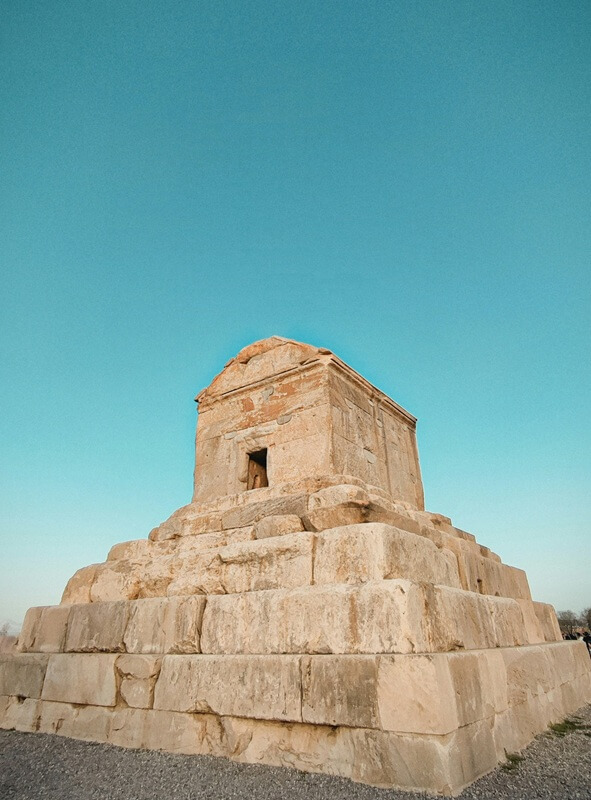
This is the undisputed highlight of Pasargadae and one of the most quietly powerful monuments in the world. The tomb is a plain rectangular chamber of white limestone blocks, some up to seven metres long, set atop a platform of six gradually receding steps — a form reminiscent of a ziggurat. The structure stands approximately 12 metres high.
Construction began around 546 BCE and was completed after Cyrus died around 530 BCE. When Alexander passed through Pasargadae in the 4th century BCE, he visited the tomb and had his soldiers investigate its interior, which ancient accounts describe as containing a golden bed, a gold coffin, precious ornaments, and an inscription identifying the occupant as Cyrus. The inscription has never been found.
The monument survived the Islamic conquest largely because its guardians renamed it the “Tomb of Solomon’s Mother” (Mashhad-e Madar Suleiman), a piece of protective fiction that preserved it for centuries. Archaeologists first excavated the site in 1905.
Audience Palace (Palace S)
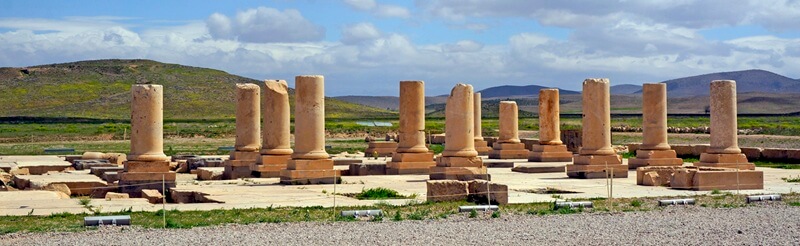
Also known by the name Ernst Herzfeld gave it — Palast mit der Säule — the Audience Palace is notable for containing the only intact ancient column surviving in Iran, standing for over 2,550 years. The palace sits in an island-like position surrounded by a permanent stream fed from the nearby Pulvar river. It served as Cyrus’s principal public reception hall, where dignitaries from across the empire would have been received.
Gate Palace (Gate R) and the Winged Man
The Gate Palace, located northeast of the tomb, functioned as the formal entrance to the palace complex. Inside, a hall once supported eight stone columns. The structure is particularly famous for the Winged Man petroglyph — one of the most intact carvings at Pasargadae — which depicts a bearded figure wearing a long cloak, a crown, and four large wings, gazing toward the centre of the palace. Scholars debate whether it represents Cyrus himself, a protective deity, or a divine guardian figure. Whatever the interpretation, it is extraordinary.
Private Palace
Located roughly 1,300 metres northeast of the Tomb of Cyrus, the Private Palace is believed to have served as the personal residence of Cyrus the Great. Its architectural plan distinguishes it clearly from the more formal Audience Palace, giving archaeologists insight into how the king’s private and public lives were spatially separated.
📷Photo by Soheil Callage on Wikicommons
Tall-e Takht (Solomon’s Throne)
This fortified terrace sits on a hill at the northern edge of the complex, overlooking the plain. It is the most structurally imposing element of Pasargadae after the tomb, built from massive stone blocks without mortar. In 2006, archaeologists excavating near Tall-e Takht discovered what are believed to be the remains of the tomb of Cambyses II, Cyrus’s son and successor who conquered Egypt.
Royal Garden (Paradise Garden)
The Persian word pairidaeza — paradise — originally meant a walled garden, and Pasargadae is where that concept was first given physical form. The Royal Garden, also known as the Campus of Cyrus, is considered the earliest known example of the Persian chahar bagh (four-garden) design: a formal garden divided by water channels into quadrants, with pavilions for shade and observation. A rocky stream once irrigated its trees, flowers, and birds. This garden layout would go on to influence Islamic garden design, Mughal architecture (including the gardens surrounding the Taj Mahal), and eventually European formal garden traditions. Pasargadae’s garden is the origin point of an aesthetic language still spoken worldwide.
Mozaffari Caravansary
Located near the Tomb of Cyrus, this later-period caravansary was built using stone repurposed from Pasargadae itself. While not Achaemenid in origin, it speaks to the site’s continuous use and cultural layering across centuries.
Architecture and Cultural Significance
What makes Pasargadae architecturally remarkable is not scale — Persepolis surpasses it in sheer grandeur — but synthesis. Archaeologists have concluded that its construction integrated Anatolian column traditions, Mesopotamian monumental stonework, and indigenous Iranian spatial planning in a way that had no precedent. This was not borrowing; it was invention.
That spirit of synthesis reflects how Cyrus governed. Unlike most ancient conquerors, Cyrus pursued a policy of active religious and cultural tolerance. When he captured Babylon in 539 BCE, he freed enslaved peoples, allowed deported communities to return home, and permitted the restoration of local temples. The Hebrew Bible credits him with liberating the Jews from Babylonian captivity — he is the only non-Jewish figure in the Torah addressed with the title mashiach (anointed one).
The Cyrus Cylinder, inscribed in Babylonian cuneiform and discovered in 1879, records these policies in Cyrus’s own administrative language. It guarantees religious freedom, forbids mistreatment of subject communities, and documents the liberation of enslaved peoples. In 1971, the United Nations published translations of it in all official UN languages. A replica stands at UN Headquarters in New York.
When UNESCO formally recognized it as the world’s first written human rights document in November 2025, it cemented what historians had long argued: that Pasargadae is not merely an Iranian heritage site, but a foundational location for the entire concept of human rights.
The influence extended even to the American founding. U.S. founding fathers, including Thomas Jefferson, studied Xenophon’s Cyropaedia — a biography of Cyrus — as a model of enlightened governance. The connections from this plain in Fars province to modern democracy are not metaphorical; they are documented.
Pasargadae vs Persepolis: Which Should You Visit?
This is the most common question visitors to the Fars region wrestle with, and most travel articles dodge it. Here is an honest answer.
Persepolis wins on spectacle. Founded by Darius the Great around 520 BCE as the ceremonial capital of the empire, Persepolis is vastly more monumental. The Gate of All Nations, the Apadana Palace, the Hundred-Column Hall — these are among the most photogenic ruins on earth. If you have limited time and can only visit one, Persepolis is the choice.
Pasargadae wins on historical primacy and emotional weight. Persepolis was the empire’s showcase. Pasargadae is where it began. Standing in front of the Tomb of Cyrus — a simple limestone structure in an open plain — carries a different kind of gravity. This is the grave of the man who invented the idea that conquered peoples deserve dignity. That simplicity is the point.
The practical reality: The two sites are about one hour apart by car. Most visitors combine them in a single full day from Shiraz, adding Naqsh-e Rostam in between. If you are genuinely interested in Persian history, visiting both is not optional. If you are a casual tourist with a half day, go to Persepolis. If you care about the roots of human rights, governance, or ancient architecture, Pasargadae deserves its own morning.
📷Photo by Herbert karim masihi on Wikicommons
Pasargadae Nearby Attractions: Building Your Full Itinerary
Pasargadae sits at the centre of one of the world’s greatest concentrations of ancient heritage. Within a reasonable driving distance, you can combine it with several other unmissable sites.
Persepolis (Takht-e Jamshid) — ~90 km south
The ceremonial capital of the Achaemenid Empire, founded by Darius the Great around 520 BCE and a UNESCO World Heritage Site. Its carved reliefs, towering columns, and royal tombs make it one of the most awe-inspiring archaeological sites anywhere on earth. The Gate of All Nations, the Apadana reliefs showing delegations from 23 subject nations bearing tribute, and the tomb of Artaxerxes III carved into the hillside behind the complex are all unmissable. Allow at least two to three hours.
Naqsh-e Rostam — ~84 km south
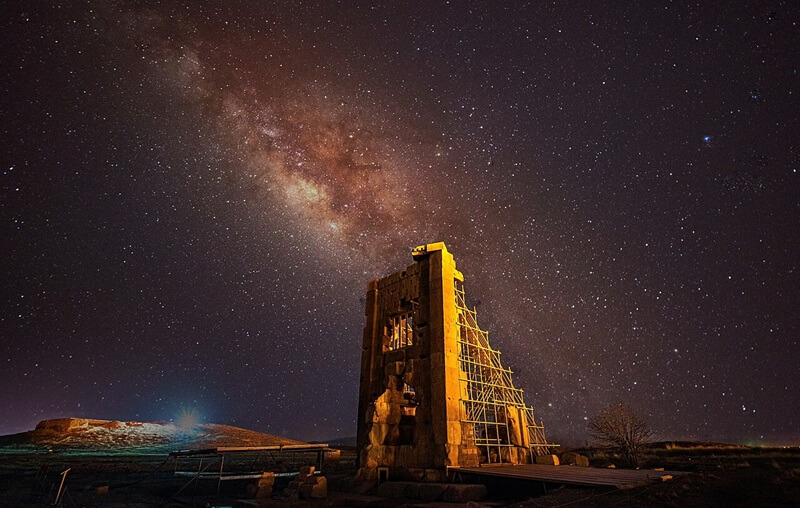
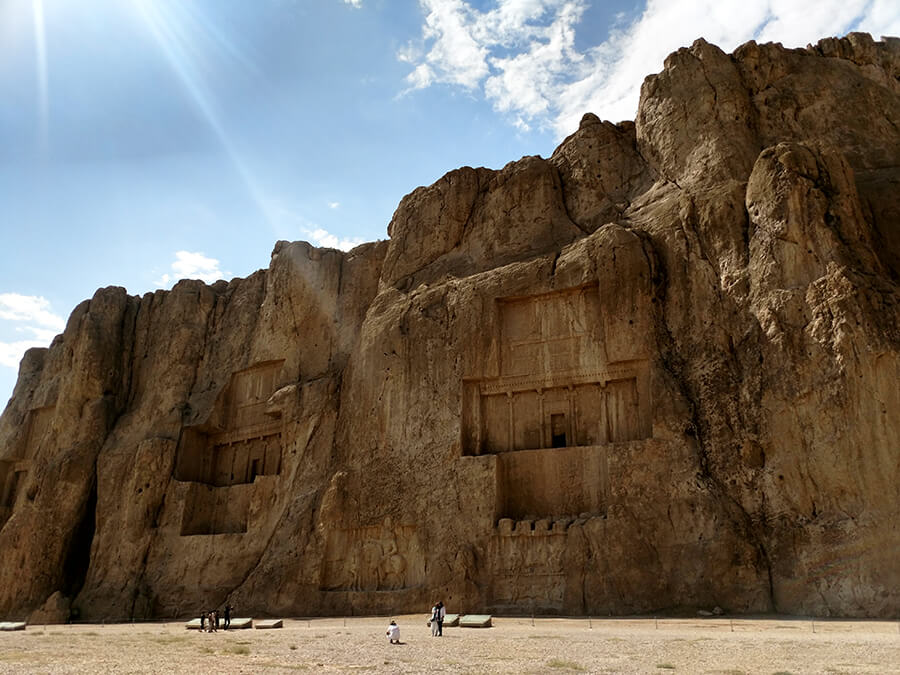
Located just 6 km from Persepolis, Naqsh-e Rostam is an ancient necropolis carved directly into a cliff face. Four massive cross-shaped tombs are cut high into the rock — believed to belong to Darius I, Xerxes, Artaxerxes I, and Darius II. Below the tombs, a series of Sasanian-era rock reliefs from the 3rd and 4th centuries CE show scenes of royal investiture and military triumph, most famously the surrender of the Roman Emperor Valerian to the Persian king Shapur I. Also on site is the Cube of Zoroaster (Ka’ba-ye Zartosht), a mysterious Achaemenid-era tower identical to one found at Pasargadae itself. Evidence suggests the site dates back to Elamite times, possibly as far as 3200 BCE. Allow one hour.
Naqsh-e Rajab — ~84 km south
Just 7 km from Persepolis and very close to Naqsh-e Rostam, Naqsh-e Rajab features four Sasanian rock reliefs including an investiture scene of Ardashir I, the founder of the Sasanian Empire. It is smaller and quicker to visit than Naqsh-e Rostam but worth including if you have time; the carvings are well-preserved.
Shiraz — ~130 km southwest
The nearest major city and the cultural capital of Fars province. Shiraz is one of Iran’s most beloved cities, famous for its warm friendly people, poetry, gardens, and architecture. From Pasargadae, it is the logical base for your exploration of the region. Key sites include the tomb of the poet Hafez, the tomb of Saadi, the Vakil Mosque, the Eram Garden (also a UNESCO-listed Persian garden), and the Pink Mosque (Nasir al-Mulk) — one of the most photographed interiors in Iran.
Qashqai Nomads Experience
For visitors interested in living Persian culture rather than only ancient ruins, the area around Pasargadae offers encounters with the Qashqai nomadic tribe — one of the few remaining Persian-speaking nomadic communities with a documented presence stretching back through Iranian history. We offer an experience to spend a day or so with Qashqai Nomads to see their nomadic camps, and live a day with them to get to know their traditional meals cooked from ancient recipes, and how their daily life looks like. This is a genuinely unique element of the region that no monument can replicate.
Practical Visitor Information
Opening hours: 8:00 AM – 6:00 PM daily
Entrance fee: Approximately $2 USD for international visitors. Fees are subject to change and may differ slightly at the time of your visit.
Best time to visit: Spring (March to May) and autumn (September to November) offer the most comfortable conditions, with mild temperatures and clear skies. Summer temperatures in the region can reach 50°C, making outdoor exploration difficult. Winter is mild but occasionally brings brief rainfall.
Getting there from Shiraz: Pasargadae is approximately 130 km northeast of Shiraz, roughly a 1.5-hour drive. Options include booking a guided tour — the recommended choice for first-time visitors, renting a car, or hiring a private taxi as there is no direct public bus to the site. Buses run from Shiraz to the town of Saadatshahr, from where a local taxi can complete the journey, but coordination is complex for unfamiliar travellers.
What to wear and bring: The entire complex is open-air with virtually no shade. Bring a wide-brimmed hat, sunscreen, and comfortable walking shoes. Modest dress is required as in all public places in Iran.
Photography: Personal cameras and smartphones are welcome. However, professional cameras, tripods, and drones (quadcopters) are prohibited within the complex.
Guides and audio guides: Available on-site. Given the sparse labelling of the ruins themselves, a knowledgeable guide makes a significant difference to the experience. Hiring one locally or booking a guided tour from Shiraz is strongly recommended.
Facilities: Restaurants and cafes are located near the entrance. There are no food or water points inside the ruins themselves. Parking is available for visitors arriving by car. Allow 1.5 to 2 hours for a comfortable visit.
Final Thought: Pasargadae Is a Story Worth Hearing in Person
Pasargadae is a site that rewards context. The ruins are spread across a wide open plain with minimal on-site labelling, and without knowing what you are looking at — which crumbling platform was a royal audience hall, which carved figure may be Cyrus himself, why a simple six-step tomb carries more historical weight than most palaces on earth — the experience can feel underwhelming. With the right guide, it becomes unforgettable.
A knowledgeable local guide transforms Pasargadae from a field of ancient stones into a living story: of the king who freed enslaved nations, of the garden that gave the world the word “paradise,” of an empire that began right here on this quiet plateau and changed how human beings think about power. That is the visit worth making.
Compassimo’s guided Pasargadae and Persepolis day tour from Shiraz pairs both UNESCO sites in a single well-paced day, with an expert English-speaking guide who brings the Achaemenid world to life at every stop. Transport, entrance fees, and a thoughtfully planned itinerary are all taken care of — so you can focus entirely on the experience.
Ready to Plan your Trip?
Walk through 2,500 years of history with the story in your hands.
FAQs for Pasargadae UNESCO World Heritage Site
1. When was Pasargadae inscribed as a UNESCO World Heritage Site?
Pasargadae was inscribed on the UNESCO World Heritage List in 2004 during the 28th session of the World Heritage Committee, as the fifth Iranian property on the list.
2. Who built Pasargadae?
Pasargadae was founded and built by Cyrus II the Great, the founder of the Achaemenid Empire, in the 6th century BCE. Construction began around 546 BCE and continued after his death around 530 BCE.
3. Is Pasargadae worth visiting if I have already seen Persepolis?
Yes — the two sites offer fundamentally different experiences. Persepolis is more visually spectacular; Pasargadae carries more historical and philosophical weight as the birthplace of the empire and the resting place of Cyrus. If Persian history interests you at any depth, both are essential.
4. Can I visit Pasargadae without a guide?
You can enter independently, but the ruins have minimal on-site interpretation. The complex is large and the structures are fragmentary. A guide or audio guide will dramatically improve your understanding of what you are seeing.
5. What is the Cyrus Cylinder and how does it relate to Pasargadae?
The Cyrus Cylinder is a clay document inscribed in 539 BCE recording the policies of Cyrus the Great following his conquest of Babylon. It guarantees religious freedom, forbids forced labour, and documents the liberation of enslaved peoples. Pasargadae is Cyrus’s capital and burial place — the physical centre of the civilization that produced the Cylinder. In November 2025, UNESCO formally recognized the Cylinder as the world’s first written declaration of human rights.
6. How long does it take to explore Pasargadae?
Allow 1.5 to 2 hours for a thorough visit, including the Tomb of Cyrus, the Audience Palace, the Gate Palace, and Tall-e Takht.
7. Are drones allowed at Pasargadae?
No. Drones and quadcopters are prohibited within the Pasargadae complex, as they are at Persepolis and Naqsh-e Rostam.
0 Comment