

Table of Contents
Iranians have a saying: Isfahan nesf-e jahan — Isfahan is half the world. Spend even a single day here and you begin to understand it not as boast but as plain observation. This is the city where Shah Abbas the Great relocated his capital in 1598 and proceeded to build, in the space of a single reign, one of the most complete and coherent urban visions in human history. The result — a UNESCO World Heritage square ringed by four monumental buildings, a network of Safavid palaces and gardens, a river crossed by bridges that double as open-air concert halls, and a bazaar producing handicrafts unchanged in technique for five centuries — is still largely intact and still breathtaking.
Isfahan is the city that consistently leaves visitors questioning why it doesn’t appear on more international travel lists. It is safer, more walkable, more architecturally dense, and more hospitable to foreign visitors than almost any city of comparable historical significance anywhere in the world. Whether you have three days or a week, Isfahan rewards every hour invested.
This guide covers the best things to do in Isfahan — organized to help you build a meaningful itinerary and go beyond the surface of a city that has more layers than any single visit can exhaust.
Isfahan: Why It Deserves More Than a Day
Isfahan sits at the crossroads of central Iran, in a broad valley watered by the Zayandeh Rood — “the life-giving river” — at an elevation of roughly 1,590 meters. Its moderate altitude gives it a climate more forgiving than Tehran or Shiraz, with warm summers, cool winters, and two of the most beautiful seasons in Iran: a spring when the city’s gardens and fruit trees bloom, and an autumn when the light turns golden over the domes.
The city’s historic core is genuinely walkable. Most of the headline attractions sit within a 20–30 minute walk of Naqsh-e Jahan Square. Beyond the center, Isfahan’s surroundings offer one of the most varied day-trip menus in the country: an ancient red-clay mountain village, two very different desert landscapes, and a living nomadic culture in the Zagros foothills.
Getting there: Isfahan International Airport (IFN) receives domestic connections from Tehran, Shiraz, and Mashhad, as well as some regional international routes. Overnight trains from Tehran are a comfortable alternative. There are also a wide bus system to Isfahan from different cities throughout the country.
📷Photo by Behnam Minaei on Wikicommons
Naqsh-e Jahan Square: The Heart of Safavid Isfahan
There is no point easing into Isfahan. Naqsh-e Jahan Square — “Image of the World” — stops you in your tracks from the moment you step into it.
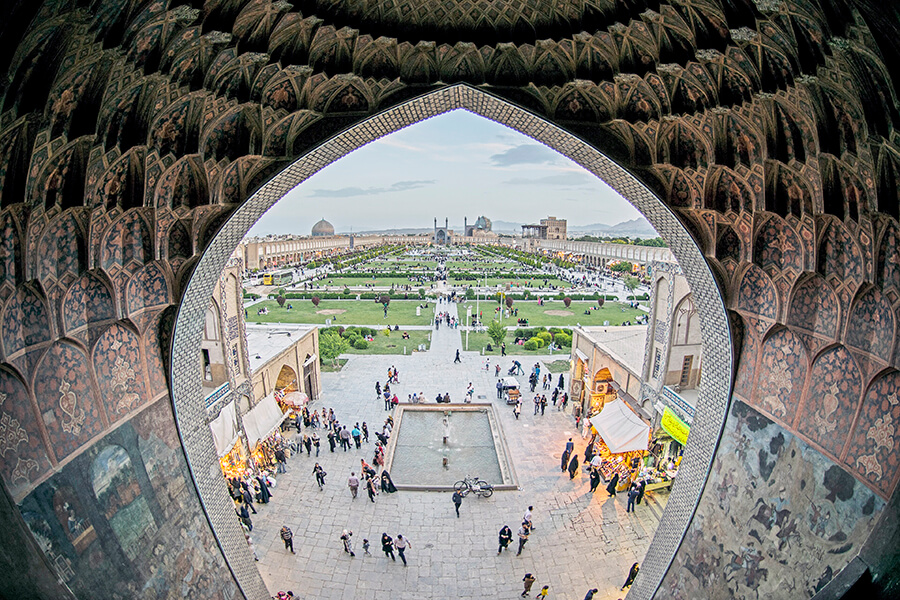
Built by Shah Abbas I at the beginning of the 17th century and bordered on all sides by monumental buildings linked by a series of two-storey arcades, the square covers almost 9 hectares — 560 meters long by 160 meters wide, making it one of the largest public squares in the world. Constructed between 1598 and 1629, it is now a UNESCO World Heritage Site, and yet it is not a museum piece. In the evenings, families spread picnic blankets on the grass, horse-drawn carriages circle the perimeter, and the fountain jets cast long shadows across the tile-paved esplanade. The polo goalposts at each end of the square — still standing — are a quiet reminder that this was once the Shah’s personal polo ground, where he watched matches from the balcony of Ali Qapu Palace.
Shah Mosque (Imam Mosque)
The mosque on the south side of the square is the defining monument of Safavid architecture — its 54-meter portal, twin minarets, and central dome covered in a mosaic of blue, turquoise, and gold tiles are among the most photographed images in Iran. It remains the most celebrated example of the colorful architecture which reached its high point in Iran under the Safavid dynasty. The interior is vast, the acoustics remarkable, and the tilework so dense that entire afternoons can disappear trying to follow its patterns.
Sheikh Lotfollah Mosque
Directly across the square, Sheikh Lotfollah is smaller, more intimate, and for many visitors more beautiful. Built by Shah Abbas the Great and dedicated to his father-in-law, a revered religious scholar, it was constructed between 1603 and 1619 as the private mosque of the royal court. Because it was not intended for public worship, it has no minarets and no courtyard — departures from mosque convention that make it architecturally unique. The buff-colored dome shifts from cream to soft pink over the course of the day as the light changes, and the interior tilework — deliberately, philosophically asymmetrical — contains a famous peacock design at the center of the dome that takes your eyes a long moment to resolve. The tilework’s intentional asymmetry is interpreted as a deliberate attempt to show the imperfection of human construction against the flawless creation of God.
Ali Qapu Palace
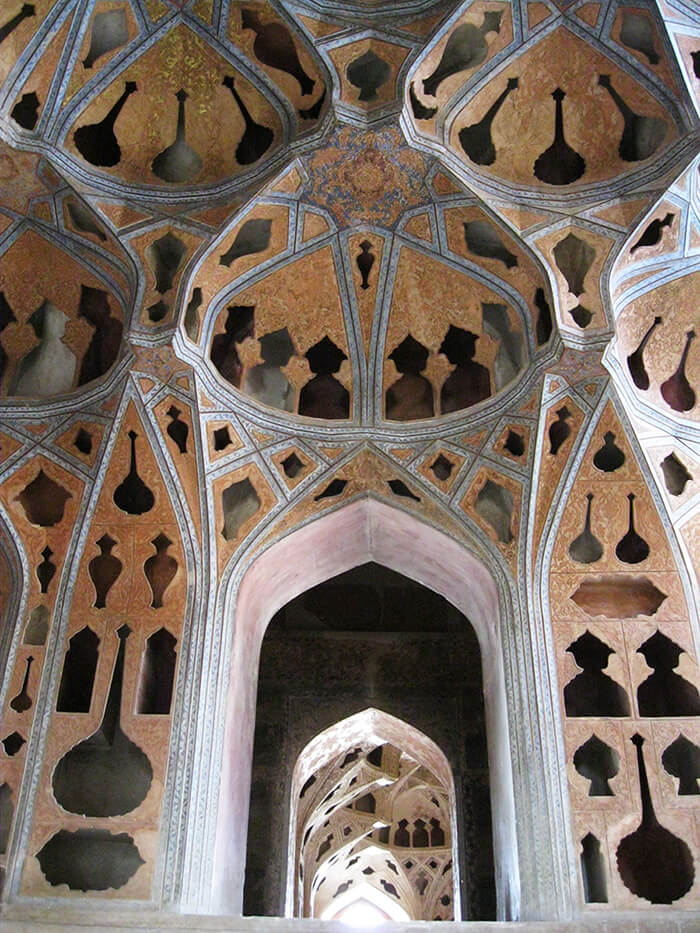
On the west side of the square, Ali Qapu (“Exalted Gate”) is a six-storey palatial pavilion that served as the formal entrance to the Safavid royal quarter behind it. On the sixth floor, the royal reception and banquets were held — this floor was popularly called the music room as it was here that various ensembles performed music. The music room’s defining architectural feature is its ceiling, carved with deep niches in the shapes of vases, cups, and vessels — a system that is simultaneously decorative and acoustic, amplifying sound through the hollow forms. Climb to the terrace on the upper floors for the best elevated view of the entire square.
Isfahan Grand Bazaar
The Qaysarieh Gate and Bazaar is one of the largest and most beautiful markets in Iran. Its construction took three generations and was completed during the Safavid and Qajar eras. Entering through the grand Qeysarieh Gate at the north end of the square, the bazaar extends outward in all directions — a city within a city of caravanserais, workshops, mosques, and trading halls. Isfahan’s bazaar differs from those of Tehran and Shiraz in one important way: here, the craftsmen are still making things inside it. Metalworkers, enamel painters, and carpet weavers work in open-fronted workshops as visitors browse — more on this in the craft workshops section below.
Isfahan’s Safavid Palaces and Gardens
Chehel Sotoun Palace
A ten-minute walk from Naqsh-e Jahan, Chehel Sotoun — “Palace of Forty Columns” — is one of the most graceful buildings in the city. The name comes from the reflection of its twenty tall wooden columns in the long rectangular pool in front: twenty columns plus twenty reflections equal forty. The palace was Shah Abbas II’s reception hall for foreign dignitaries, and its interior walls are covered with enormous frescoes depicting battles, royal banquets, and mythological scenes — executed in a style that blends Persian miniature painting with larger-scale mural work. The surrounding garden, one of the finest surviving examples of the formal Persian garden tradition, is at its best in spring.
Hasht Behesht Palace
Less visited than Chehel Sotoun but equally beautiful, Hasht Behesht (“Eight Paradises”) is a late Safavid pleasure pavilion set within its own garden. Its name refers to the eight rooms arranged around a central octagonal hall — a layout derived from Quranic descriptions of paradise. The building’s exterior tile mosaic and interior mirror and fresco work have been carefully restored. If you visit Chehel Sotoun, add Hasht Behesht — it is a 15-minute walk away and rarely crowded.
Chahar Bagh Boulevard
Running south from the palace zone toward the river, Chahar Bagh (“Four Gardens”) was Shah Abbas’s grand urban planning gesture — a tree-lined boulevard flanked by gardens, palaces, and caravanserais, designed to connect the royal quarter to the river bridges. Much of the original planting has been replaced and the buildings evolved over centuries, but the Chahar Bagh School (Madrasa) along its length remains a stunning example of late Safavid tilework. In the evenings, the boulevard becomes one of Isfahan’s main promenading streets — walk it south and end at the Zayandeh River and the bridges.
Jameh Mosque: 12 Centuries in One Building
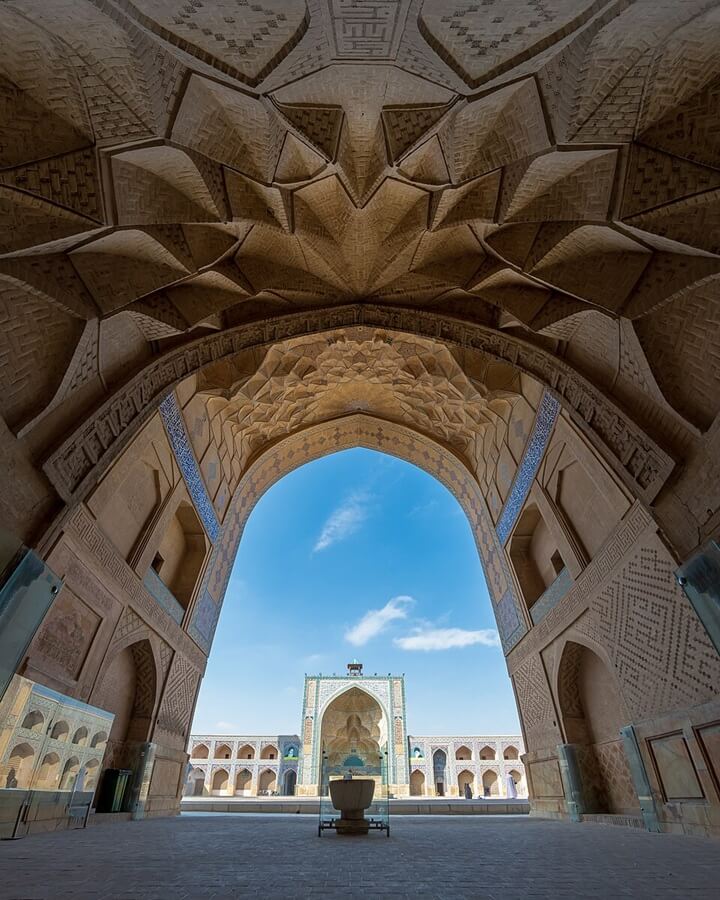
Isfahan has two UNESCO World Heritage Sites, and the second — the Jameh Mosque, also known as the Friday Mosque or Masjed-e Jame — deserves a section entirely its own.
Where Naqsh-e Jahan is a single perfectly planned ensemble built in one reign, the Jameh Mosque is the opposite: a single building modified, expanded, and rebuilt by almost every major dynasty in Iranian history, from the Seljuks in the 11th century through the Ilkhanids, Timurids, Safavids, and Qajars. Walking through it is like reading a textbook of twelve centuries of Persian mosque architecture in a single structure. One Seljuk-era dome chamber survives virtually unchanged from the 11th century. The Mongol-era stucco work in another section has a different character entirely. A Timurid-era winter prayer hall brings a third aesthetic. None of it was planned to cohere — and yet it does.
Most visitors to Isfahan walk past the Jameh Mosque entirely, drawn straight to Naqsh-e Jahan. This is a mistake. For anyone with more than a passing interest in architecture or history, the Jameh Mosque is one of the most intellectually rewarding two hours in Isfahan.
📷Photo by Ali Alirezaei666 on Wikicommons
The Historic Bridges of the Zayandeh Rood
If Naqsh-e Jahan is Isfahan’s grandest set piece, the bridges of the Zayandeh Rood are its most intimate. These are not merely crossings — they are social institutions, gathering places, and in at least one case, one of the most distinctive acoustic experiences in Iran.
Si-o-Se Pol
The Bridge of Thirty-Three Arches, built in 1602, stretches 298 meters across the river and is one of the most photographed structures in the country. By day it is a place for walking and photography. By evening it becomes something else entirely: locals gather in the lower arched chambers, and it is not unusual to find groups singing traditional Persian folk songs beneath the vaults — the stone arches amplifying and reverberating the sound in a way that turns the bridge into an accidental concert hall. This tradition has no formal organization; it simply happens, has happened for generations, and is one of the most unexpectedly moving things you can stumble into in Isfahan.
Khaju Bridge
Built by Shah Abbas II in 1650, Khaju is the more ornate of the two great Safavid bridges — its two levels decorated with tilework and paintings, with a central pavilion that once served as a teahouse for the royal court. Today, as at Si-o-Se Pol, locals gather here in the evenings to sit in the lower arches, chat, and sing. The bridge also functions as a dam, with sluice gates that can control the river’s flow — a dual-purpose engineering solution that the Safavids executed with characteristic elegance.
Shahrestan Bridge
Older than either of the Safavid bridges, the Shahrestan Bridge incorporates Sassanid-era foundations that make it the oldest surviving bridge structure in Iran — a remarkably understated historical fact for a structure most visitors walk past without stopping. The Safavid era rebuilt the upper piers on these ancient foundations; what you see today is a living palimpsest of nearly 1,700 years of Iranian engineering.
Practical note: The Zayandeh Rood has run dry during dry seasons in recent years due to upstream water management and drought. The bridges are worth visiting regardless — their architecture and social life exist independent of the river — but it is worth knowing that the reflection-in-water photographs may not be achievable year-round. Winter and spring visits offer the best chance of seeing the river flowing.
Jolfa: Isfahan’s Armenian Quarter
On the south bank of the Zayandeh Rood, the New Jolfa district is one of Isfahan’s most distinctive neighborhoods — and one that surprises almost every visitor who hasn’t heard about it.
New Jolfa was established in 1606 as an Armenian quarter by Shah Abbas the Great, who resettled over 150,000 Armenians from the town of Julfa, granting them religious freedom and land to build a thriving community. The reasoning was partly pragmatic — the Armenians were master silk traders and craftsmen, and Abbas wanted their skills inside his capital — but the degree of religious autonomy he extended them was remarkable for the era. Today, New Jolfa remains an Armenian-populated area with a school and sixteen churches, where Armenians observe Iranian law but retain a distinct language, identity, cuisine, and culture that the Iranian government protects.
Vank Cathedral
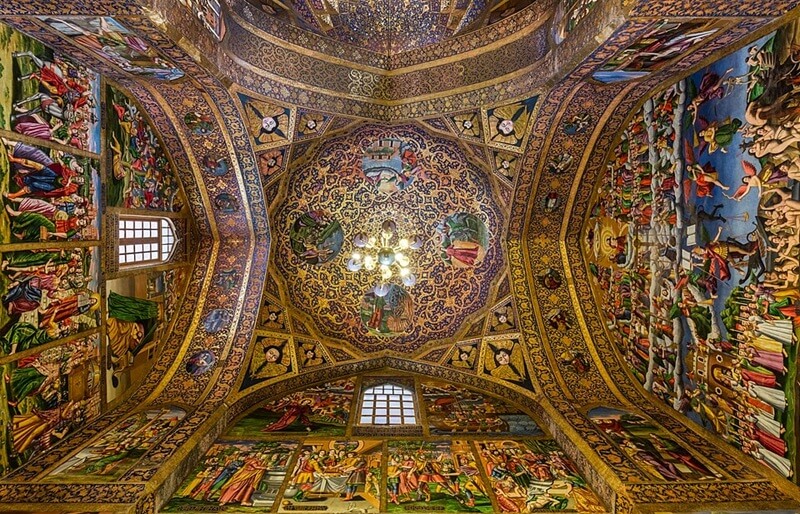
The centerpiece of the quarter, Vank Cathedral was founded in 1606 by the first Armenian immigrants and construction was finalized between 1655 and 1664. The exterior is deceptively plain — simple brickwork influenced by Safavid mosque aesthetics — but the interior is among the most extraordinary in Iran: every surface covered with gilded carvings, vibrant biblical frescoes painted by Armenian artists, and a central dome depicting the story of creation. The attached museum holds Armenian manuscripts, the first printing press introduced to Iran (by an Armenian scholar), and cultural artifacts spanning four centuries of Armenian life in Isfahan.
Jolfa Street and Café Culture
Jolfa Street is today the most significant area in Isfahan for nightlife and cafés. The combination of the Armenian community’s cultural heritage and a younger, cosmopolitan Isfahani crowd has made this the city’s most relaxed and socially open neighborhood — with coffee shops, restaurants, bookshops, and small galleries lining its streets. An afternoon in Jolfa, ending with dinner at one of its Armenian-influenced restaurants, gives a very different experience of the city than the mosque-and-palace itinerary and is one of the highlights of spending more than two days in Isfahan.
📷Photo by Diego Delso on Wikicommons
Isfahan Food: Essential Dishes and Local Food Tours
Isfahan has one of the most distinctive regional food identities in Iran, built around a handful of dishes so specific to the city that you’ll struggle to find their equal anywhere else in the country.
Essential Dishes
Beryani — Isfahan’s signature dish, and one of the most acquired tastes in Persian cuisine: finely minced lamb, spiced with cinnamon and saffron, pan-fried and served with flatbread and raw onion in dedicated beryani restaurants that open only for breakfast and lunch. The name comes from the Persian word for frying, and the dish has been made in Isfahan the same way for centuries. First-time visitors sometimes find it confronting; those who return to Isfahan often cite it as the dish they missed most.
Gaz — Isfahan’s great confection: a nougat made from the sap of the angebin plant, combined with pistachios and rosewater, and considered the finest version of a sweet made across the region. The best gaz is sold in the bazaar and in specialist shops along Chahar Bagh Boulevard — it keeps well and is the single most popular Isfahan souvenir to take home.
Saffron ice cream — Persian ice cream (bastani) made with saffron and rosewater has devotees across Iran, but Isfahan’s version, served sandwiched between two thin wafers at traditional ice cream parlours near Naqsh-e Jahan, has a particular fame. The combination of floral saffron, chewy mastic, and cream makes it unlike any ice cream you will have tasted elsewhere.
Traditional stews and kebabs — as across Iran, koobideh and joojeh kebab, ghormeh sabzi and fesenjan are available at both traditional and upscale restaurants throughout the city. Several Isfahan restaurants operate from restored Safavid or Qajar-era caravanserais and courtyard houses — eating in a 400-year-old building adds considerably to the experience.
Food Tours
For a deeper engagement with Isfahan’s food culture, a number of local hosts offer hands-on food experiences where small groups join an Isfahani family or local cook to prepare a traditional dinner together — making the stews, rice, and bread from scratch, learning the techniques and stories behind the dishes, and then eating together as guests at the family’s table. This kind of experience provides access to the domestic food culture of Isfahan that no restaurant can replicate, and is one of the most memorable ways to spend an evening in the city. Contact us at Compassimo to arrange a guided Isfahan Food Tour and discover the city’s best local dishes and hidden culinary gems.
Isfahan’s Craft Workshops and Persian Carpet Experience
Isfahan is Iran’s undisputed handicraft capital. The city has been producing enamelware, metal engraving, hand-printed textiles, and carpets at the highest level for centuries — and what makes it different from other Iranian cities is that in Isfahan, you can still watch these crafts being made in open-fronted workshops inside the bazaar, and in many cases participate directly.
Minakari (enamelware) — hand-painted copper plates, bowls, and vases whose characteristic blue-and-turquoise designs echo the city’s mosque tilework. Several bazaar workshops allow visitors to watch the painting process and, in some cases, try it themselves.
Ghalamzani (metal engraving) — the art of engraving intricate geometric and floral patterns onto copper, silver, and brass using small hammers and chisels. The sound of a ghalamzani workshop — dozens of tiny hammers tapping in overlapping rhythms — is one of Isfahan’s most characteristic sounds.
Qalamkari (hand-printed textiles) — hand-blocked cotton fabric using carved wooden blocks and natural dyes, producing the distinctive floral and geometric patterns seen on tablecloths, clothing, and wall hangings throughout the bazaar.
Persian Carpet Workshop
The most immersive craft experience available in Isfahan is a dedicated visit to a Persian carpet workshop — not a sales floor, but a working studio where weavers are at the loom and a knowledgeable guide explains the entire process: the difference between hand-knotted and hand-woven, how to read a carpet’s knot density and quality, the regional styles of different Iranian weaving traditions (Isfahan’s own style is among the most technically refined in the country), and how to identify a genuine antique versus a high-quality reproduction. If you are considering purchasing a carpet — and Isfahan is one of the best places in the world to do so — spending an hour in a workshop before you buy is the best possible preparation. For a structured experience, we offer a dedicated Persian carpet workshop visit that covers the full story of Persian carpet-making and gives you the knowledge to make a confident, informed purchase.
Qazi Hammam: A Traditional Bathhouse
Isfahan’s hammam tradition is one of the finest in Iran, and the Qazi Hammam offers the most complete visitor experience of any historic bathhouse in the city.
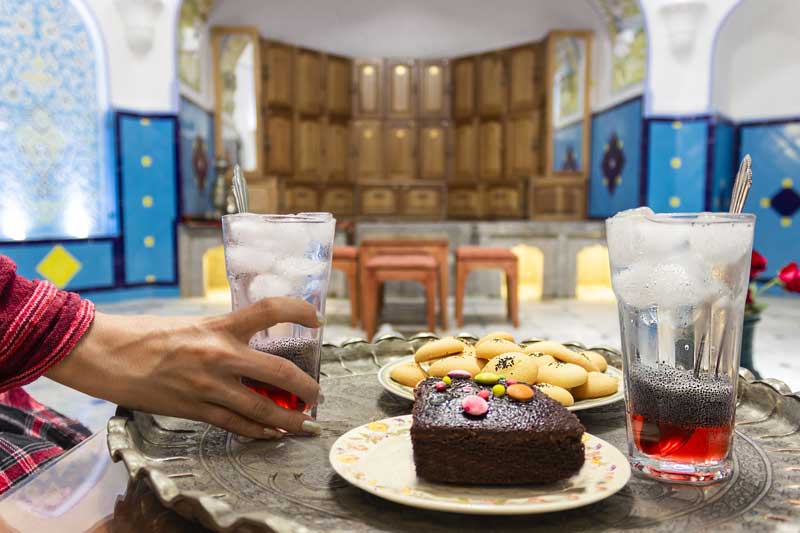
A functioning heritage hammam operating in a beautifully restored historic building, Qazi Hammam takes visitors through the full traditional bathing ritual: the steam room (garmkhaneh), the exfoliating scrub with a kessa mitt to remove dead skin, the full-body soap massage (dalak), and a long, unhurried rest in the cooling room (sarbineh) with tea and conversation. The architecture — star-patterned skylights filtering softened light into the domed chambers, marble basins, carved plasterwork — creates an atmosphere that is as much about space and quiet as it is about the bathing itself.
The experience typically takes two to three hours and is one of the most genuinely restorative things you can do mid-trip, particularly after days of walking Isfahan’s monuments in the heat. We offer a dedicated Qazi Hammam half-day experience that includes transfers and a guided introduction to the hammam’s history and rituals — an ideal way to spend a slower afternoon in Isfahan.
Best Day Trips from Isfahan
Isfahan’s surroundings offer three completely different kinds of escape, all within a few hours of the city.
Abyaneh Village
About 90 kilometers southeast of Isfahan in the Karkas Mountains, Abyaneh is one of the most visually distinctive villages in Iran: its houses built from a deep reddish-brown clay that gives the entire settlement a warm, monochrome glow against the surrounding grey rock. The village is estimated to be over 1,500 years old, retains elements of pre-Islamic Zoroastrian culture in its calendar and some local customs, and is one of the few places in Iran where older women still wear the local traditional dress — a white headscarf printed with red flowers, distinctive and unchanged for generations. The village is small enough to walk in an hour but atmospheric enough to justify an entire morning.
Varzaneh Desert
About 90 kilometers east of Isfahan, Varzaneh is the closest desert landscape to the city — a landscape of sand dunes, salt flats, and an ancient wind-tower-equipped caravanserai town that has been adapted for desert tourism. Sunset over the dunes and an overnight stay in a desert camp are the headline experiences, but the area also has camel treks, sandboarding, and the possibility of photographing the salt lake and its dramatic light at different times of day. It is an easy half-day or full-day trip from Isfahan, and pairs naturally with a visit to the traditional houses of Varzaneh town itself.
Maranjab Desert
Further north, near the ancient city of Kashan and roughly 90 kilometers from Isfahan, Maranjab offers a different desert character from Varzaneh: a harder, more austere landscape of salt desert and sparse dunes, anchored by the Maranjab Caravanserai — a beautifully preserved Safavid-era roadhouse that once served travelers on the Silk Road route through central Iran. The combination of a standing caravanserai in a desert setting gives Maranjab an atmospheric depth that Varzaneh, more oriented toward recreation, doesn’t quite match. Overnight stays inside or near the caravanserai are available and are genuinely memorable. Maranjab works well as a day trip from Isfahan or as a stop between Isfahan and Kashan.
Bakhtiari Nomad Experience
In the Zagros Mountains west of Isfahan, the Bakhtiari are one of the great nomadic peoples of Iran — a distinct Luri-speaking tribal confederation who have practiced a seasonal transhumance migration for centuries, moving their flocks between winter lowland pastures and summer mountain pastures in one of the largest regular migrations of people and animals in the world. Several Bakhtiari families in the foothills accessible from Isfahan welcome visitors for day trips or overnight stays, offering an experience similar in structure to the Qashqai visits available from Shiraz but in a different landscape, a different language, and a distinct cultural tradition. As with any nomadic visit, this is best arranged in advance through a tour operator with genuine relationships with specific families.
Isfahan’s Café Culture
Isfahan’s café scene has grown substantially over the past decade, and the city now has one of the most developed specialty coffee and independent café cultures in Iran outside Tehran. The Jolfa neighborhood is the epicenter, but good coffee and independent spaces have spread through the university district around Chahar Bagh and into the lanes around the bazaar. The Azadegan teahouse near the bazaar is the classic, long-established version of this — an atmospheric historic space layered with antiques and collectibles — while newer cafés represent a younger, more international aesthetic.
Essential Isfahan Travel Tips
Best Time to Visit
Spring (March–May) is the best time to visit Isfahan: the gardens and fruit trees are in bloom, the Zayandeh Rood is most likely to be flowing, and Nowruz (Persian New Year, around March 20–21) adds cultural richness. Autumn (September–November) is an equally pleasant alternative. Summer is hot but manageable given the city’s elevation — mornings and evenings are comfortable even in July. Winter is cold and occasionally snowy, which gives the domes a striking appearance but makes outdoor exploration less comfortable.
Getting Around
Isfahan’s historic core is walkable — most visitors cover the square, palaces, mosques, and bazaar on foot over one or two days. The city also has a metro, useful for reaching Jolfa and sites further from the center. Snapp (Iran’s ride-hailing app) works well here, as do licensed taxis. For day trips to Abyaneh, Varzaneh, or Maranjab, a private driver with a pre-arranged tour is the most practical option.
Cultural Etiquette
Isfahan’s mosques and religious sites require the same modest dress standards as across Iran — headscarves and manteau for women, long trousers and no shorts for men. The Jameh Mosque, as an active place of worship, is particularly important to enter with appropriate clothing and respectful behavior. Friday is the weekly day of rest — the bazaar and government sites are closed.
Final Thoughts: Is Isfahan Worth It?
The question answers itself fairly quickly once you’re standing in Naqsh-e Jahan at dusk, watching the Shah Mosque’s dome shift from gold to cobalt as the light changes and the fountains begin their evening display. But the deeper answer is this: Isfahan is not just worth visiting — it is the city that most consistently changes how people think about Iran.
Tehran surprises you with its modernity; Shiraz moves you with its poetry and ruins. Isfahan convinces you. It makes the case, in stone and tile and living social custom, for an Iranian civilization of extraordinary sophistication — a city that was, for a period in the 17th century, one of the largest and most cosmopolitan cities on earth, and that has held onto more of that legacy than almost anywhere else in the Islamic world.
Come for the square. Stay for the bridges at night. Go to the Jameh Mosque when you think you’ve seen enough mosques. Eat beryani for breakfast even if it sounds like the wrong idea. And leave, if you can, time for one desert and one village — because Isfahan’s surroundings complete something the city itself begins.
Want to Experience Isfahan with a Local Guide?
FAQs: Top Things to Do in Isfahan
1. Is Isfahan safe for tourists?
Yes — Isfahan is consistently rated one of the safest and most visitor-friendly cities in Iran. The tourist infrastructure is well developed, English is widely spoken at hotels and major sites, and the city’s long history as a Silk Road stop means foreign visitors are a familiar presence.
2. How many days do I need in Isfahan?
Two to three days is the minimum to cover the main sites comfortably. Four to five days allows you to add more experiences like Jolfa full discovery, a craft workshop, the Qazi Hammam, and at least one day trip. A week is not too long for travelers who want to include Abyaneh, Varzaneh or Maranjab, and a Bakhtiari nomad visit.
3. What is Isfahan most famous for?
Isfahan is most famous for Naqsh-e Jahan Square — one of the largest public squares in the world and a UNESCO World Heritage Site — and for its Safavid-era Islamic architecture, which includes some of the most technically refined tilework and dome construction in the Islamic world.
4. What is the best time to visit Isfahan?
Spring (March–May) is the best time, when the gardens bloom and the weather is mild. Autumn (September–November) is a close second. Summer is hot but manageable; winter is cold with occasional snow.
5. How far is Isfahan from Tehran?
Isfahan is roughly 450 kilometers south of Tehran. The drive takes about 4.5 hours, the train overnight, and flights about one hour.
6. What should I not miss in Isfahan?
Naqsh-e Jahan Square and all four of its monuments, the Jameh Mosque, the Khaju and Si-o-Se Pol bridges in the evening, Jolfa and Vank Cathedral, and at least one desert or village day trip.
7. Can I visit Isfahan as a day trip from Tehran?
Technically yes, but inadvisable — Isfahan deserves at minimum two nights. A day trip leaves no time for the bridges at night, the Jameh Mosque, or any of the surrounding areas.
8. Is Isfahan expensive?
No. Isfahan is exceptional value for visitors holding USD or EUR. Entry fees to major sites are a few dollars each, a full restaurant dinner for two costs $10–20, and the Qazi Hammam experience costs a fraction of any comparable spa in the West.
9. Do I need a visa to visit Isfahan?
Visa requirements are the same as for Iran generally. Most Western nationals can obtain a tourist visa; citizens of the US, UK, and Canada typically need additional arrangements. Check current Iran visa requirements before booking.
10. Can I use a credit card in Isfahan?
No. International credit and debit cards do not work anywhere in Iran due to banking sanctions. Bring clean, undamaged USD or EUR and exchange at a licensed bureau on arrival.
0 Comment