

Table of Contents
Tehran is not a city that eases you in gently. From the moment you land, it hits you — a sprawling metropolis of 15 million people wedged between arid desert plains and the snow-capped Alborz Mountains, where the call to prayer mingles with honking traffic, and ancient bazaars sit a short taxi ride from contemporary art galleries. This is a city of glorious contradiction, and that is precisely what makes it so compelling.
For the cautious international traveler, Tehran can feel like uncharted territory. Western media rarely does it justice. What you’ll actually find is a city brimming with warmth, extraordinary food, layered history, and some of the most hospitable people you’ll ever encounter. Whether you have two days or two weeks, Tehran rewards every kind of curiosity — historical, artistic, culinary, athletic, or adventurous.
This guide goes beyond the generic to give you real, ground-level intelligence for planning your trip. Here are the top things to do in Tehran, organized to help you build a meaningful itinerary.
Why Tehran Demands Your Attention
Before diving into what to do, it’s worth understanding what Tehran is — because that shapes how you experience everything else.
Tehran became Iran’s capital in 1796 under the Qajar dynasty, replacing Isfahan. Since then it has expanded relentlessly, swallowing ancient villages and suburbs, accumulating history in layers. Walk ten minutes in almost any direction and you’ll transition between eras: a Qajar-era mansion behind a wall, a modernist tower block rising behind it, a rooftop garden above that.
The city’s most disorienting quality — which quickly becomes its most exciting one — is this compression of time. To the north, the Alborz Mountains loom close enough that you can be skiing by mid-morning and walking through a 500-year-old bazaar by afternoon. To the south, the city flattens into older, denser, more traditional neighborhoods where the pace of life and the texture of the streets feel generations removed from the café-lined boulevards of the north.
Logistically, Tehran is served by Imam Khomeini International Airport (IKA), which handles most international arrivals, and Mehrabad Airport (THR) for domestic connections. Grab an Iranian SIM card on arrival for navigation (Google Maps works), download the Snapp app (Iran’s ride-hailing answer to Uber), and you’re ready to explore.
Step Inside Tehran’s Royal Palaces
No visit to Tehran is complete without exploring its great palace complexes, which together offer one of the most immersive windows into Iran’s royal past.
Golestan Palace Complex
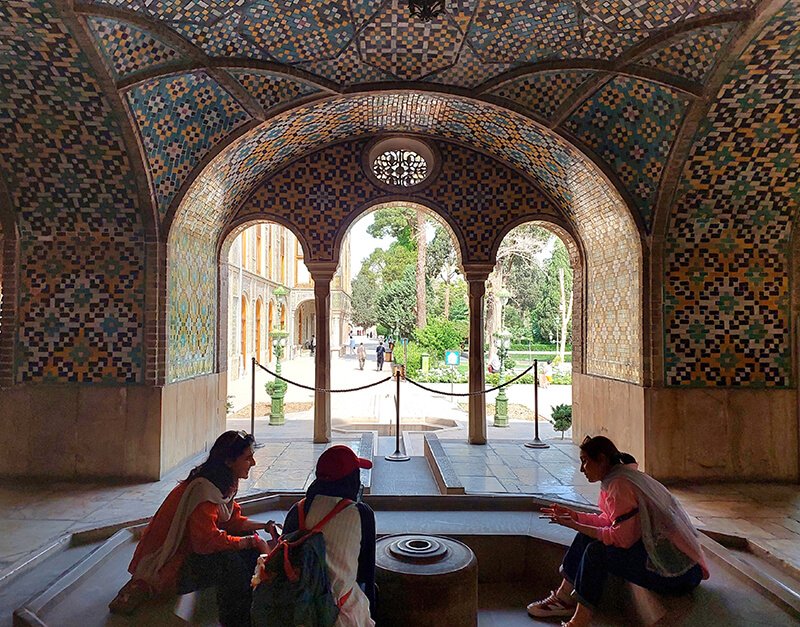
Right in the heart of old Tehran, Golestan Palace is the crown jewel of Qajar-era architecture and a UNESCO World Heritage Site recognized in 2013. The complex contains 17 distinct structures — throne rooms, mirror halls, museums, and landscaped courtyards — assembled over centuries, with the most celebrated additions dating to the 19th-century reign of Naser al-Din Shah.
The Marble Throne Hall (Takht-e Marmar) is the defining image of the complex: an open-air pavilion whose carved marble throne was used for royal coronations. The Edifice of the Sun (Shams ol-Emaneh) dazzles with its soaring mirrored interior.
Entry tips: Budget at least two to three hours here, and consider hiring an English-speaking guide— the layers of symbolism in the tilework, mosaics, and European-influenced paintings reward explanation. Morning visits are cooler and less crowded. Photography is permitted in most areas.
Niavaran Palace Complex
Head north toward the foothills and the cityscape changes dramatically. The Niavaran Palace Complex served as the primary residence of Mohammad Reza Shah Pahlavi, Iran’s last monarch, and his wife Empress Farah until the 1979 Revolution. It is a fascinating study in contrasts: a formal garden surrounds a complex that is notably modern in aesthetic, blending traditional Persian architectural elements with 1970s international design.
The main Niavaran Palace building contains the royal family’s personal quarters, preserved largely as they were left — down to books, personal effects, and artwork. A separate building houses an exceptional collection of Impressionist and Post-Impressionist works gifted to Empress Farah. For anyone interested in 20th-century Iranian history, this complex is essential.
Sa’dabad Palace Complex
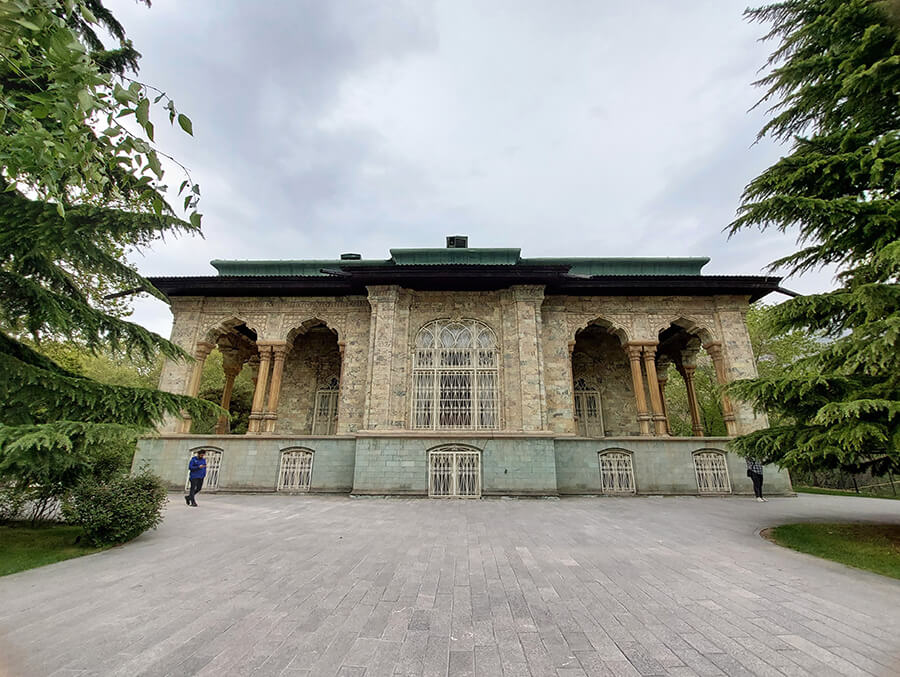
Further up into the northern hills lies Sa’dabad, a vast 110-hectare complex of forests and palaces that served across both the Qajar and Pahlavi dynasties — some of its older structures predate the 20th century, while others were built as royal summer retreats under the Pahlavis. Several buildings are open to visitors, each housing different collections — fine arts, military history, natural history, and more. The White Palace (Kakh-e Sefid), with its famous bronze boots at the entrance (all that remains of a statue of Reza Shah), is the main draw. The forested grounds alone make for a beautiful afternoon walk, especially in spring and autumn.

Get Lost in the Grand Bazaar — and Then Tajrish
Tehran’s Grand Bazaar
Tehran’s Grand Bazaar (Bazaar-e Bozorg) is not merely a marketplace. It is the economic and social nervous system of the city — a living, breathing institution that has operated continuously for centuries and today employs tens of thousands of people across an estimated 10 kilometers of covered alleyways.
Entering the bazaar is an exercise in sensory overload: the roar of handcarts, the smell of saffron and rosewater, shafts of light falling through domed brick ceilings, the rapid Persian of merchants negotiating on the phone while gesturing you into their stalls. It is deliberately confusing — and that is part of the experience.
The bazaar is organized into specialized sections, or rasteh: the carpet bazaar, the gold bazaar, the spice bazaar, the fabric bazaar, the copper bazaar. Allow yourself to get lost between them. You will stumble onto a centuries-old caravanserai being used as a warehouse, a neighborhood mosque at the center of a courtyard, a tea house serving laborers and businessmen alike.
Shopping tips: Prices are generally negotiable for goods aimed at tourists. The gold bazaar offers certified weights at fixed prices. For souvenirs, look for hand-painted enamelware (minakari), saffron (buy from reputable stalls in the spice section), dried nuts and fruits, and hand-printed cotton tablecloths.
Practical note: The bazaar is closed on Fridays and public holidays. It gets extremely crowded mid-morning — arrive at opening (around 9am) or in the late afternoon.
Tajrish Bazaar: The Northern Counterpoint
While the Grand Bazaar dominates most travel itineraries, experienced Tehran visitors know that Tajrish Bazaar, at the northern end of the city’s main artery Valiasr Street, offers a completely different experience. Smaller, more neighborhood-scaled, and surrounded by the restaurants and cafés of Tajrish Square, it is where northern Tehranis shop for fresh herbs, spices, and daily groceries. The pace is more relaxed, the crowds less overwhelming, and the adjacent Imamzadeh Saleh shrine adds a layer of religious and social life you won’t find in the south. Spend a morning here, eat lunch in the square, and you’ll feel less like a tourist and more like a resident.
Walk the Length of Valiasr Street
At roughly 18 kilometers from Tajrish Square in the north to Rah Ahan Square in the south, Valiasr Street is the longest street in the Middle East and, for many Tehranis, the symbolic spine of the city. Lined from end to end with enormous plane trees that form a cathedral-like canopy in summer, it traverses every social stratum of Tehran — from the upscale cafés and boutiques of the northern end to the workshops and traditional teahouses of the south. You cannot walk its full length in a day, but spending time on different sections gives you a reading of the city that no museum can match.
Tehran Food Tours and Essential Dishes
Tehran’s food scene is one of the most underrated in the world, and eating well here requires almost no effort — the city’s culinary culture is one of abundance, generosity, and extraordinary depth of flavor.
The Essential Dishes
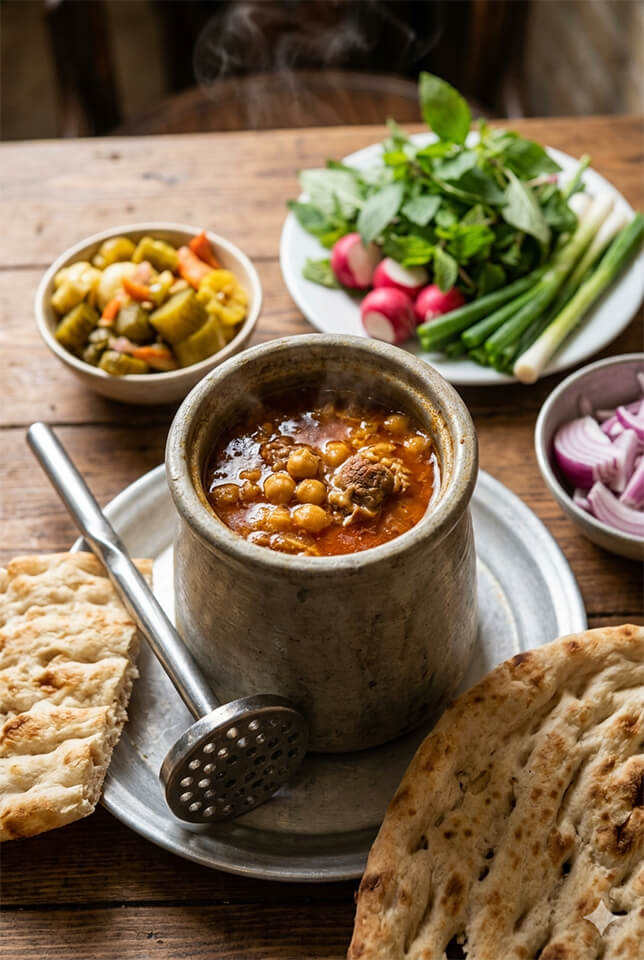
Dizi (Abgoosht) — the defining dish of traditional Tehran: a slow-cooked lamb and chickpea stew served in individual stone pots, mashed at the table and eaten in two stages (the broth first with bread, then the mashed solids). Find it at dedicated dizi restaurants in the bazaar district and southern Tehran, where it has been served the same way for generations.
Ghormeh Sabzi — Iran’s unofficial national dish: a deeply fragrant stew of fenugreek, dried limes, kidney beans, and lamb that has been slow-cooked until the herbs are almost black. It is the dish every Iranian thinks of when they think of home cooking.
Kebab — Iran’s kebab tradition is genuinely its own thing: koobideh (ground lamb and beef on flat skewers), barg (thinly pounded lamb fillet), and joojeh (saffron-marinated chicken) are the main varieties, served with grilled tomatoes, butter, and saffron rice. The best versions are found at dedicated kebab restaurants, not at tourist-facing establishments.
Ash-e Reshteh — a thick herby noodle and legume soup, especially popular in the colder months, eaten at teahouses and street kitchens.
Food Tours
For visitors who want guided orientation, Tehran has a growing number of local tour operators who lead small groups through the Grand Bazaar’s food stalls, local breakfast spots (sangak bakeries, egg-and-herb joints), and traditional restaurants in older neighborhoods. A half-day guided food walk through the bazaar district is one of the most efficient ways to get context on both the cuisine and the social life of the city.

Where to Eat
Food is one of the great social pleasures of Tehran life. Eating out — whether a long family lunch on a Friday, a late-night kebab after a gathering, or a drawn-out tea session between friends — is central to how Tehranis spend their leisure time, and the city’s restaurant culture reflects that. Across every neighborhood and every price point, from hole-in-the-wall dizi shops charging a dollar a bowl to white-tablecloth Persian fine dining, the standard is remarkably high. For a city that rarely appears on international food radar, Tehran quietly punches well above its weight.
The bazaar district and southern Tehran are where traditional eating is at its most concentrated and its most affordable — dedicated dizi houses, ash kitchens, and old-school kebab restaurants that have been feeding the same neighborhoods for generations. Head north and the city shifts register entirely. Around Tajrish, Jordan Avenue (known locally as Africa Street), and the Farmanieh neighborhood, a contemporary restaurant scene has taken root: Iranian fusion cooking, international cuisine, specialty coffee shops, and rooftop restaurants whose quality rivals anything you’d find in Istanbul or Beirut. The price gap between north and south is real but rarely dramatic — even in Tehran’s most upscale neighborhoods, a full dinner for two remains extraordinarily affordable by Western standards.
Whatever your budget or appetite, eating well in Tehran requires almost no effort. The harder challenge is choosing where to stop.
Experience Zurkhaneh: Iran’s Ancient Sport
One of the most distinctive and culturally specific experiences available to visitors in Tehran — and one that almost no Western travel guide mentions — is attending a zurkhaneh session.
A zurkhaneh (literally “house of strength”) is a traditional Iranian gymnasium where practitioners perform varzesh-e bastani, a system of athletic and martial exercises that traces its roots back over a thousand years, blending pre-Islamic Persian warrior training with Sufi devotional practice. The exercises — performed in a sunken pit (goud) to the rhythm of a drummer and the recitation of poetry from Shahnameh (Ferdowsi’s epic) by a morshed (master) — include club swinging, shield spinning, and a rhythmic group calisthenics routine that is unlike anything else you will see anywhere.
The atmosphere is extraordinary: part sport, part ceremony, part music. Men of all ages train together, from teenagers to men in their seventies, and the sessions are communal in a way that modern gyms never are. The morshed’s sung poetry sets the pace, accelerating and slowing the physical movements.
Several zurkhaneh in Tehran welcome visitors to watch sessions, which typically take place in the early morning or evening. Sessions are free or accept a small donation. Dress modestly, arrive a few minutes early, and watch quietly from the benches — you may be invited for tea afterward.
Unwind in a Traditional Hammam
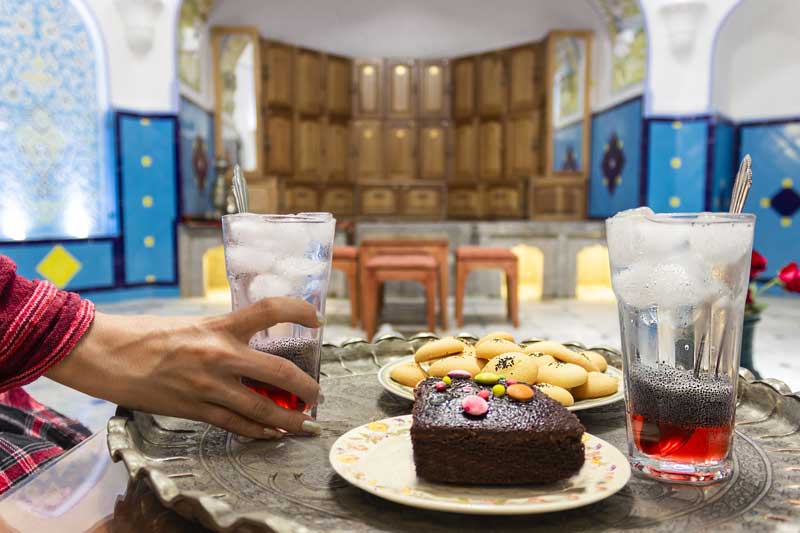
Iran’s hammam tradition — the public bathhouse as social institution — stretches back to the pre-Islamic era and reached its architectural peak during the Safavid and Qajar periods. While the functional neighborhood hammam has largely been replaced by modern plumbing, several historic hammams have been restored and now operate as visitor experiences or cultural spaces.
In Tehran, the most accessible hammam experience for visitors is through heritage hammams that operate as museum-bathhouses, combining authentic architecture — star-patterned skylights, marble basins, domed steam rooms — with the full traditional bathing ritual. The experience typically involves a steam room (garmkhaneh), a scrub with a kessa mitt to remove dead skin, a full-body soap massage (dalak), and a long rest in the cooling room with tea. It is deeply relaxing, culturally immersive, and extremely affordable by international standards.
Walk the Parks and Bridges of Modern Tehran
Tehran’s parks are a revelation for visitors who expect the city to be all concrete and traffic. The municipality has invested heavily in green spaces, and for locals, parks are essential social infrastructure — family picnic spots, evening promenades, weekend gathering places.
Tabiat Bridge (Nature Bridge)
The Tabiat Bridge is the single most remarkable piece of contemporary urban design in Tehran, and arguably in the wider region. Completed in 2014 and designed by architect Leila Araghian, it is a 270-meter pedestrian bridge spanning Modarres Highway and connecting Taleghani Park and Ab-o-Atash (Fire and Water) Park. Its three-level, tree-shaped structure allows pedestrians to walk across, sit at café terraces, or simply look out over the city from multiple vantage points. Architecture critics describe it as a seamless, human-centered answer to urban infrastructure — a bridge that functions as a destination in itself. Visit at dusk when the city lights begin to emerge below.
Mellat Park and Jamshidieh Park
Mellat Park, in northern Tehran, is a vast landscaped garden popular with families and joggers, with a small lake, outdoor cinemas in summer, and a sense of calm that feels miles from the city’s chaos. Jamshidieh Park, slightly further north, is carved into the rocky lower slopes of the Alborz Mountains and incorporates stone pathways, streams, and classical teahouses — the climb up to its higher sections rewards with sweeping views across the city.
Darband, Darakeh, and the Mountain Villages
No visit to Tehran is complete without one afternoon in the Alborz foothills. Darband, accessible from northern Tehran via metro and a short taxi rige, is a mountain trail lined with teahouses and small restaurants where locals gather to eat traditional lamb dishes and drink tea. On weekends it is full of families, hikers, and couples — a vivid slice of Tehran social life against a backdrop of streams and mountain air.
Darakeh, a few kilometers to the west of Darband, is quieter and slightly wilder in character — a narrow valley with a stream running through it and a series of teahouses that become progressively more traditional as you climb. Many locals prefer it precisely because it draws fewer visitors than Darband.
Explore the Must-See Museums of Tehran
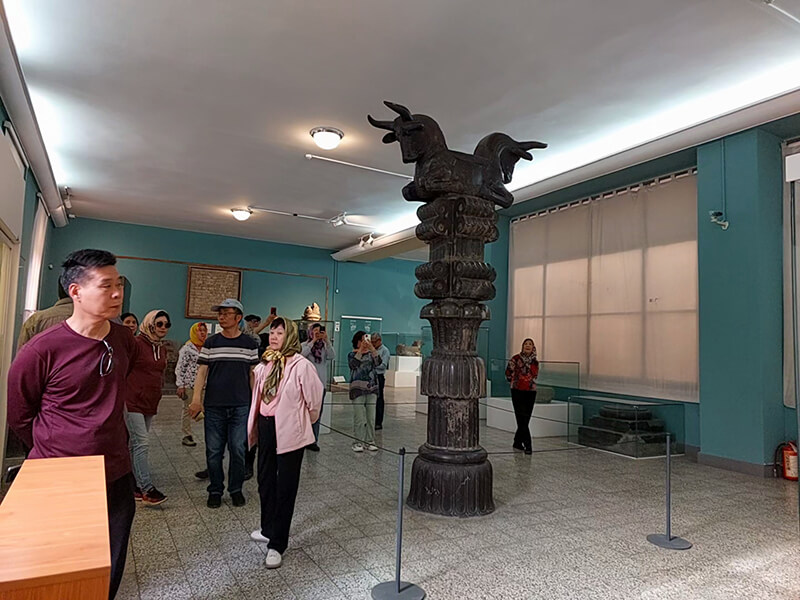
Tehran has a genuinely world-class museum offer that goes largely undiscovered by international visitors. Here are the essential ones.
National Museum of Iran (Iran Bastan Museum)
Housed in a building whose arched entrance was inspired by the Sassanid palace at Ctesiphon, the National Museum is the country’s most important archaeological repository. Its collections span from prehistoric Iran through the Islamic period, with particular highlights including a 5,000-year-old salt man excavated from a mine in Zanjan, cuneiform tablets from the Persepolis treasury, and a remarkable array of Achaemenid, Parthian, and Sassanid metalwork. Combine a visit here with the adjacent Islamic Period Museum next door.
Tehran Museum of Contemporary Art (TMoCA)
This is one of the most extraordinary museums in the world that most people have never heard of. Built in 1977 and designed by architect Kamran Diba, the museum holds a collection of modern Western art assembled on behalf of Empress Farah before the Revolution — works by Picasso, Warhol, Pollock, Bacon, Lichtenstein, Miró, and many others. By most assessments, it is among the most valuable collections of modern Western art outside of Europe and the United States. Note that portions of the collection are occasionally loaned internationally or placed in storage for temporary exhibitions, so check current display details before you visit. The spiraling brutalist-organic building is worth seeing regardless of what is on the walls.
Carpet Museum of Iran
A short walk from TMoCA, the Carpet Museum is housed in a building whose roof is shaped like a loom — a beautiful architectural touch. Inside, rotating exhibitions showcase the finest examples of Persian carpet-weaving from across the country, spanning centuries and styles. If you are considering buying a carpet (and you should be), this museum provides invaluable context for understanding regional styles, knotting densities, and the difference between a genuine antique and a decorative reproduction.
Jewelry Museum of Iran
Located inside the Central Bank of Iran and open Saturday through Tuesday only, the Jewelry Museum is almost absurdly spectacular. It houses the Iranian Imperial Crown Jewels — including the Sea of Light diamond (one of the largest uncut diamonds in the world), the Taj-e-Mah tiara, and a globe encrusted with emeralds and rubies. Entry requires queuing and security checks, but it is worth every minute. Arrive early on your chosen day.
Glassware and Ceramics Museum (Abgineh Museum)
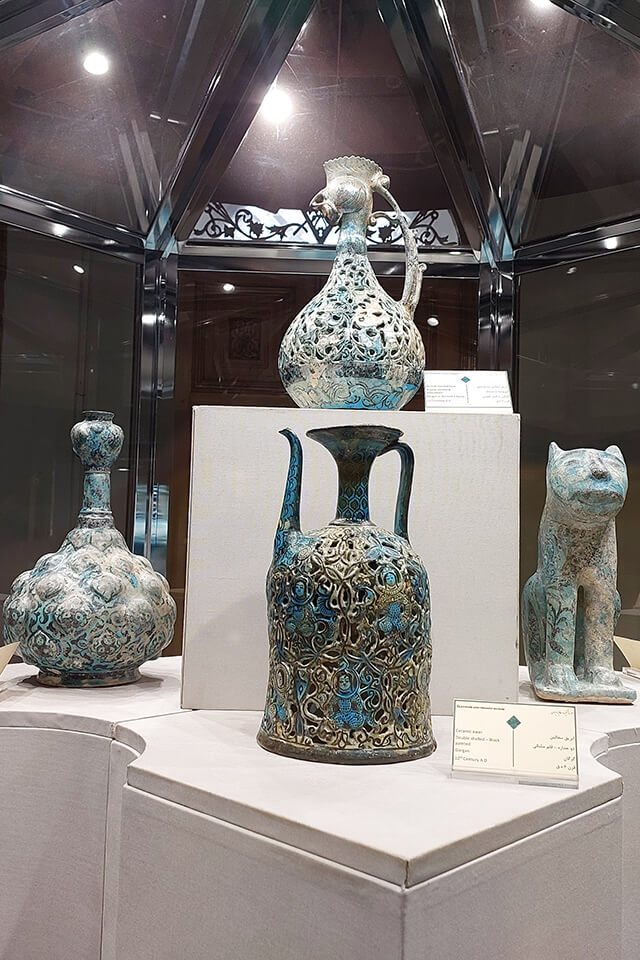
Often overlooked even by repeat visitors, the Abgineh Museum is housed in a stunning early 20th-century mansion and presents one of the finest collections of pre-Islamic and Islamic-period glassware and ceramics in existence. Objects range from Achaemenid-era glass vessels to Seljuk and Safavid ceramics of extraordinary refinement. The building alone — all carved plasterwork and stained-glass windows — is worth the visit.
Tehran Cinema Museum
For visitors interested in Iranian film — one of the most critically celebrated national cinemas in the world — the Cinema Museum is a well-curated introduction to its history, from the earliest silent films to the works of Abbas Kiarostami, Jafar Panahi, and Asghar Farhadi. The building, a restored cinema from the Pahlavi era, is itself part of the experience.
Music Museum of Iran
A smaller but charming institution near the city center, the Music Museum houses a collection of traditional Iranian instruments — tar, setar, santur, daf, kamancheh — along with archival recordings and documentation of regional musical traditions from across Iran’s diverse ethnic communities.
Look Up: Tehran’s Two Great Towers
Azadi Tower (Freedom Tower)
Azadi Tower is the symbolic gateway to Tehran — the monument you see on the city’s western approach, standing at the end of a broad plaza. Built in 1971 to commemorate the 2,500th anniversary of the Persian Empire, it was designed by architect Hossein Amanat and merges Sasanian and Islamic architectural styles in a form that is instantly recognizable worldwide. The tower has a small museum inside covering the history of Iranian architecture, and its observation deck offers sweeping views over the western city. The plaza around it is a popular evening gathering place, particularly on weekends when families come out after dark.
Milad Tower
On Tehran’s northwestern skyline, Milad Tower dominates everything around it. Standing at 435 meters (1,427 feet) in total height — making it the sixth tallest telecommunications tower in the world — it was completed in 2007 and contains offices, a revolving restaurant, and multiple observation decks. On a clear day, best after winter rain has settled the dust, the views extend to Mount Damavand and south across the full breadth of the city. The revolving restaurant at the top makes for a memorable dinner: the food is good by any standard and the slow rotation means you see the entire panorama over the course of a meal. The attached mall and convention center complex at the base have made it a self-contained destination in its own right.
Tehran’s Surroundings: Mountains, Ski Slopes, and Ancient Sites
One of the most underappreciated things about visiting Tehran is what lies just beyond the city limits. The surrounding region offers landscapes and experiences that few capitals can match.
Mount Damavand
At 5,610 meters (18,406 feet), Damavand is the highest volcano in Asia and the highest peak in the Middle East. Visible from Tehran on clear days as a perfect snow-capped cone to the northeast, it has been a symbol of Iranian national identity since ancient times, featuring in Zoroastrian mythology and classical Persian poetry. Serious climbers tackle the summit via established routes from the village of Polour — typically a 3 to 5-day ascent for non-acclimatized travelers, with acclimatization hikes on earlier days being critical for safety. Day-trippers can drive or take a bus to Rineh or Polour for spectacular views and mountain walks without the full ascent.
Tochal, Dizin, and Shemshak: Skiing Within Reach of the Capital
Iran’s ski resorts are one of the country’s best-kept secrets. Tochal, accessible via a gondola that departs from the northern edge of Tehran itself, offers skiing at altitudes up to 3,900 meters. In winter, it is genuinely surreal to ski in the morning and walk through Tehran’s bazaar in the afternoon.
Dizin, about 70 kilometers from Tehran in the Alborz Mountains, is Iran’s largest and most developed ski resort, with modern lifts, a long season often running November through May at higher elevations, and facilities that consistently surprise international visitors with their quality. Shemshak, closer to the city, is more intimate and favored by locals for weekend skiing.
Rey: Ancient Tehran
South of the modern city, the ancient town of Rey is one of the oldest continuously inhabited settlements in the world, mentioned in Zoroastrian scriptures and serving as an Achaemenid administrative center. Today its attractions include the Cheshmeh Ali rock reliefs and gardens, the imposing Rashkan Castle on its rocky hill, and the tomb of Shah Abdol-Azim — a significant Shia shrine whose adjacent bazaar is a more authentic, less touristy version of the Grand Bazaar. The ruins of the ancient city walls round out a half-day exploration.
Combine Rey with Varamin, about 40 kilometers further south, which has a superbly preserved 14th-century Friday mosque (Masjid-e Jame Varamin) considered one of the finest examples of Ilkhanid-period architecture in Iran.

📷Photo by Mehdi Ghanimifard on Wikicommons
Tehran’s Café Culture and Underground Arts Scene
This is the side of Tehran that surprises almost every visitor, and it rarely makes it into travel guides.
Northern Tehran — particularly the neighborhoods of Elahiyeh, Zafaraniyeh, Jordan, and around Tajrish — has developed one of the most vibrant café cultures in the region. Specialty coffee shops, independent bookshops, small music venues, and design-led restaurants have proliferated, particularly since 2015, catering to a young, educated, cosmopolitan population that is intensely curious about the wider world. Many of these spaces function simultaneously as art galleries, live music venues, or literary salons. Conversations with owners and regulars, where language allows, are some of the most unexpectedly rich experiences Tehran has to offer.
Tehran also has a small but serious street art scene — look for it in the alleys around the University of Tehran, in the Laleh Park area, and in the newer districts of the north. The city’s muralist tradition (famously political since the Revolution) coexists with a newer generation of artists working in a more international idiom. Walking these streets with your eyes up rewards careful attention.
Spending Power: Is $100 a Lot of Money in Tehran?
The short answer is yes — emphatically. For international visitors holding USD or EUR, Tehran offers good value. However, understanding how money works in Iran is essential before you arrive.
Iran operates with a dual and often confusing currency system. The official currency is the Iranian Rial (IRR), but colloquially most Iranians use Toman (1 Toman = 10 Rial), and prices are almost always quoted in Toman.
What $100 gets you in practical terms:
- A comfortable mid-range hotel in central Tehran for two nights
- Meals for a full day, including a traditional restaurant dinner with multiple courses
- Entry to all the major museums and palace complexes in the city (most charge the equivalent of $1–5 USD)
- A full day of Snapp (ride-hailing) travel across the city
A fine restaurant dinner for two — kebab, stew, salad, bread, drinks — will typically cost the equivalent of $8–15 USD. Subway rides cost pennies. Museum entries are subsidized and extremely affordable.
Critical money logistics:
- Bring USD or EUR in clean, undamaged notes. Worn or torn notes are frequently refused.
- Exchange at licensed exchange bureaus (sarafi), not hotels or airports.
- Carry a mix of denominations — large bills can be hard to break in small shops.
- International credit and debit cards do not work anywhere in Iran. There are no workarounds. Plan accordingly.
- Keep a reasonable amount of cash on you at all times. ATMs are not accessible to foreign cardholders.
Essential Tehran Travel Tips
When to Visit
Tehran’s climate varies dramatically by season. Spring (March–May) is widely considered the best time to visit: temperatures are mild, the city’s gardens are in bloom, and Nowruz (Persian New Year, around March 20–21) is one of the most culturally rich periods to experience. Autumn (September–November) offers a similarly pleasant window. Summer in Tehran is hot — often exceeding 35°C/95°F — and the city partially empties as residents head to the Caspian coast or mountains. Winter is cold and snowy in the northern districts and the ideal time for skiing; Dizin and Tochal are typically at their best December through February.
Getting Around
Tehran’s metro system is one of its great unsung assets — extensive, extremely cheap (fares cost a few cents), air-conditioned, and largely safe, however crowded in rush hours. It reaches most major attractions including Azadi Tower, Tajrish Bazaar, and the city’s southern historic areas. Snapp, the local ride-hailing app, is reliable, affordable, and accepts cash. Traditional shared taxis (savari) are even cheaper but require knowing your route and destination in Persian.
Visa
Most Western nationals can obtain an Iran tourist visa, though citizens of the US, UK, and Canada face additional restrictions and typically need a guided tour or a formal invitation letter. Visa-on-arrival is available at major airports for many nationalities. Check current requirements directly through an Iranian embassy or contact us to assist you in your visa process.
Connectivity
Buy a local SIM card (Irancell or MCI) at the airport or any phone shop. A tourist SIM with data is inexpensive and gives you access to navigation, translation apps, and local services. Some international platforms are filtered — a VPN downloaded before you arrive will restore access to Instagram, WhatsApp, and others.
Cultural Etiquette
Iranians are extraordinarily hospitable to foreign visitors and you will almost certainly be offered tea, invited to someone’s home, or encounter ta’arof — the Persian system of elaborate ritual politeness in which an initial offer or refusal is rarely the final one. A few key points to keep in mind: remove shoes before entering homes and some traditional buildings; public displays of affection between couples are not acceptable; photography of military installations, government buildings, and airports is prohibited; and Friday is the weekly day of rest — government sites and many shops are closed.
Final Thoughts: Is Tehran Worth It?
Tehran is not an easy destination in the conventional tourist sense. The visa process requires planning (from a few days to weeks, depending on your nationality). The financial logistics demand preparation. The cultural codes are different from what most Western visitors are used to. And yet, almost universally, travelers who make the effort report that it is among the most rewarding city experiences they have had — precisely because so few international tourists arrive, and the city has not adapted itself for mass tourism.
What awaits you is genuine: palaces that rival Versailles without the queues, bazaars that have operated for centuries, mountains you can ski on in the morning and leave behind by afternoon, museums holding world-class collections at a fraction of the cost of any Western equivalent, ancient sports practiced in candlelit underground gyms, teahouses on mountain trails, and above all, a population with an intense curiosity about and warmth toward foreign visitors.
Tehran rewards the prepared traveler. Do the groundwork — sort your visa, arrange your cash, download Snapp, understand the dress code — and the city will give you back far more than you invest.
Building an itinerary for Iran requires careful planning, especially around visas, currency logistics, and timing. Our team specializes in tailor-made Iran travel itineraries for international visitors — whether you want a focused three-day Tehran deep dive or a two-week journey across the country. Explore our ready-made tours or contact us to start planning your trip.
Ready to Explore the Magic of Tehran?
FAQs for Top Things to Do in Tehran
1. Is Tehran safe for tourists?
Tehran is generally safe for tourists. Crime against visitors is rare, and Iranians are known for their warmth and hospitality toward foreigners. The main considerations are practical rather than security-related: understanding the dress code, carrying cash (international cards don’t work), and being aware of which areas to photograph. Most visitors report feeling safer walking Tehran’s streets than those of many comparable capitals.
2. How many days do I need to see Tehran?
Three to four days is the ideal minimum for Tehran. This gives you enough time to cover the major palaces, the Grand Bazaar, the key museums, and a half-day in the Alborz foothills — without rushing. If you want to add a day trip to Rey, a ski morning at Tochal, or more time exploring the city’s café culture and arts scene, five days is more comfortable.
3. What is the best time of the year to visit Tehran?
Spring (March–May) is the best time to visit Tehran. Temperatures are mild, the city’s gardens are in bloom, and Nowruz (Persian New Year, around March 20–21) offers one of the richest cultural experiences of the calendar year. Autumn (September–November) is an equally pleasant second choice. Summer is hot, often exceeding 35°C, while winter is best suited to visitors who plan to ski at Dizin or Tochal.
4. Do I need a visa to visit Tehran?
Most international visitors need a visa to enter Iran. Visa-on-arrival is available for many nationalities at Imam Khomeini International Airport. Citizens of the US, UK, and Canada face additional restrictions and typically require a guided tour or formal invitation letter. Visa requirements and processing times vary by nationality and can change — always check current requirements through an Iranian embassy or contact Compassimo as a specialist Iran tour operator before booking.
5. Can I use my credit card or ATM in Iran?
No. International credit cards, debit cards, and ATMs are not accessible to foreign visitors in Iran due to banking sanctions. There are no workarounds. You must bring sufficient cash in USD or EUR — in clean, undamaged notes — and exchange it at licensed exchange bureaus (sarafi) on arrival. Carry a range of denominations, as large bills can be difficult to break in smaller shops.
6. What should I wear as a tourist in Iran?
Iran has a mandatory dress code for all visitors. Women must wear a headscarf (hijab) and a loose-fitting coat or manteau covering the body to at least mid-thigh in all public spaces. Men should wear long trousers and avoid sleeveless shirts. Enforcement has been uneven in recent years — stricter at religious sites and in traditional southern neighborhoods, more relaxed in northern Tehran and mountain areas — but compliance is strongly recommended throughout your visit.
7. Is Tehran expensive for tourists?
Tehran is one of the most affordable major cities in the world for visitors holding USD or EUR. A full restaurant dinner for two typically costs the equivalent of $8–15 USD. Museum and palace entry fees are subsidized and usually under $3. A mid-range hotel for a night costs a fraction of its Western equivalent. The metro is nearly free. Even on a modest daily budget, international visitors find their purchasing power goes remarkably far.
8. How do I get around Tehran?
The best ways to get around Tehran are the metro and Snapp (Iran’s ride-hailing app). The metro is extensive, air-conditioned, and extremely cheap — it covers most major attractions including Azadi Tower, Tajrish, and the bazaar district. Snapp works like Uber, accepts cash, and handles navigation for you even if the driver doesn’t speak English. Traditional shared taxis (savari) are available but require knowing your route in Persian.
9. What is Tehran most famous for?
Tehran is best known for its UNESCO-listed Golestan Palace, the Grand Bazaar (one of the largest covered bazaars in the world), and the Tehran Museum of Contemporary Art — which holds one of the most valuable collections of modern Western art outside Europe and the US. Beyond its landmarks, the city is famous for its dramatic contrast between ancient and modern, its proximity to ski slopes, and the legendary hospitality of its people.
10. Do people speak English in Tehran?
English is spoken to varying degrees across Tehran. At hotels, guesthouses, major museums, and tourist-facing businesses in northern Tehran, you will generally find English speakers. In the bazaar, traditional restaurants, and southern neighborhoods, communication relies more on gestures, translation apps, and goodwill — which Tehranis offer in abundance. Downloading a Persian-English translation app before you arrive, and learning a few basic phrases, goes a long way.
0 Comment