


Table of Contents
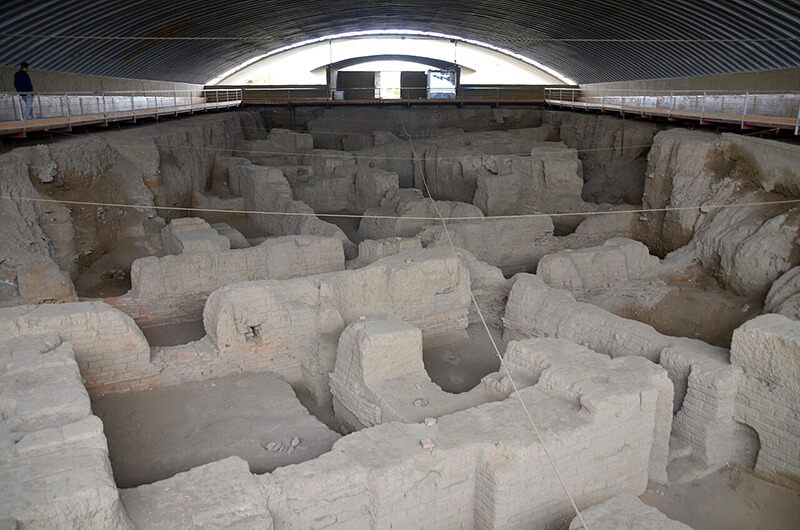
Beneath the ordinary street life of Hamadan — a cool, mountain city in western Iran — lies one of the oldest planned capitals in the Iranian world: Hegmataneh, known to Greek historians as Ecbatana. Inscribed on UNESCO’s World Heritage List in 2024, this is not a site of soaring columns or reconstructed palace gates. It is a place of layers: mudbrick foundations under apartment blocks, a checkerboard street grid traced by archaeologists, and a modest museum case of gold and silver that once belonged to kings.
In one sentence, the top things to do at Hegmataneh (Ecbatana) are: walk the excavated grid of parallel streets and mudbrick walls, visit the on-site Hegmataneh Museum, then pair your visit with Hamadan’s other landmarks — the Avicenna Mausoleum, Ganjnameh inscriptions, Alavian Dome, Tomb of Esther and Mordechai, and the historic bazaar — before considering a half-day trip to Ali Sadr Cave.
Ecbatana At a Glance
| Detail | Information |
|---|---|
| Location | Hamadan, Hamadan Province, western Iran |
| UNESCO Status | Inscribed July 27, 2024; Iran’s 28th World Heritage property; criteria (ii) and (iii) |
| Best Time to Visit | Spring (April–June) and early autumn (September–October) for comfortable walking weather. |
| Top Attractions On-Site | Excavated street grid, mudbrick defensive walls, Hegmataneh Museum |
| Ideal Stay in Hamadan | 1–2 nights (pairs well with nearby sites in a full day or two) |
| Getting Around Hamadan | Taxis and ride-hailing apps (Snapp/Tap30); site is a 10–15 minute walk north from Imam Khomeini Square. |
| Opening Hours | Spring/Summer: 8:00 AM–7:30 PM; Autumn/Winter: 8:30 AM–5:00 PM (daily; may vary in Ramadan) |
| Nearby Pairings | Avicenna Mausoleum, Ganjnameh inscriptions, Alavian Dome, Tomb of Esther and Mordechai, Hamadan Bazaar, Ali Sadr Cave (half-day trip) |
What Ecbatana Means, and Why It Has Two Names
The name most travelers search for — Ecbatana — is Greek. Herodotus and later classical writers rendered the local name as Agbatana or Ekbatana, and the term stuck in Western sources ever since. The name Iran uses today, Hegmataneh, comes closer to the original: it derives from the Old Persian Hagmatāna, meaning “the place of gathering,” a term that appears in Darius the Great’s inscription at Bisotun.
The “gathering place” meaning isn’t just etymology — it points to what the site may have been before it was ever a capital. Herodotus recounts a tradition in which the Medes convened here to appoint Deioces (also transliterated Dayukku) as their first king, a founding myth that blends recorded history with legend in a way that’s worth flagging honestly rather than repeating as fact.
A Capital Through Five Empires
The Medes and the Rise of Ecbatana
The Median kingdom rose in the 8th century BCE in the Zagros highlands of northwestern Iran, uniting a loose confederation of Iranian tribes into the region’s first major indigenous power. Deioces is traditionally credited with choosing Ecbatana as his seat, and by the 7th and 6th centuries BCE the city had become the political center of an empire strong enough to help topple Assyria. This is the period UNESCO singles out as archaeologically rare — Median-era material culture is scarce anywhere in Iran, which makes what survives under Hamadan unusually significant.
Cyrus the Great and the Achaemenid Summer Capital
Before Ecbatana became an Achaemenid possession, the empire’s founder had already built his own capital a few hundred kilometers to the south — a useful point of comparison for travelers tracing the empire’s early years. In 550 BCE, Cyrus the Great defeated the Median king Astyages and absorbed Ecbatana into the new Achaemenid Empire. Rather than abandon the city, the Achaemenids elevated it: Ecbatana became one of the empire’s seasonal capitals, the place Darius and Xerxes retreated to when the heat at the ceremonial capital further south or in Susa grew unbearable. Its position at nearly 1,800 meters in the Zagros gave it a genuinely different climate — cool summers, snowy winters — which is precisely why Achaemenid kings valued it as a retreat rather than a year-round court.
📷Photo by Alireza Javaheri on Wikicommons
The Ecbatana Palace of Legend
No structure has drawn more speculation than the Ecbatana palace Herodotus describes: a citadel ringed by seven concentric walls, each painted a different color, with the innermost gates plated in silver and gold. It’s a vivid image, and almost certainly an exaggeration filtered through Greek storytelling rather than an architectural record. Archaeology at the site hasn’t confirmed anything resembling seven walls, and it’s worth being upfront about that gap — the legend endures because it’s dramatic, not because it’s been dug up.
Seleucid and Parthian Ecbatana: The Treasury City
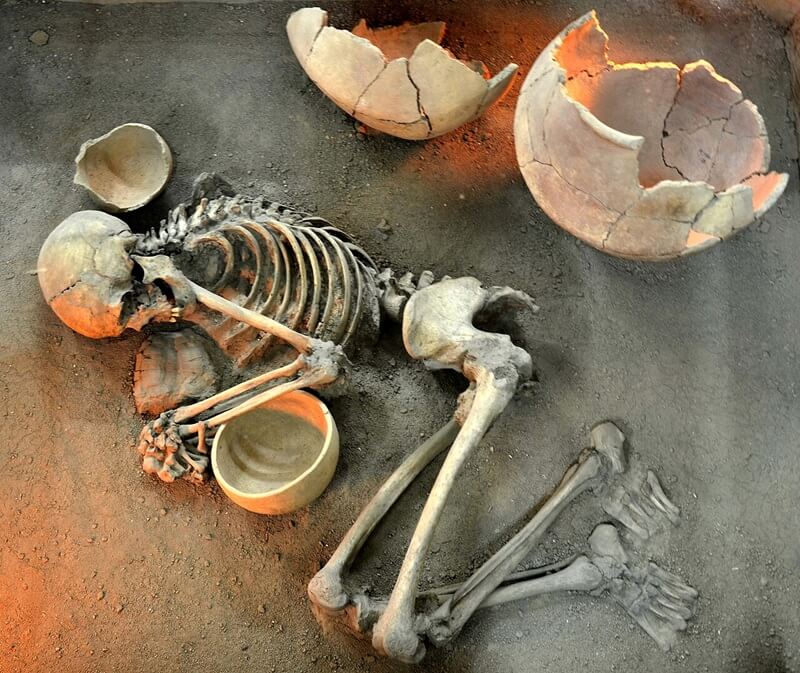
Under the Seleucids and then the Parthians, Ecbatana kept its status as a summer capital and, by classical accounts, as a treasury. Excavations and museum holdings from the wider Hegmataneh site have produced golden and silver Achaemenid-era pieces — most famously a golden rhyton in the shape of a winged lion — along with inscriptions attributed to Aryaramna and Arsames, ancestors of Darius the Great. These finds, now largely held in Tehran, are part of why the site matters more as an archive of objects than as a place of standing monuments.
Sasanian and Early Islamic Continuity
The city’s importance didn’t end with antiquity. Occupation continued into the Sasanian period and beyond, into the Islamic era, with evidence from the Buyid dynasty among the layers archaeologists have identified. That continuity — nearly three thousand years of people living on and around the same hill — is one of the details UNESCO’s citation highlights, and it’s part of what separates Hegmataneh from ruins that were abandoned outright.
Inside the Ruins: Hegmataneh Mudbrick City
A Grid That Predates Grid Cities
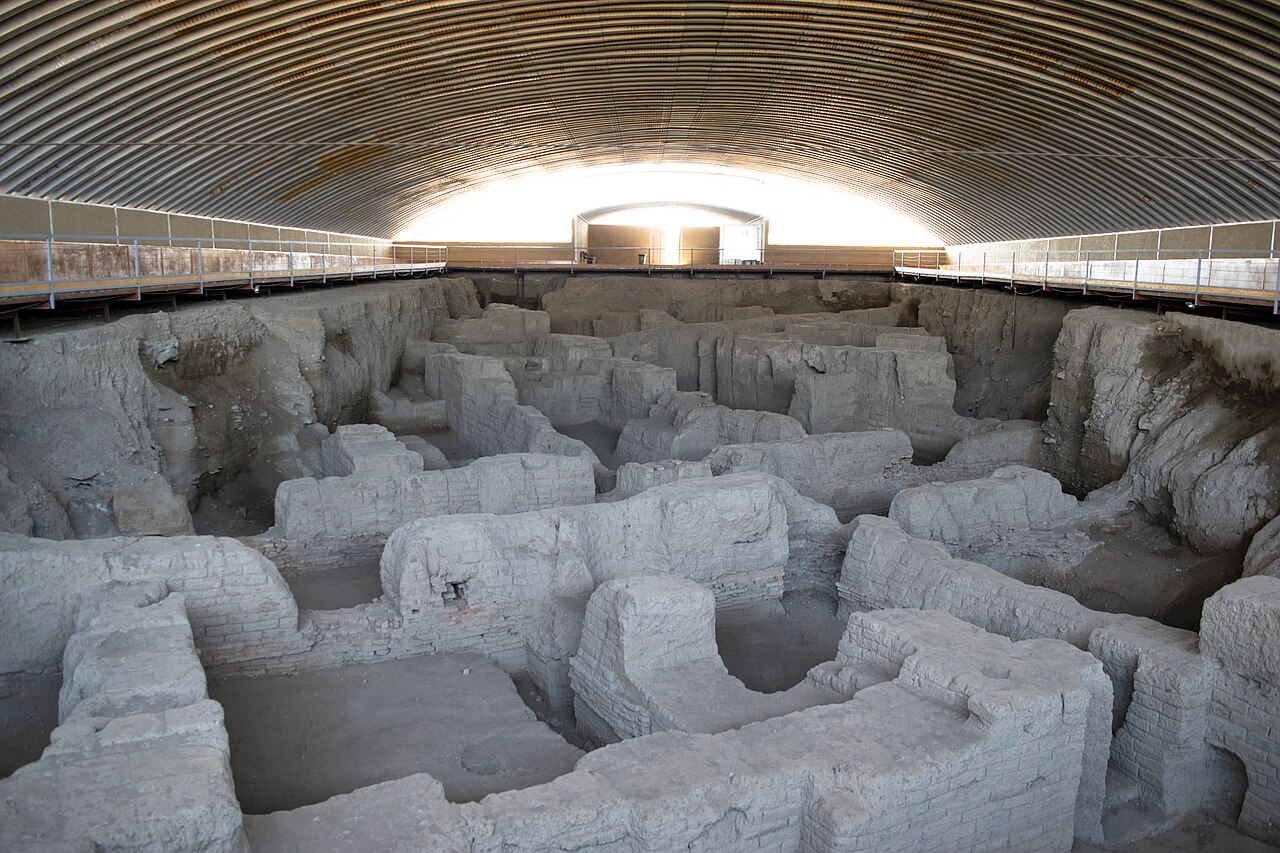
The most striking archaeological finding at Hegmataneh isn’t a building — it’s a street plan. Excavated sections reveal a checkerboard layout of parallel and perpendicular streets, with houses built back to back in a repeating pattern. Ancient engineers laid out massive mudbrick complexes in strict geometric patterns — residential and administrative units each measuring exactly 17.5 by 17.5 meters — arranged along parallel passageways running northeast to southwest. The city featured broad main streets measuring 3.5 meters wide, intersected by smaller, organized alleys about 2.5 meters across. It’s considered one of the earliest known examples of deliberate urban planning anywhere in the ancient world, evidence of a city designed rather than one that simply grew.
📷Photo by Majphoto on Wikicommons
Mudbrick Walls and What’s Still Underground
Much of what’s been excavated is mudbrick rather than stone, which is part of why first-time visitors sometimes come away underwhelmed — this isn’t a site of dramatic standing columns. What has been uncovered includes substantial defensive wall foundations — some up to 9 meters thick and rising over 10 meters high in their prime — and residential quarters, but by most estimates a large majority of ancient Ecbatana still lies buried beneath modern Hamadan, unexcavated and, in places, unexcavatable without disturbing the living city above it.
What Hegmataneh Doesn’t Have
In the spirit of setting honest expectations: Hegmataneh does not offer the visual payoff of a Persepolis or a Naqsh-e Jahan Square. There are no soaring facades. The best individual artifacts recovered from the site — the golden rhyton chief among them — live in Tehran’s National Museum and Reza Abbasi Museum, not in Hamadan. The on-site museum has real, worthwhile pieces, but it’s modest. Visitors expecting a monument should recalibrate; visitors interested in walking the actual footprint of a three-thousand-year-old capital will find that expectation met.
Hegmataneh’s UNESCO World Heritage Listing
Hegmataneh was formally inscribed on the UNESCO World Heritage List on July 27, 2024, during the 46th session of the World Heritage Committee in New Delhi. It became the country’s 28th UNESCO World Heritage property, joining a growing roster of internationally recognized UNESCO sites across Iran, with the inscribed area covering roughly 75 hectares and a buffer zone extending to about 287 hectares around it.
UNESCO inscribed the site on the basis of two criteria — (ii) and (iii) — after the original nomination (which included criterion iv) was narrowed at the Committee session. In plain terms:
- Criterion (ii): the site shows important evidence of cultural exchange among Middle Eastern civilizations in antiquity — specifically, the town planning and architectural remains from the Parthian period, along with artifacts made for the royal courts at Susa and Persepolis, which point to skilled craftsmanship at Hegmataneh and the movement of ideas and techniques between major ancient cities.
- Criterion (iii): Hegmataneh stands as one of the ancient seats of government in the Middle East, offering exceptional testimony to the cultural, social, economic, and political developments that shaped the Iranian Plateau during the first millennium BCE.
In short: the site earned its listing not for a single spectacular structure, but for what it reveals about how power, craft, and culture moved across the region over more than a thousand years. You can read UNESCO’s full official listing at the World Heritage Centre.
The Nomination That Nearly Doubled in Size
The path to inscription involved a genuine tug-of-war over scope. Iran’s original dossier proposed a much larger property — “Hegmataneh and the Historic Centre of Hamadan” — encompassing not just the archaeological hill but the city’s old bazaar and roughly 140 additional historical sites across Hamadan’s urban core. In 2023, ICOMOS, UNESCO’s advisory body, raised concerns about the file, requesting more documentation on authenticity, conservation planning, legal protections, and how the surrounding historic neighborhood would be safeguarded. Rather than resolve every concern before the 2024 session, the committee narrowed the nomination: the historic center of Hamadan was reclassified as a buffer zone rather than part of the core listing, and Hegmataneh alone went forward for inscription. It’s a useful reminder that World Heritage status is often a negotiated outcome, not a simple stamp of approval — and that the boundaries of what’s officially protected can shift right up to the final vote.
Visiting Hegmataneh Today
Getting There
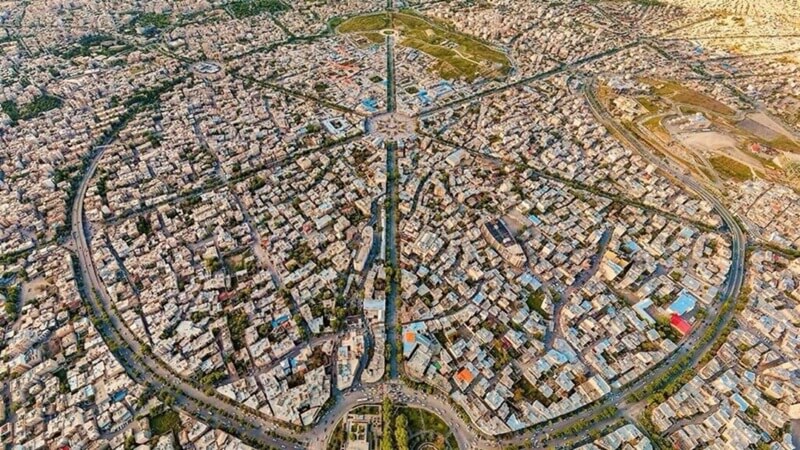
Hegmataneh sits within the modern city of Hamadan, roughly 320–360 km southwest of Tehran depending on the route, a drive of about three to five hours. Within the city, the site sits at the end of Ekbatan Street and is easy to reach by taxi or ride-hailing apps from anywhere in Hamadan’s compact, circular street layout; from Imam Khomeini Square, it’s a 10–15 minute walk north.
Hours, Tickets, and What to Expect
Opening hours shift seasonally — roughly 8:00 AM to 7:30 PM in spring and summer (April–September), narrowing to around 8:30 AM to 5:00 PM in autumn and winter (October–March). Times may fluctuate slightly during Ramadan or national mourning holidays. The entrance fee for foreign tourists is around €2 – €5, payable in local cash at the gate.
Comfortable, closed-toe shoes are worth the effort; parts of the excavated area involve uneven ground.
How Much Time to Set Aside
Realistically, most visitors need somewhere between 45 minutes and 90 minutes to walk the excavated grid and visit the on-site museum. It’s not a half-day destination on its own — which is exactly why it pairs well with Hamadan’s other historic sites in a single day.
Best Time to Visit
Spring (April to June) and early autumn (September to October) bring Hamadan’s most comfortable weather for walking an open-air site. Summer days can be hot, though evenings cool quickly at altitude, and winter brings genuine snow and freezing temperatures that make the exposed excavation area far less pleasant to explore. If you’re mapping Hamadan against the rest of your trip, our season-by-season breakdown of travel across the country is worth checking before you lock in dates.
Suggested Order
Start at the Hegmataneh site and museum in the morning, when the site is quieter and the light is better for the open excavation area. From there, most of Hamadan’s other landmarks are a short taxi ride away, making it easy to build out a fuller half-day or full-day itinerary around the ancient capital.
Nearby Attractions to Pair with Ecbatana Visit
Avicenna Mausoleum: Tomb and Museum
The Avicenna Mausoleum (Tomb of Abu Ali Sina) honors Ibn Sina, the philosopher-physician who remains one of Hamadan’s most celebrated historical residents. The modern structure — a striking geometric mausoleum with a conical dome — houses a museum with inscriptions of his own writings and medical manuscripts. Opening hours are generally 8:30 AM–8:30 PM daily, with a modest entrance fee. It’s a short taxi ride from Hegmataneh and pairs naturally as a second stop in a Hamadan day.

Ganjnameh Inscriptions: Achaemenid Cuneiform
The Ganjnameh inscriptions are twin Achaemenid-era cuneiform texts attributed to Darius I and Xerxes, carved into the rock face at the base of Mount Alvand, about 12 km southwest of Hamadan. The site sits within the Ganjnameh Tourist Village complex, which also includes a waterfall, hiking trails, and a cable car (operating roughly 9:00 AM–7:00 PM). The inscriptions themselves are free to view and make a compelling complement to Hegmataneh’s Median-Achaemenid narrative.
Alavian Dome: Seljuk Stucco Carving
The Alavian Dome (Gonbad-e Alavian) is a 12th-century Seljuk-era mausoleum known for some of the finest stucco carving surviving from that period — intricate floral and geometric motifs covering the interior walls. Construction dates are contested (late 12th to early 13th century), but the quality of ornament is undisputed. Opening hours are commonly cited as 9:00 AM–5:00 PM (some sources list until 7:00 PM; seasonal variation is likely). It’s a compact visit — 20–30 minutes — but essential for anyone interested in Islamic architecture.
Tomb of Esther and Mordechai
The Tomb of Esther and Mordechai is one of the most significant Jewish heritage sites in Iran, tied to the biblical Book of Esther and a longstanding local tradition. The brick-domed structure is humble but deeply resonant, with two tombs — the southern one attributed to Esther, the northern to Mordechai. Opening hours are typically 8:00 AM–5:00 PM daily, and entrance is free. It sits in central Hamadan, at the beginning of Dr. Shariati Street, and is easily reached by taxi from Hegmataneh.
Hamadan Historic Bazaar
The Hamadan Historic Bazaar is a working bazaar with vaulted passageways and traditional guilds — coppersmiths, goldsmiths, fabric sellers — offering a sense of the city’s continuous life above the buried capital below it. Shops typically follow a split schedule: open around 9:30 AM–1:00 PM, then 4:30 PM–9:00 PM, and are largely closed on Fridays. It’s a good place to end a day with tea, nuts, and local handicrafts.

Ali Sadr Cave: World’s Largest Water Cave
Ali Sadr Cave is one of the largest water caves in the world, roughly 70–75 km northwest of Hamadan (about 90 minutes by car). Guided boat tours through the cave’s water channels last 45–90 minutes. The cave is open year-round, roughly 8:00 AM–6:00 PM daily (with reduced hours on Fridays). It’s a worthwhile add-on if you have an extra day, though the distance makes it a separate excursion rather than a same-visit stop.
Final Thoughts: Ecbatana, the Capital That Refused to End
Most of Iran’s UNESCO sites announce themselves. Persepolis has its columns, Isfahan has its domes, Yazd has its wind towers rising over the desert. Hegmataneh asks for something different — a willingness to stand in an ordinary-looking excavation and understand that you’re looking at the footprint of a capital that predates Persepolis by centuries, one that Cyrus the Great inherited rather than built, and that later empires kept returning to for exactly the reasons the Medes chose it first.
That’s really what makes Ecbatana worth the detour. It isn’t a monument you photograph and move on from; it’s a place that rewards a bit of prior reading and a willingness to imagine what isn’t visible. The grid streets under your feet, the golden rhyton now sitting in a Tehran museum case, the seven-walled palace that may never have existed quite as Herodotus described it — all of it adds up to a city that has been rewritten and rediscovered more times than almost anywhere else in Iran.
For travelers building a route through western Iran, Hamadan and its buried capital fit naturally alongside some of the country’s most-visited landmarks — a quieter counterpart to sites like Persepolis or Pasargadae, and a strong addition to any itinerary built around Iran’s deeper, pre-Islamic history. If you’re still sketching out the rest of the trip, our complete planning guide to visiting Iran is a good next stop.
Curious what else the Medes and Achaemenids left behind?
FAQs about Visiting Ecbatana Ancient City
1. What is Ecbatana called today?
Ecbatana is the Greek name for the ancient city; today the site is known locally and officially as Hegmataneh, and it sits beneath the modern city of Hamadan in western Iran.
2. Is Hegmataneh the same as Ecbatana?
Yes — Hegmataneh and Ecbatana refer to the same ancient city. Hegmataneh is the name derived from Old Persian and used in Iran and by UNESCO, while Ecbatana is the Greek-derived name most common in Western sources.
3. Is Hegmataneh a UNESCO World Heritage Site?
Yes, Hegmataneh was inscribed on UNESCO’s World Heritage List on July 27, 2024, becoming Iran’s 28th World Heritage property, recognized under criteria (ii) and (iii) for its evidence of ancient cultural exchange and political development.
4. What can you see at Hegmataneh today?
Visitors can walk sections of the excavated checkerboard street grid (main streets ~3.5 m wide, alleys ~2.5 m), view mudbrick wall foundations (some up to 9 m thick), and explore the on-site museum, which holds artifacts from the Median, Achaemenid, and later periods — though the most famous pieces are housed in Tehran.
5. How far is Hamadan from Tehran?
Hamadan is roughly 320 to 360 kilometers southwest of Tehran, a drive of about three to five hours, or a shorter trip by domestic flight between the two cities.
6. What is the best time to visit Hegmataneh?
Spring (April to June) and early autumn (September to October) offer the most comfortable weather for exploring the open-air excavation site, avoiding both summer heat and winter snow at Hamadan’s mountain elevation.
7. Is Hamadan worth a stop on an Iran itinerary?
Hamadan works well as a stop for travelers with an interest in ancient history or those routing through western Iran, particularly when paired with nearby sites like the Avicenna Mausoleum, the Ganjnameh Inscriptions, Alavian Dome, Tomb of Esther and Mordechai, and Ali Sadr Cave.
8. How old is Ecbatana?
Ecbatana’s history stretches back more than three thousand years, with its rise as a capital dated to the Median period in the 8th to 6th centuries BCE, making it one of the oldest continuously significant urban sites in Iran.
9. Where are the artifacts found at Ecbatana now?
Many of the most significant artifacts recovered from Hegmataneh, including the famous Achaemenid golden rhyton, are held in the National Museum of Iran in Tehran, while the on-site museum in Hamadan displays a smaller, still worthwhile collection.
10. Why was Ecbatana important to the Achaemenid Empire?
After Cyrus the Great conquered the Medes in 550 BCE, Ecbatana became one of the Achaemenid Empire’s seasonal capitals, valued for its cooler mountain climate as a retreat from the summer heat in Persepolis and Susa.
0 Comment