


Table of Contents
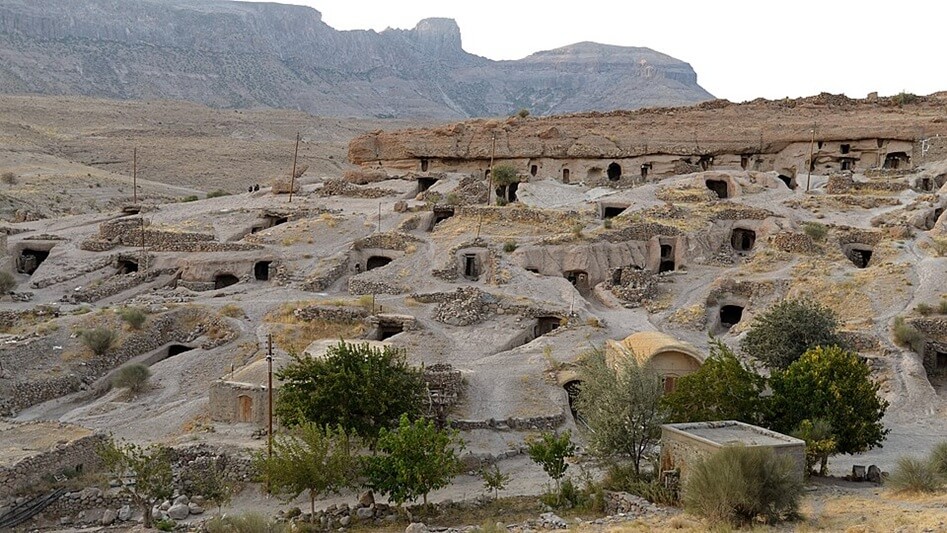
There is a moment, driving into the valley, when the mountainside stops looking like a mountainside. What first reads as plain rock — no color, no signage, nothing to mark it as inhabited — resolves, slowly, into rows of square window openings pressed into the stone. Maymand village, tucked into the southern reach of Iran’s central mountains in Kerman province, is one of the last places on earth where a community still lives, part of the year, inside homes its own ancestors carved by hand. UNESCO inscribed it in 2015 as the Cultural Landscape of Maymand, recognizing not a ruin but a way of life still in practice.
There are no grand facades here, no gilded domes. What Maymand offers instead is quieter and, in its way, harder to find anywhere else: a living record of how people learned to move with the seasons rather than fight them, and to build their shelter not on the land but inside it. It sits alongside Iran’s other UNESCO-listed treasures as one of the country’s least visited, and most quietly rewarding, entries on the list.
What Is Maymand Village?
Maymand—also spelled Meymand, and formally inscribed by UNESCO as the Cultural Landscape of Maymand—lies near the town of Shahr-e Babak in Kerman Province at an elevation of about 2,200 meters (7,200 feet). This semi-arid mountain valley is home to a local community whose traditional semi-nomadic agro-pastoral lifestyle has shaped the landscape for centuries.
What makes Maymand unique is not simply its rock-cut architecture, but its remarkable continuity. Cappadocia in Turkey is famous for similar cave dwellings, yet most no longer serve as permanent homes. Kandovan, in northwestern Iran, is still inhabited, but its houses were carved into naturally formed volcanic cones. Maymand is different: its dwellings were entirely excavated by hand into soft rock and remain part of a seasonal way of life, with local families returning each winter in a pattern of migration that UNESCO recognizes as a rare survival of traditional human adaptation to a harsh environment.
📷Photo by Wojciech Kocot on Wikicommons
A History Held Between Legend and Evidence
Maymand’s history is not a single, settled story—and that’s part of its appeal. Rather than repeating the most dramatic claims as fact, it’s worth separating what archaeology supports from what survives through local tradition.
Between Myth and Evidence
Many travel articles describe Maymand as 12,000 years old, a figure based on prehistoric petroglyphs and archaeological finds discovered in the surrounding landscape rather than the cave village itself. These discoveries show that people have been present in the valley for millennia, but they do not prove that the present settlement has been continuously inhabited for 12,000 years.
What is better supported is the age of the rock-cut village itself. UNESCO and archaeological research point to around 2,000 to 3,000 years of continuous or near-continuous occupation, placing the origins of today’s cave dwellings in pre-Islamic Iran, with many scholars suggesting they date to the Parthian period.
The name Maymand has inspired its own folklore. One popular explanation links it to the Persian words mey (wine) and mand, telling of early inhabitants who carved their homes while intoxicated—a memorable story, but one without historical evidence. Another interpretation connects the name with the idea of a “blessed” or “fortunate” place. Local tradition also speaks of an inscription hidden in the surrounding mountains, promising that when the rocks finally split open, a treasure will be revealed to the one who “comes from the sun.” Like many stories passed down through generations, these legends remain part of Maymand’s cultural identity rather than its documented history.
From National Monument to World Heritage
Maymand’s modern history is documented with much greater certainty. The village was registered as an Iranian National Heritage Site in 2001 and, in 2005, received the UNESCO–Greece Melina Mercouri International Prize for the Safeguarding and Management of Cultural Landscapes—an international recognition that came a decade before its World Heritage inscription. In 2015, Maymand became Iran’s 19th UNESCO World Heritage Site, recognized not as an abandoned archaeological site, but as a living cultural landscape where traditional seasonal migration and rock-cut dwellings remain part of everyday life.
The valley also preserves traces of its long religious history. Near the cave settlement stand a rock-cut mosque, the remains of what is believed to have been a pre-Islamic place of worship, and an ancient circular burial ground without a roof. Together, they reflect the succession of beliefs and communities that have shaped Maymand over the centuries. This layering of history is a hallmark of Kerman Province, which is also home to the UNESCO-listed Bam Citadel, another site where centuries of Iranian history remain visible in the landscape.
📷Photo by Wojciech Kocot on Wikicommons
The Three-Phase Transhumance System
What truly distinguishes Maymand is not just its cave dwellings, but the traditional seasonal migration that has shaped life here for centuries. UNESCO recognized the site as a World Heritage property because of this living cultural landscape, where architecture, agriculture, and pastoralism still function as a single system.
Unlike many pastoral communities, where only the herds move between seasonal pastures, Maymand’s residents traditionally relocated their entire households with their livestock, following a three-stage annual cycle.
- Sar-e Āghol – simple seasonal shelters used from late winter through spring, as families move with their herds to fresh mountain pasture.
- Sar-e Bāgh – summer and early autumn homes near orchards, gardens, and seasonal streams, where families tend crops and fruit trees.
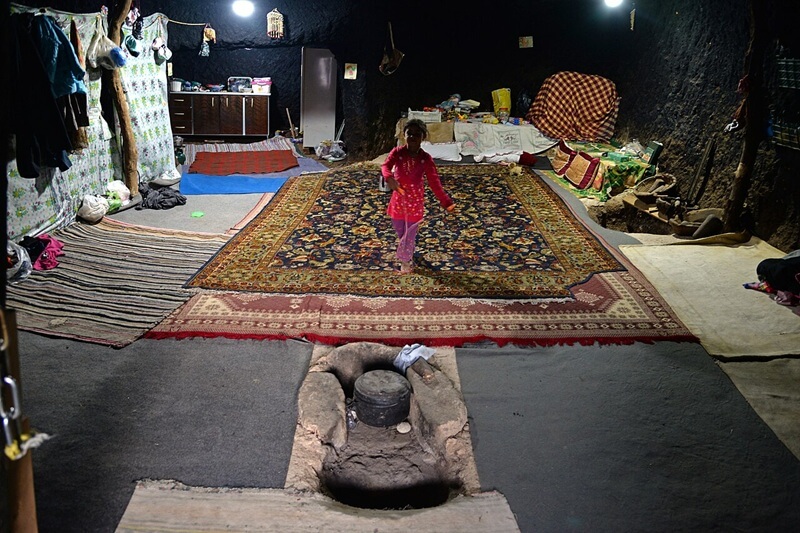
- Kamar (Kicheh) – the village’s hand-carved cave dwellings, occupied throughout winter, when the surrounding rock naturally insulates the interiors against the cold desert climate.
UNESCO considers this one of the last surviving examples of a traditional transhumance system that was once much more widespread across the region. At the same time, the organization notes that the way of life is gradually changing. The resident population has declined, fewer families still follow the full seasonal cycle, and the irrigated fields that once supported a largely self-sufficient community are no longer cultivated as extensively as they once were. Even so, Maymand remains one of the rare places where this centuries-old pattern of life can still be experienced as a living tradition rather than reconstructed history.
Inside the Cave Architecture
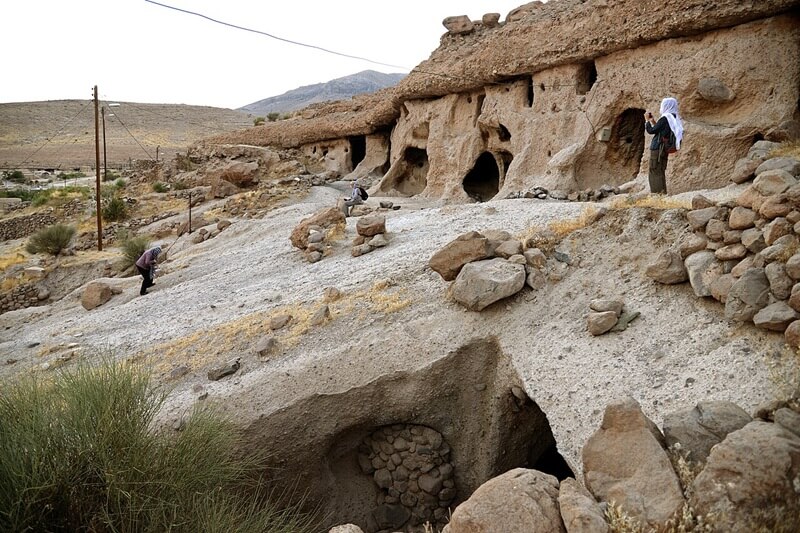
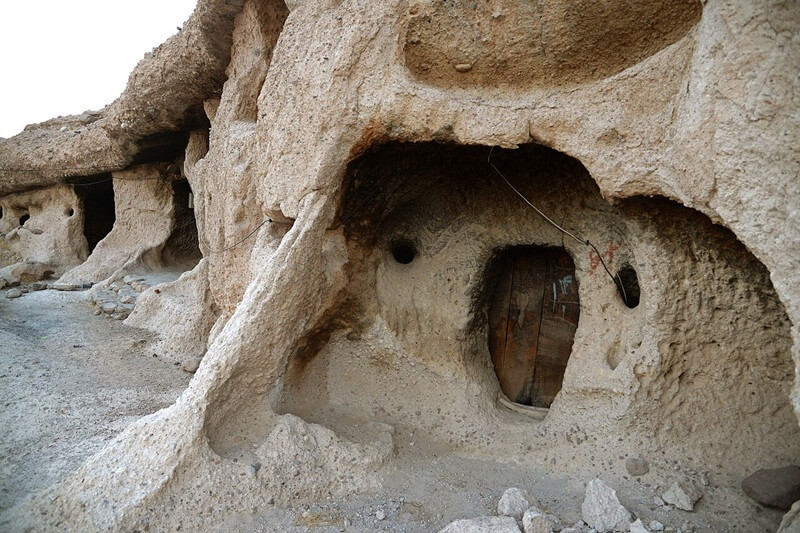
Around 400 rock-cut dwellings, known locally as kamar, are carved directly into the valley’s soft sedimentary rock. Soft enough to shape with hand tools yet durable enough to withstand centuries of use, the caves were created without mortar, bricks, or structural reinforcement. Many remain in use today during the winter months.
Step inside and one detail stands out immediately: there are no windows or chimneys. Instead, the caves rely on the insulating properties of the surrounding rock and carefully positioned entrances to regulate temperature and airflow. The result is an interior that stays remarkably warm in winter and naturally cool in summer, despite the valley’s harsh climate.
Beyond the cave homes, Maymand’s traditional architecture extends to kapar and gambeh—simple shelters built for livestock and seasonal use using the same locally available stone and earth. Together, these structures create a settlement where almost every building was constructed from materials found within the valley itself, reflecting generations of adaptation to a landscape with few natural resources.
Rather than relying on elaborate decoration, Maymand’s architecture is remarkable for its practicality. Every carved room, shelter, and seasonal dwelling reflects a deep understanding of the local climate and terrain—one of the clearest examples of how traditional Iranian vernacular architecture evolved by working with the landscape instead of against it.
📷Photo by Wojciech Kocot on Wikicommons
UNESCO Recognition and Criterion (v)
The Cultural Landscape of Maymand was inscribed on the UNESCO World Heritage List under a single criterion, which UNESCO’s official documentation states as follows:
Criterion (v): The Cultural Landscape of Maymand, a small mainly self-sufficient community within one large valley, reflects a traditional three-phase transhumance system with unusual troglodytic winter housing in a dry desert environment.
In plain terms, this criterion protects sites that stand as outstanding examples of traditional human settlement or land-use, particularly ones vulnerable to irreversible change. For Maymand, that means UNESCO is safeguarding not the caves as static objects, but the entire seasonal pattern of movement and dwelling that produced them — a designation that, by its nature, depends on people continuing to live it. Full technical documentation is available on the official UNESCO World Heritage Centre listing.
This is also the section of the story most worth an honest pause. UNESCO’s integrity assessment for the site notes real vulnerability: a declining resident population and reduced reliance on the valley’s irrigated plots for subsistence farming. Visiting Maymand thoughtfully means recognizing that the culture on display is not a museum piece — it is a community adapting in real time, and tourism is only one small part of what will determine its future.
Planning Your Visit to Maymand Village
Getting There
Maymand sits roughly 1.5 to 2 hours from Kerman city by road, making it a natural stop for travelers moving between the desert city of Yazd or Shiraz’s poetry gardens and palaces and Kerman, rather than a standalone destination requiring a dedicated trip. The final approach climbs into the mountains, and the road itself — narrow, winding, and quiet — is part of the experience of arriving somewhere the modern world hasn’t smoothed over.
Best Time to Visit
The best time to visit depends on what you want to experience. Spring and early autumn generally offer the most comfortable weather for exploring the valley on foot, with mild daytime temperatures and clear skies. Summer brings intense heat to the surrounding desert, although the cave interiors remain noticeably cooler thanks to the insulating rock. Winter is much colder, especially after dark, but it’s also the season when the kamar dwellings are traditionally occupied, giving visitors the rare chance to see Maymand’s rock-cut homes functioning as they were intended. If you’re prepared for freezing nights, winter can be one of the most rewarding times to visit. For a broader look at seasonal travel across the country, see our month-by-month guide to the best time to visit Iran.
What to See
- Beed Cave Café, a small café set inside one of the rock-cut dwellings, offering a chance to rest and chat with local residents.
- The kamar cave dwellings, hand-carved into the rock and still used seasonally by local families during the winter months.
- The rock-cut mosque, whose interior is supported by pillars carved directly from the surrounding stone.
- The remains of a pre-Islamic place of worship, traditionally associated with Zoroastrian fire rituals.
- An ancient circular burial ground, an unusual roofless cemetery overlooking the valley.
Practical Notes
Cave homestays are available directly in the village, typically at modest, informal rates, and offer the rare chance to sleep inside a kamar dwelling rather than simply visiting one — pack warmly regardless of season, as nights cool quickly even in the caves. Entrance arrangements at Maymand have been inconsistent by visitor accounts, with some travelers reporting a small posted fee and others reporting none at all, particularly in low season; it is worth confirming current practice locally rather than assuming either way.
Kerman city itself makes a comfortable base, and Maymand pairs naturally with a wider look at the region’s desert and heritage sites — including Bam’s fortified citadel, the extremes of the Lut Desert, and Kerman’s own bazaars and gardens.
Final Thought: The Valley That Keeps Its Own Time
Most heritage sites ask you to imagine the past. Maymand asks something quieter — to notice that the past, here, never fully finished happening. The families who move between Sar-e-Āghol, Sar-e-Bāgh, and the winter kamar aren’t reenacting a system for visitors; they are living inside one that has simply outlasted most others like it.
What makes Maymand worth the detour isn’t scale or spectacle. It’s the rare chance to stand inside a piece of architecture that was never separated from the land it came from — and to understand, briefly, what it takes for a community to keep choosing that rhythm, season after season, even as fewer people remain to choose it.
For travelers drawn to Iran’s quieter corners rather than its best-known monuments, Maymand belongs on the same itinerary as the deserts and citadels of Kerman province — a region that rewards slowing down far more than it rewards checking boxes. If you’re still mapping out where a trip like this fits, our broader guide to Iran’s essential sights is a good place to start.
Maymand is one stop on a route built specifically for travelers who see Iran through a lens
FAQs about Maymand Village
1. What is Maymand village?
Maymand, also spelled Meymand and formally listed by UNESCO as the Cultural Landscape of Maymand, is a semi-nomadic agro-pastoral community in Kerman province, Iran. It is best known for its hand-carved cave dwellings, still occupied seasonally by local families.
2. How old is Maymand village really?
Verified continuous occupation of the current cave dwellings dates back roughly 2,000 to 3,000 years, likely to the Parthian era. Claims of 12,000 years appear widely in popular writing but are based on nearby surface finds rather than confirmed excavation of the settlement itself.
3. Is Maymand still inhabited today?
Yes, though the resident population has declined over recent decades. Families still move between the site’s three seasonal settlements, including the winter cave dwellings, making Maymand a living cultural landscape rather than a preserved ruin.
4. How do I get to Maymand from Kerman?
Maymand is roughly 1.5 to 2 hours from Kerman city by road, making it a practical stop for travelers moving between Kerman and Yazd or Shiraz. The final stretch climbs into mountainous terrain, so a private driver or organized tour is the most comfortable option.
5. Can I stay overnight in the caves at Maymand?
Yes, informal cave homestays are available directly in the village, offering visitors a chance to sleep inside a kamar dwelling. Accommodations are basic, so warm clothing is recommended regardless of season.
6. What is the best time of year to visit Maymand?
Spring and early autumn offer the most comfortable conditions for exploring the valley on foot, while winter is when the traditional cave-dwelling system is most actively in use. Summers in the surrounding desert are severe, though the caves themselves stay comparatively cool.
7. How is Maymand different from Kandovan or Cappadocia?
Unlike Cappadocia’s largely uninhabited cave complexes, Maymand’s kamar dwellings are still used seasonally by local families. Unlike Kandovan, which formed through natural volcanic erosion, Maymand’s homes were entirely hand-excavated from sedimentary rock by the community itself.
8. What does UNESCO Criterion (v) mean for Maymand?
Criterion (v) recognizes outstanding, vulnerable examples of traditional human settlement or land use. For Maymand, this covers the entire three-phase transhumance system — not just the cave architecture, but the seasonal pattern of movement that produced it.
9. Is there an entrance fee to visit Maymand?
Visitor reports on entrance fees at Maymand have been inconsistent, with some travelers charged a small fee and others not, particularly in low season. It’s worth confirming current practice with a local guide rather than assuming either way.
10. What else is worth visiting near Maymand?
Maymand pairs naturally with a wider look at Kerman province, including the ancient citadel at Bam, Iran’s extreme desert landscapes at Lut, and the city of Kerman itself with its bazaars and historic gardens. Most visitors treat it as a stop along a Kerman-region route rather than a standalone destination.
11. Why did UNESCO inscribe Maymand as a cultural landscape rather than a monument?
Maymand’s designation protects an active way of life — the movement of people between seasonal settlements — rather than a single fixed structure. This distinguishes it from most heritage listings, which typically preserve buildings rather than ongoing practices.
12. Is Maymand suitable for a day trip, or does it require an overnight stay?
Maymand can be visited comfortably as a day trip from Kerman city. Travelers wanting to experience a cave homestay, however, should plan to stay overnight directly in the village.
0 Comment