



Table of Contents
The Shushtar Historical Hydraulic System is a network of dams, canals, and tunnels in Iran’s Khuzestan province that has moved water from the Karun River for nearly two thousand years — and much of it is still working today. Stand at the edge of the Gargar Canal in late afternoon and you can hear it before you see it: water falling in stepped cascades over stone channels carved during the Sassanid era, past the silhouette of watermills that once ground the grain of an entire province. Swallows cut low over the basin. Somewhere below, an old millstone still turns, powered by nothing but the same current that powered it seventeen centuries ago. This is not a ruin being interpreted for visitors. It is a piece of ancient infrastructure that never stopped doing its job.
Inside the Shushtar Historical Hydraulic System
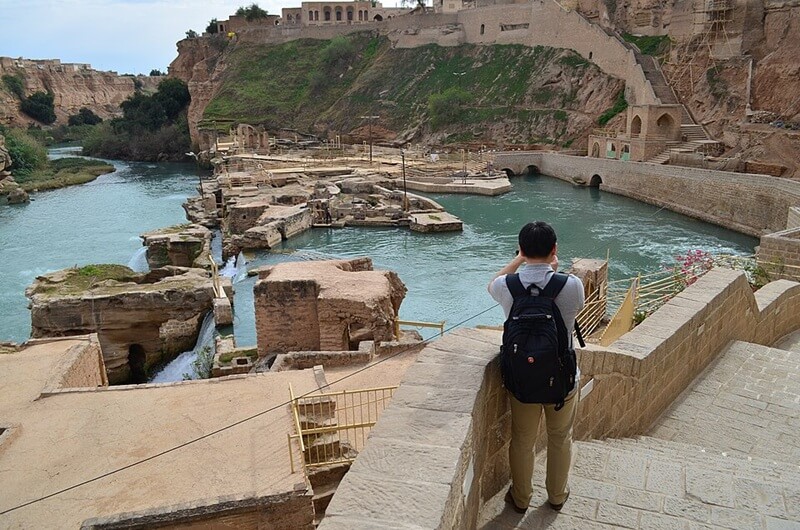
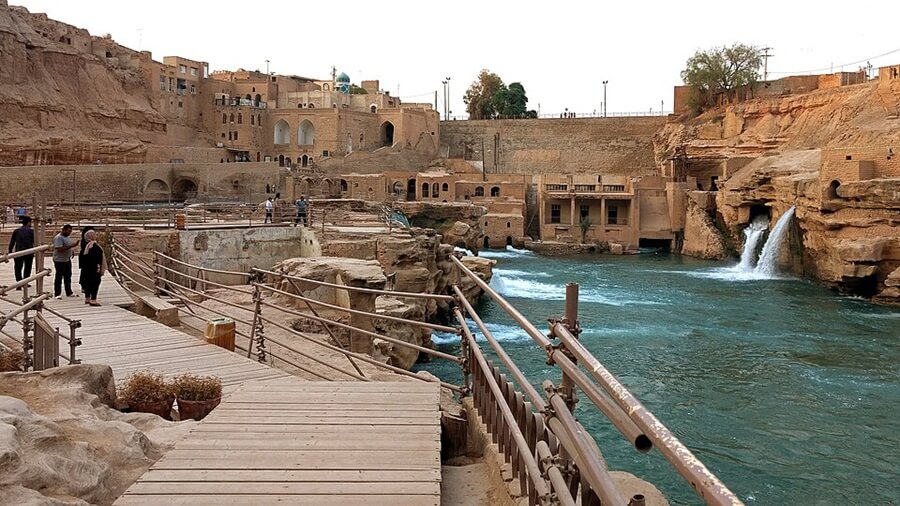
At its core, the Shushtar Historical Hydraulic System is an engineered relationship between a city and a river. The Karun is split at a diversion point into two channels, one of which — the Gargar Canal — is directed through rock-cut tunnels into a narrow ravine, where it once turned dozens of watermills before spilling as waterfalls into a basin and irrigating the farmland beyond. Dams, weirs, sluice gates, and a fortified control point all work together as a single coordinated system rather than a scattering of separate monuments. UNESCO’s own assessment calls it a “homogeneous hydraulic system, designed globally” — meaning it was conceived as one machine, with every part built in relation to every other part.
That distinction matters. Most ancient irrigation networks grew piecemeal, adapted and expanded over centuries by different hands with different priorities. Shushtar’s system, by contrast, reflects a unified engineering vision realized under Sassanid rule and never really superseded. It’s the reason this site earns comparisons to a “water museum” rather than a single ruin: walking through it means walking through the entire lifecycle of ancient water management, from diversion to power generation to irrigation, in the space of an afternoon.
Why Shushtar Is Worth the Detour into Khuzestan
Khuzestan sits well off Iran’s classic Tehran–Isfahan–Shiraz–Yazd circuit, and travelers weighing a trip here often ask the same honest question: is it worth the extra days? The answer depends on what draws you to Iran in the first place. If your interest lies in engineering, ancient infrastructure, or seeing history that still functions rather than history behind glass, Shushtar delivers something none of Iran’s more famous sites can — a monument you can watch doing its original job. The Reza Golab mill still turns using the same water power it always has, and the Gargar Canal still irrigates the Mianab plain exactly as it did under Sassanid rule.
It helps that Shushtar rarely has to justify the trip alone. Susa, one of the oldest continuously inhabited cities on earth and a site layered with Elamite, Achaemenid, and biblical history, sits close enough to fold into the same few days without adding real distance to the journey. Its highlights — including the Apadana Palace and the tomb of Daniel — are well worth visiting in their own right, which means the “detour” into Khuzestan is really two significant destinations for the price of one longer drive, not a single-site diversion.
It is, admittedly, a genuine detour, and travelers with only a week or two planning their first trip through Iran often reserve this pairing for a second visit or a slower itinerary. But those who make the trip consistently describe it as a highlight rather than a footnote — not despite the distance, but partly because of it. Neither site yet appears on most rankings of Iran’s must-see landmarks, which is itself part of the appeal: Khuzestan sees a fraction of the visitors that Isfahan or Shiraz do, and both Shushtar and Susa reward that relative quiet with an atmosphere closer to discovery than tourism.
📷Photo by Darafsh on Wikicommons
The Story Engineers Still Study Today
The most dramatic chapter in Shushtar’s history begins on a battlefield far from any river. In 260 CE, the Sassanid king Shapur I inflicted a rare and humiliating defeat on Rome, capturing the emperor Valerian near Edessa — one of the only recorded instances of a Roman emperor taken alive by an enemy. Rather than execute his prisoners, Shapur put them to work, and Roman military engineers, trained in the aqueduct and dam-building traditions of their empire, were set to labor on Persian soil.
Their fingerprints are still visible at Shushtar. The Band-e Kaisar, sometimes called the Caesar’s Dam, blends Roman construction technique with Persian hydraulic ambition in a way found nowhere else in Iran — a rare case of two ancient empires, bound together by conquest rather than trade, leaving behind a single structure neither could have built alone.
This dramatic expansion built on groundwork laid centuries earlier. The Achaemenid king Darius the Great is traditionally credited with the earliest attempts to control the Karun’s flow through this stretch of land back in the 5th century BCE, establishing the principle — that a river could be redirected rather than merely used — that Sassanid engineers would later perfect. Under Ardashir I, founder of the Sassanid dynasty, and his successors, that principle became the Gargar Canal itself: an artificial watercourse that made possible the construction of an entirely new town and the irrigation of what had been semi-desert land. Most historic irrigation systems adapt an existing settlement; Shushtar’s canal came first, and the city grew because of it.
What You’ll Actually See at Shushtar
The Waterfalls and the One Mill Still Turning
The most photographed section of the site is the mill ravine, where water dropped from the Gargar Canal once powered dozens of watermills in sequence before spilling as cascading waterfalls into the basin below. Most of those mills have fallen silent over the centuries — worn down by flooding and the arrival of modern milling elsewhere in Iran. Only the Reza Golab mill is still reported to function, a single working link to a system that once operated at genuine industrial scale. Watching it turn is a quiet thing, and also the closest most visitors will come to seeing Sassanid technology do exactly what it was built to do, in real time.
Salasel Castle — Where the Water Was Once Controlled
Perched above the ravine, Salasel Castle functioned as the operational heart of the entire system — the point from which sluice gates and water flow across the whole network could be managed. Its name, meaning “chain castle,” is thought to reference the mechanisms once used to regulate the gates below. It survives mostly as a ruin today, but its position still makes the logic obvious: whoever controlled Salasel Castle controlled the water supply for an entire city and its farmland.
Fact or Folklore — The Mystery of the Kolah Farangi Tower
The octagonal tower known as Kolah Farangi, above the Mizan Dam, is where verified history and local legend start to diverge. Some traditions hold that it served as a lookout post — watching either for the captured Roman emperor’s escape attempts or the movements of enslaved laborers under Sassanid guard. Others maintain a more sober explanation: that the tower measured the river’s water level, a practical instrument rather than a watchtower. UNESCO’s own documentation favors the water-measurement function, and it fits the tower’s design and position more convincingly than the lookout stories. Those stories persist because they’re good stories — but it’s worth knowing which parts of what you hear on-site are documented and which are folklore passed down through generations of local guides.
Beyond the Water System — Shushtar’s Other Historic Sites
The hydraulic system tends to dominate Shushtar’s reputation, but the surrounding old city holds enough on its own to fill a half-day. The Jameh Mosque of Shushtar, built during the early Abbasid period, houses the oldest minbar in Iran and remains a working mosque with deep ties to the city’s early Islamic history. The Lashkar Bridge-Dam, though only 11 of its original 13 spans survive, is among the most intact Sassanid-era bridge structures left in the country. Band-e Kaisar itself is worth viewing as a standalone structure, not just as part of the hydraulic ensemble — medieval writers regarded it as one of the engineering wonders of its age. For a quieter stop, Bagh Khan, a Qajar-era garden on the western bank of the Gargar, is still irrigated by the same canal network and makes a pleasant close to a day spent exploring the city on foot.
Together, these sites turn what could be a two-hour stop into a genuine half-day of exploring Shushtar’s layered history — Sassanid, early Islamic, and Qajar, all within walking distance of one another.
Shushtar Compared to Iran’s Other UNESCO Sites
Travelers building an Iran itinerary often want to know how a lesser-known UNESCO site like Shushtar stacks up against the country’s headline attractions, and the honest answer is that it offers something genuinely different rather than a lesser version of the same experience. The ceremonial capital of the Achaemenid Empire and Naqsh-e Jahan Square are monumental and symbolic — built to project imperial power and now preserved as static, awe-inspiring ruins. The desert city’s ancient qanat network represents a related but separate irrigation tradition, largely hidden underground and best understood through explanation rather than direct observation. Even Bam Citadel, Kerman’s ancient mudbrick fortress, for all its scale, is fundamentally a preserved fortress rather than working infrastructure. Shushtar is the rare exception that remains visibly, audibly functional: water still moving through channels built under Sassanid rule, a mill still turning, farmland still irrigated by a two-thousand-year-old canal. For travelers who want to see engineering at work rather than admire it in stillness, Shushtar occupies a category of its own among Iran’s UNESCO sites.
Why UNESCO Calls Shushtar a Masterpiece of Creative Genius
Shushtar Historical Hydraulic System was inscribed on UNESCO’s World Heritage List in 2009, becoming Iran’s tenth cultural site to receive the designation — one entry among the country’s full roster of UNESCO-listed treasures. The listing rests on three specific criteria, and understanding what each one actually means helps explain why this particular site — rather than any number of other ancient dams — earned the distinction.
Criterion (i) recognizes Shushtar as testimony to an early and remarkably complete vision for what diversion canals and large weir-dams could achieve for land development. In plain terms: this wasn’t trial and error. The Sassanid engineers appear to have understood, from the outset, how the finished system needed to function — and it was designed for sustainable, long-term operation rather than short-term use. Nearly two millennia of continued function is the evidence for that claim.
Criterion (ii) acknowledges Shushtar as a synthesis of diverse techniques — Elamite and Mesopotamian foundations, Achaemenid initiative, and Roman construction expertise — brought together into one large-scale, coherent ensemble. Few heritage sites anywhere can claim to physically embody the meeting of three or more distinct engineering traditions in a single working structure.
Criterion (v) speaks to the site as an outstanding example of land use representing a culture’s interaction with its environment, particularly where that interaction becomes vulnerable under the pressure of change. Shushtar’s landscape — city, canals, orchards, and river — exists in its current form because of deliberate, coordinated human intervention centuries ago, and the ongoing challenge of maintaining that balance today is part of what UNESCO’s protections aim to preserve.
For the full inscription details and official documentation, see UNESCO’s World Heritage Centre listing for Shushtar Historical Hydraulic System.
📷Photo by Wojciech Kocot on Wikicommons
How Much Time to Spend at Shushtar
Most visitors need two to three hours to see the core hydraulic system — the waterfalls and mill ravine, Salasel Castle, and the viewpoint from Marashi House. Add the surrounding old-city sites covered above, and a relaxed half-day is more realistic. A logical route follows the water itself: begin at the entrance near the Shari’ati Street bridge, where steps lead down toward the waterfalls and mill ravine — the most atmospheric section of the complex — then move toward the remains of Salasel Castle to understand the system’s control point, before making the climb up to Marashi House, a restored hillside residence offering the single best panoramic view over the entire ensemble. Travelers combining Shushtar with Chogha Zanbil, the well-preserved Elamite ziggurat within reasonable day-trip distance, should plan for closer to a full day covering both sites comfortably.
Planning Your Visit to Shushtar, Khuzestan
Getting there. Shushtar sits roughly 90 kilometers — about 90 minutes by road — from Ahvaz, Khuzestan’s provincial capital and the most practical base for a visit. Ahvaz is well connected to Tehran and Shiraz by regular domestic flights, making it the sensible entry point rather than attempting the roughly nine-hour overland drive from the capital. From Ahvaz, buses, shared taxis, and private transfers all run to Shushtar regularly.
Hours and closures. The site generally opens around 8:00 AM, with closing times shifting seasonally — later in spring and summer, earlier in autumn and winter. Less commonly noted: several religious observances, including Tasua and Ashura and the 9th and 10th of Muharram, bring closures or restricted access. Because these dates shift each year relative to the Gregorian calendar, it’s worth confirming the current schedule before finalizing travel plans.
Best time to visit. Spring (March to May) and autumn (October to November) offer the most comfortable temperatures for exploring on foot — broadly consistent with seasonal patterns across the country as a whole, though Khuzestan runs hotter than most of the country. Khuzestan is among Iran’s hottest provinces, and summer heat here regularly makes outdoor exploration difficult for several hours each day. Within a single day, late afternoon into sunset is the most rewarding window — the light softens across the waterfalls, the heat eases, and the site’s floodlighting activates after dark, casting the cascades and mills in a quieter, different atmosphere entirely.
Accessibility. This is a site built on elevation changes by necessity — water needs a drop to fall through — which means stairs, uneven stone paths, and some genuinely steep sections around the mill ravine and the climb to Marashi House. Travelers with limited mobility can still take in the main views from the Shari’ati Street bridge without descending into the ravine, but the full circuit is not easily adapted for wheelchairs or significant mobility restrictions.
Final Thought: Water That Still Remembers How to Work
Iran’s history is often told through empires that rose and fell, but Shushtar tells a quieter story — one about people who solved a practical problem so well that the solution outlived every dynasty that touched it. That kind of endurance says something about the region as a whole: Khuzestan holds some of the oldest continuous human settlement on earth, and its landscape still carries the marks of ambitions that predate most of what travelers associate with Persia.
Sites like this rarely get the attention they deserve, precisely because they ask more of a visitor than a photograph can capture. Understanding what you’re looking at — why a canal runs where it does, why an empire’s engineers ended up building for their captors — makes the difference between passing through and actually seeing the place.
That’s the kind of depth a guided visit adds, and it’s why Khuzestan rewards travelers willing to go a little further off the usual route.
Curious to see this living engineering firsthand?
FAQs for Shushtar UNESCO World Heritage Site
1. What is the Shushtar Historical Hydraulic System?
It is a complex of dams, canals, tunnels, and watermills in Khuzestan province, Iran, built primarily during the Sassanid era to divert water from the Karun River for irrigation, milling, and urban water supply. Parts of the system remain functional nearly two thousand years after their construction.
2. Is Shushtar safe to visit?
Shushtar itself is a quiet provincial city with no particular local safety concerns beyond the general considerations that apply to travel in Iran. For a fuller picture, what daily life and security actually look like for visitors is covered in depth elsewhere on our site, alongside current government travel advisories worth checking before any trip.
3. Are the watermills at Shushtar still working?
Most of the historic watermills have fallen out of use over the centuries due to flooding, wear, and the shift to modern milling elsewhere in Iran. The Reza Golab mill is the notable exception, still functioning on the original water-powered system.
4. What role did Roman prisoners play in building Shushtar?
After Shapur I captured the Roman emperor Valerian in 260 CE, Roman military engineers among the captives were put to work on Sassanid infrastructure, most notably the Band-e Kaisar dam. Their construction techniques merged with Persian hydraulic design in a way not seen elsewhere in Iran.
5. Can you combine Shushtar with Chogha Zanbil or Susa?
Yes. Chogha Zanbil, an Elamite ziggurat, and Susa, one of the world’s oldest continuously inhabited cities, are both within a reasonable day-trip distance and pair naturally with a Shushtar visit for travelers with a full day to spend in the area.
6. Is Shushtar accessible for visitors with mobility issues?
Only partially. The site involves stairs and uneven terrain, particularly around the mill ravine and the climb to Marashi House, though the main waterfall view from the Shari’ati Street bridge is accessible without descending into the site.
7. How do you get to Shushtar from Ahvaz?
Shushtar is roughly 90 kilometers from Ahvaz, a drive of about 90 minutes by car, bus, or shared taxi. Ahvaz is the most practical base, with regular domestic flights connecting it to Tehran and Shiraz.
8. What is the best time of year to visit Shushtar?
Spring (March–May) and autumn (October–November) offer the most comfortable temperatures for exploring the site on foot. Summer in Khuzestan brings extreme heat that makes outdoor visits uncomfortable for much of the day.
9. What is the Kolah Farangi tower used for?
Most documentation, including UNESCO’s, identifies it as a structure built to measure the Karun River’s water level. Local legends offer alternative lookout-tower explanations dating to the Sassanid era, though these remain undocumented folklore rather than verified history.
10. How long does it take to visit Shushtar?
Most visitors need two to three hours for the core hydraulic system, or closer to half a day including the Jameh Mosque, Lashkar Bridge, and Bagh Khan garden nearby.
11. Why is Shushtar a UNESCO World Heritage Site?
Shushtar was inscribed in 2009 under criteria (i), (ii), and (v), recognized for its early and complete engineering vision, its synthesis of Elamite, Achaemenid, and Roman techniques, and its status as an outstanding example of human interaction with a challenging landscape. It is Iran’s tenth cultural site on the UNESCO list.
12. How is Shushtar different from other Iran UNESCO sites like Persepolis or Yazd’s qanats?
Unlike Persepolis, which is a static ruin, or Yazd’s qanats, which run largely underground and out of sight, Shushtar remains visibly and audibly functional — water still moves through its channels and one mill still turns using its original power source.
0 Comment