


Table of Contents
There is a particular hour in Yazd, just after the muezzin’s call fades and before the streetlights fully take hold, when the whole city turns the color of the desert around it. Rooftops the color of clay stretch toward the horizon, windcatchers rise like sentries against the fading light, and somewhere below, in an alley too narrow for a car, someone is still selling bread. Yazd is one of the oldest continuously inhabited cities on earth, a UNESCO World Heritage Site built almost entirely of earth, and this guide walks through the top things to do in Yazd, from its windcatcher-lined Old City to the desert villages just beyond it.
Yazd does not announce itself the way Isfahan or Shiraz do. It has no single, postcard-famous square. What it has instead is texture — mud-brick alleys that fold back on themselves, a fire that has reportedly burned since antiquity, and a rhythm of life that has adapted to one of the driest climates on the planet for well over a thousand years. Travelers who come expecting a quick stopover between two of Iran’s other major destinations tend to leave wishing they had stayed longer, a pattern common enough across an Iran itinerary that it is worth planning extra time in from the start.
Why Yazd Feels Like Nowhere Else in Iran
Yazd sits in a natural basin between two great deserts, the Dasht-e Kavir and the Dasht-e Lut, which is precisely why it developed the way it did. Cut off by geography and protected by its remoteness, the city was rarely a target for the invading armies that reshaped much of the rest of Iran. That relative isolation is the reason Yazd’s Old City survives largely intact today, while comparable urban fabric elsewhere in the region was lost to war, fire, or modern redevelopment.
The name itself carries weight. “Yazd” derives from an old Persian word connected to reverence and the divine, and locals will tell you the city has been called, informally, the City of God for centuries. Marco Polo is said to have passed through on his way east and described it as a fine and noble city — a detail repeated often enough in guidebooks that it is worth noting plainly: it comes from an oral tradition surrounding the Polo travelogues rather than a single verified primary source, though it reflects Yazd’s genuine standing as a Silk Road trading post where Chinese silk, Central Asian goods, and Persian textiles changed hands on their way to the Persian Gulf.
What makes Yazd worth dwelling on, rather than simply passing through, is how directly its architecture answers its climate. Every wind tower, every underground room, every qanat channel exists because someone, centuries ago, solved the problem of surviving extreme heat without a single modern tool — and the solutions still work.
Yazd’s Living Zoroastrian Heritage
Long before Islam reached the Iranian plateau, Yazd was already a significant center of Zoroastrianism, the monotheistic faith founded by the prophet Zoroaster that shaped Persian civilization under the Achaemenid and Sassanid empires. When the Arab conquest brought Islam to Iran in the seventh century, many Zoroastrian communities retreated toward the desert cities of Yazd and Kerman, where the terrain offered some protection from forced conversion and taxation pressures.
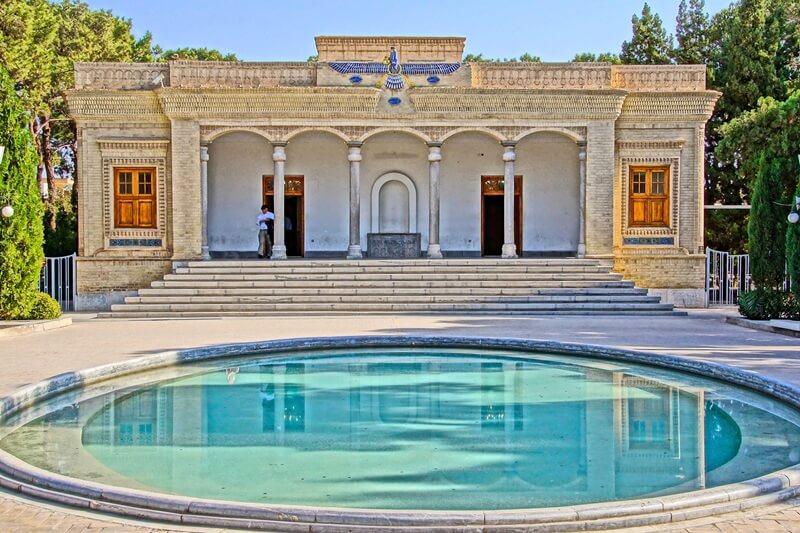
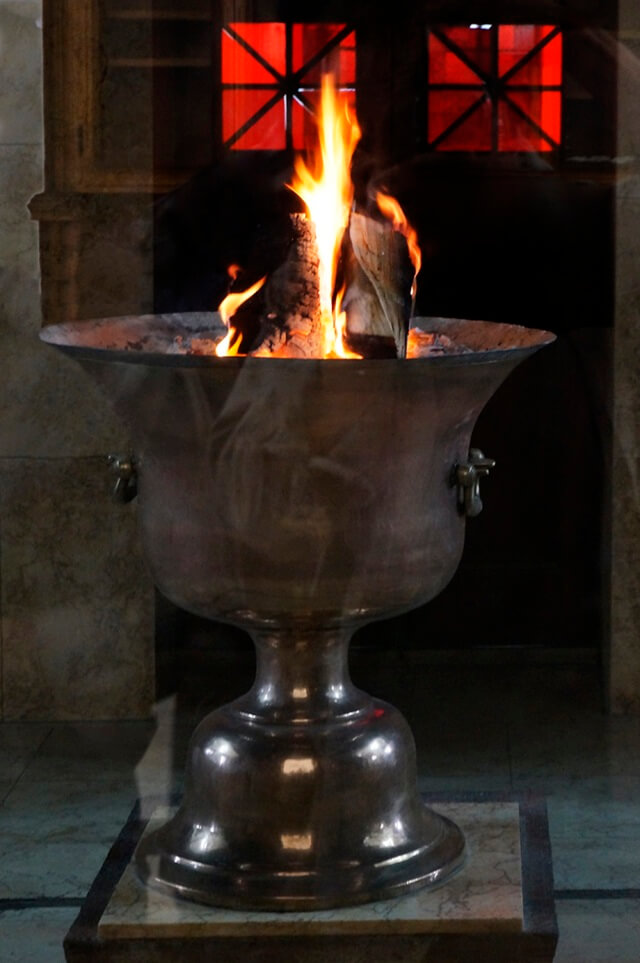
That history is not a museum piece here. Yazd remains home to one of Iran’s largest living Zoroastrian communities, and the faith’s presence is woven into daily life — in the fire that still burns in the city’s temple, in the neighborhoods where Zoroastrian families have lived for generations, and in a sense of continuity that few other Iranian cities can claim. Understanding this is what separates a meaningful visit from a checklist of old buildings, and it is one of the reasons Yazd holds its own among Iran’s most compelling attractions.
📷Photo by Soheil Callage on Wikicommons
Exploring the Old City’s Mud-Brick Alleys
The single best thing to do in Yazd costs nothing and requires no ticket: walk. The Old City’s Fahadan district is a labyrinth of narrow, covered alleyways, sun-baked courtyards, and blue wooden doors, built almost entirely from adobe and straw. Google Maps struggles here, and that is part of the appeal — getting mildly lost is how you find the quiet teahouses, the rooftop views, and the elderly residents still living in centuries-old family homes.
Amir Chakhmaq Complex
At the heart of the Old City stands the Amir Chakhmaq Complex, a three-story façade of symmetrical, illuminated alcoves that has become the closest thing Yazd has to a civic emblem. It was commissioned in the fifteenth century by Amir Jalal al-Din Chakhmaq, a Timurid-era governor of Yazd, and his wife Seti Fatima, who together funded not just the mosque and Hosseinieh at its center but a caravanserai, a bathhouse, and a bazaar around it — a single act of patronage that effectively built a new civic quarter for the city. The complex still functions today: at night, when the alcoves are lit, the square in front of it fills with locals eating saffron ice cream rather than tourists taking photographs, which tells you something about how the space is actually used.
Jameh Mosque of Yazd
A short walk away, the Jameh Mosque rises above Yazd Old City with what is often cited as the tallest minaret portal in Iran. Its origins trace to the twelfth century, though the structure seen today largely reflects fourteenth-century Muzaffarid-era rebuilding, and its entrance iwan is covered in mosaic tilework and calligraphy dense enough to reward slow, repeated looking rather than a single photograph. Like many mosques of its era in Iran, it was built on the site of an earlier structure — in this case, tradition holds it replaced an existing fire temple, a detail that mirrors the layered, palimpsest-like history found across the city.
Alexander’s Prison
Despite its dramatic name, the building known as Zendan-e Eskandar, or Alexander’s Prison, was never a prison and has no verified connection to Alexander. It was constructed in the fifteenth century as the Ziaiyeh School, endowed by a scholar named Ziauddin Hussain Razi, and its deep, domed underground chamber likely gave rise to the prison legend centuries later. It is a useful reminder, in a city full of romantic stories, to separate what is documented from what simply makes a better tale.
The Bazaar and the Zurkhaneh
Yazd’s Khan Bazaar, one of the oldest commercial arteries in the city, is where locals still buy termeh — a hand-loomed silk brocade with a centuries-old weaving tradition unique to the region, and one of many Persian handicrafts worth seeking out beyond the usual souvenir stalls — alongside dried fruit and spices. Just north of Amir Chakhmaq Square, the Saheb A Zaman Zurkhaneh occupies a former water reservoir, repurposed centuries ago into a house of strength, where practitioners of varzesh-e bastani, an ancient ritualized sport combining strength training, rhythm, and Shi’ite mystical poetry, still train beneath a canopy of windcatchers. Visitors are often welcome to watch a session from the gallery above.

Yazd’s UNESCO World Heritage Status, Explained
Yazd’s Old City was inscribed on the UNESCO World Heritage List in 2017, becoming the first Iranian city recognized under that title — a milestone covered in more depth in our companion guide to the Yazd UNESCO World Heritage Site.
What the listing covers is the historic urban fabric of the Old City as a living whole: its traditional districts, the qanat network beneath them, its bazaars, hammams, mosques, synagogues, Zoroastrian temples, and Dowlatabad Garden. What it does not cover is every individual building in Yazd, nor does it freeze the city in time — people still live, trade, and worship inside the inscribed zone, which is precisely the point UNESCO’s own citation makes. This puts Yazd alongside the small handful of Iranian UNESCO World Heritage Sites recognized not for a single building but for an entire living urban fabric. The full designation and official documentation are available through the UNESCO World Heritage Centre at whc.unesco.org/en/list/1544.
Dowlatabad Garden and Iran’s Persian Garden Tradition
Back in Yazd, Dowlatabad Garden offers a different kind of relief from the desert. Built in the eighteenth century as the residence of Mohammad Taghi Khan, a regional ruler under the Zand dynasty, the garden is one of nine Persian gardens collectively inscribed on the UNESCO World Heritage List in 2011, reflecting a design tradition — walled, symmetrical, centered on water and shade — that stretches back to the Achaemenid period. Its centerpiece is a windcatcher measuring thirty-three meters, the tallest of its kind in Iran, which channels air down through stained-glass windows into the pavilion below, cooling the space without any mechanical assistance at all. Cypress and pomegranate trees line the reflecting pool, and the effect, even in the height of summer, is a noticeable, almost startling drop in temperature.
The Qanat System and Yazd Water Museum
None of Yazd’s architecture makes sense without understanding the qanat, an underground channel system that draws groundwater from higher elevations and carries it, entirely by gravity, into the city — sometimes across dozens of kilometers. The Yazd Water Museum, housed in a restored nineteenth-century merchant’s mansion, explains the engineering behind this system through original tools, diagrams, and the personal history of the qanat-digging profession, a skilled and genuinely dangerous trade passed down through specific families for generations. It is a small museum, easily covered in under an hour, but it recontextualizes almost everything else on this list: the gardens, the windcatchers, the very existence of a city here at all are downstream, quite literally, of this one piece of ancient engineering.
Visiting the Towers of Silence and the Fire Temple
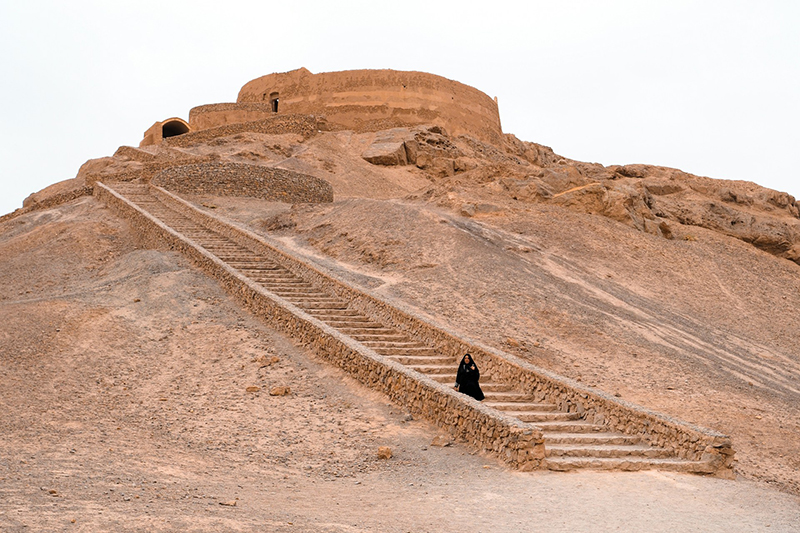
A short taxi ride from the center of Yazd, two bare hills rise from the desert floor, each crowned with a circular stone structure. These are the Dakhmeh, known in English as the Towers of Silence, where Zoroastrian communities historically practiced sky burial: the dead were laid out in the open, exposed to sun and birds of prey, based on the belief that the earth itself should not be contaminated by decaying flesh. The practice was outlawed roughly forty years ago on public health grounds, and the towers have stood empty since, but climbing to the top at sunrise or sunset remains one of the more genuinely quiet, contemplative things to do in Yazd — a place that asks for a slower, more respectful pace than a typical sightseeing stop.
In the city itself, the Yazd Atash Behram, or Fire Temple, houses a flame that Zoroastrian tradition holds has burned continuously since roughly the fifth century, though it has been relocated between temples over the centuries as communities shifted. Visitors are welcome in the entrance hall, where the fire is visible behind glass, though the inner sanctum is reserved for practicing Zoroastrians. Photography of the flame itself is generally permitted, but the temple asks for quiet, modest behavior appropriate to an active place of worship rather than a tourist attraction — a distinction worth holding onto throughout a visit to any of Yazd’s religious sites.
📷Photo by Federico Artusi on Unsplash
Day Trips Worth Taking: Things to See Around Yazd
Yazd rewards travelers who venture beyond the city limits, and the villages within a day’s reach tell a different, quieter version of the same desert story.
Kharanaq
An abandoned mud-brick village roughly ninety minutes north of Yazd, Kharanaq is largely empty now, its residents having relocated to a more modern settlement nearby decades ago. What remains is a maze of collapsing adobe houses, a precarious two-hundred-year-old minaret leaning at a genuinely alarming angle, and an atmosphere of stillness that few other sites in Iran match. It is not restored for tourism, which is exactly why it feels honest.
Chak Chak
Further into the desert, roughly seventy kilometers from Yazd, the cliffside shrine of Chak Chak is Zoroastrianism’s most important pilgrimage site in Iran. According to tradition — and it is worth stating clearly that this is legend rather than documented history — the mountainside opened to shelter Nikbanu, daughter of the last Sassanid king, as she fled the Arab conquest, and a spring has dripped from the rock ever since in remembrance of her. What is verifiable is the site itself: a small temple built into the cliff face, its ever-present drip of water, and a pilgrimage each June that draws Zoroastrians from across Iran and the diaspora. Visit during that pilgrimage and the site is full of life and ceremony; visit outside it and you will likely have the mountainside to yourself, which is a different, more solitary kind of meaningful.
Meybod
Roughly midway between Yazd and Kharanaq, Meybod is one of Iran’s oldest towns and holds the sprawling Narin Castle, a mud-brick fortress with foundations reaching back well over a thousand years, alongside a well-preserved caravanserai, an ice house, and a pigeon tower once used to harvest fertilizer for the surrounding farmland. It is easily combined with Kharanaq and Chak Chak into a single, unhurried day.
Taft and the Nartitee Ecolodge Experience
Just twenty kilometers from Yazd, Taft is a different register entirely — a town of pomegranate orchards, cooler mountain air, and a name that translates roughly to “basket of fruit.” It sits at the foot of Mount Shirkooh, the highest peak in the province at just over four thousand meters, making Taft a natural base for anyone interested in trekking rather than only sightseeing. The town is also home to a sizeable Zoroastrian population, along with its own fire temples and towers of silence, tucked into a landscape far greener than the desert most visitors associate with Yazd.
It is in Taft that one of the more memorable things to do near Yazd is found: staying at Nartitee Ecolodge, a mud-brick guesthouse run by a Zoroastrian couple, Ramtin and Tina, in a home that has been in their family for generations. Guests sleep in traditional clay rooms cooled naturally by the walls themselves, eat homemade Zoroastrian dishes prepared by Tina, and spend evenings in a pomegranate garden borrowed for the night, sometimes around an open fire. Bicycles are available to explore the surrounding orchards, and many guests use Nartitee as a quieter base for a day trip into Yazd itself, returning each evening to a pace of life the city center rarely allows. It is not a five-star stay, and it does not pretend to be — what it offers instead is the kind of unhurried hospitality that no amount of architecture alone can provide.
Tasting Yazd: What to Eat and Where
Yazdi cuisine reflects the same climate logic as its architecture — dishes built to sustain people through heat and scarcity, sweetened with saffron, rosewater, and cardamom rather than excess, and worth exploring alongside the wider landscape of Persian food travelers discover as they move through Iran.
Baklava, pashmak, and qutab form the backbone of the city’s confectionery tradition: layered pastry with pistachio, a delicate spun-sugar candy resembling cotton candy, and a fried, nut-filled pastry dusted with powdered sugar. Among the many shops selling them, one name comes up again and again, from locals and travelers alike: Haj Khalifeh Ali Rahbar, a confectioner that has been making sweets in Yazd for more than a century. Its baklava and panj loz, a boxed assortment of five traditional sweets including pistachio, saffron, and coconut varieties, are widely regarded as the standard against which the city’s other sweet shops are measured — the kind of local institution that residents themselves point visitors toward, rather than a spot found only in guidebooks.
On the savory side, abgoosht, a slow-cooked stew of lamb, beans, and dried lime traditionally mashed and eaten with flatbread, remains a staple, while faloodeh Yazdi— thin rice noodles frozen with rosewater syrup and lime, said to have originated in this very region — offers one of the more refreshing ways to close out a hot afternoon.
Planning Your Time in Yazd
Yazd’s desert setting is not a backdrop; it is a practical constraint that shapes how a visit should be structured, much as it does across the rest of the country when deciding when to visit Iran.
Best time to visit: Spring (March to May) and autumn (October to November) offer the most comfortable conditions, with daytime temperatures generally pleasant for walking. Summer temperatures regularly exceed 40°C, and outdoor sites like the Towers of Silence or Chak Chak are genuinely uncomfortable, if not risky, to visit at midday between May and September.
Time required: Two full days cover the Old City, Amir Chakhmaq, the Jameh Mosque, Dowlatabad Garden, and the Zoroastrian sites at a comfortable pace. A third day allows for Kharanaq, Chak Chak, and Meybod together, or a slower alternative spent in Taft.
Dress and etiquette: Modest dress is expected throughout Yazd, and headscarves are required for women at religious sites, including the Fire Temple and Jameh Mosque; chadors are typically available to borrow at mosque entrances if needed. At the Fire Temple and Towers of Silence, quiet, respectful behavior matters more than at a typical tourist site, since both remain active or recently active places of Zoroastrian practice.
Caveats worth knowing: During Muharram, the mourning period marking Imam Hossein’s death, some religious sites adjust visiting hours or close briefly for ceremonies, and Amir Chakhmaq’s hosseinieh becomes the center of citywide observances rather than a photo stop — a remarkable thing to witness respectfully, but worth planning around if a specific interior visit is the priority. Chak Chak is significantly more crowded, and significantly more alive, during its June pilgrimage than at any other time of year; travelers seeking solitude should visit outside that window, while those interested in the ceremony itself should time their trip deliberately around it. Travelers weighing these logistics alongside broader questions of comfort and safety may also find our honest look at travel safety in Iran useful before finalizing an itinerary.
Final Thought: The Desert City That Rewards Patience
Yazd is not a city that reveals itself in a single afternoon, and that is, in many ways, its greatest lesson for travelers moving through Iran. Places built for speed rarely ask anything of the people passing through them; Yazd does, gently, and it gives back in proportion to the time and attention offered in return.
What lingers after a visit is rarely one single sight. It is the accumulation of small, deliberate details: a windcatcher engineered centuries before air conditioning, a flame tended without interruption for longer than most nations have existed, a family in a pomegranate orchard still setting a table for guests they have never met. Together, these details say something larger about Iran itself — a country whose depth is measured less in famous landmarks than in the quiet persistence of its traditions.
For travelers building a longer route through the country, Yazd fits naturally alongside stops like Persepolis or a few unhurried days in Tehran, each offering a different register of the same civilization. Few cities make the case for slow travel as convincingly as Yazd does.
Want to Explore Yazd Attractions?
FAQs about Yazd Old City
1. Is Yazd worth visiting in Iran?
Yes — Yazd is widely considered one of Iran’s most rewarding destinations, home to a UNESCO-listed Old City, one of the country’s largest living Zoroastrian communities, and architecture uniquely adapted to desert survival. Most travelers who budget only a day end up wishing they had stayed longer.
2. How many days do I need in Yazd?
Two full days cover the essential sites within the city, including the Old City, Amir Chakhmaq Complex, Jameh Mosque, and Zoroastrian sites. A third day allows for day trips to Kharanaq, Chak Chak, and Meybod, or a slower stay in the nearby town of Taft.
3. What is Yazd famous for?
Yazd is famous for its earthen mud-brick architecture, its windcatchers used to cool buildings without electricity, its status as a center of Zoroastrianism in Iran, and its UNESCO-listed Old City, inscribed in 2017 as the first Iranian city to receive that designation.
4. Can non-Zoroastrians visit the Towers of Silence?
Yes, the Towers of Silence are open to all visitors and require no religious affiliation to enter. The site is no longer used for burial practices, which ended roughly forty years ago, but visitors are asked to remain respectful given its history and continued significance to the Zoroastrian community.
5. Is Yazd safe for tourists?
Yazd is generally considered one of the calmer, more relaxed cities in Iran for tourists, with a slower pace and less traffic than Tehran, Isfahan, or Shiraz. As with any travel in Iran, standard precautions apply, and travelers should check current government travel advisories before booking.
6. What is the best time of year to visit Yazd?
Spring (March to May) and autumn (October to November) offer the most comfortable temperatures for walking through the Old City and visiting outdoor sites. Summer temperatures regularly exceed 40°C, making midday visits to sites like the Towers of Silence or Chak Chak genuinely uncomfortable.
7. What is the UNESCO significance of Yazd?
The Historic City of Yazd was inscribed on the UNESCO World Heritage List in 2017 under criteria (iii) and (v), recognizing its exceptional earthen construction traditions and its outstanding example of a traditional settlement adapted to a hostile desert environment. Full details are available through the UNESCO World Heritage Centre.
8. Is the Chak Chak legend about Princess Nikbanu true?
The story of Princess Nikbanu and the mountain opening to shelter her is a Zoroastrian legend, not a documented historical event, and should be understood as tradition rather than verified fact. What is verifiable is the shrine itself and its status as Iran’s most important Zoroastrian pilgrimage site, drawing large crowds each June.
9. What food should I try in Yazd?
Yazd is known for baklava, pashmak, and qutab, along with faloodeh, a rosewater and lime dessert believed to have originated in the region. Haj Khalifeh Ali Rahbar, a confectioner operating for more than a century, is widely regarded as the city’s most respected sweet shop.
0 Comment