


Table of Contents
In Kashan, morning light falls through a windcatcher into a courtyard where a fountain softens the desert air. In Tehran, a few hours north by road, breakfast may arrive in a contemporary lobby of glass, stone, and swift-moving business travelers. Both are hotels in Iran, yet each offers a radically different way of entering the country.
For travelers deciding where to stay in Iran, accommodation is more than a practical overnight stop. Restored historic houses, city hotels, family-run courtyard guesthouses, and rural eco-lodges each suit different places and different kinds of journeys. The essential task is not simply finding a room, but choosing a stay that belongs to the city or landscape outside its door. The best hotels in Iran depend on your route: choose a modern hotel in Tehran, a heritage house or traditional guesthouse in Yazd and Kashan, a well-located city hotel in Isfahan and Shiraz, and an eco-lodge or organized camp for desert and mountain regions.
Booking Iranian Hotels: What Is Different
Booking a hotel in Iran can look confusing from outside the country because the usual global reservation platforms offer incomplete coverage. International banking restrictions mean that many Iranian hotels cannot process payments through the systems used by major worldwide booking websites. This is a practical issue rather than a reason to avoid independent travel: accommodation can still be arranged through local tour operators, Iran-focused booking services, or direct contact with the property.
For most visitors, the smoothest route is to have accommodation arranged through a specialist operator as part of a wider Iran itinerary. This is particularly useful when combining cities with different accommodation strengths — for example, a contemporary Tehran hotel, a Kashan heritage house, and an eco-lodge near the desert.
Independent travelers can also use booking companies that specialize in Iran and accept international payment cards, though availability and cancellation conditions should always be checked carefully. Contacting a specific hotel by email or WhatsApp remains common, especially for smaller guesthouses, but request written confirmation and keep a copy available for check-in.

Five Distinctive Types of Hotels in Iran
Modern City Hotels: Ease in Tehran
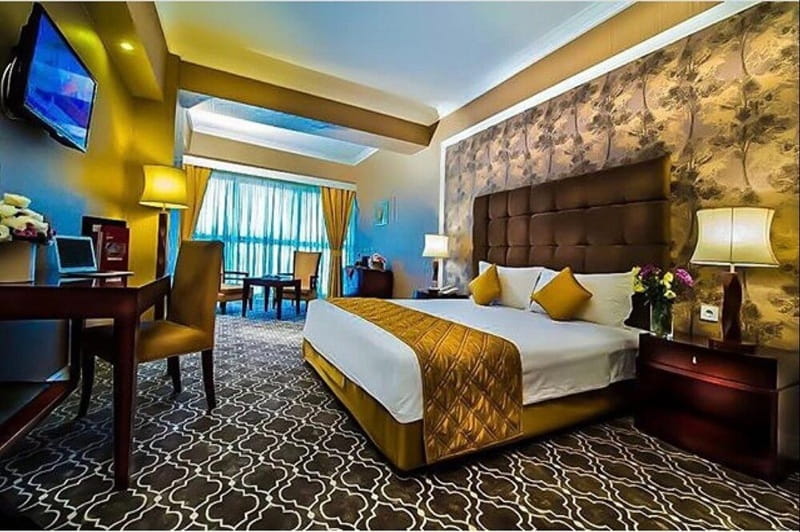
Modern hotels are most useful in Tehran and the larger urban centers of Isfahan, Shiraz, Tabriz, Mashhad and Yazd. They tend to offer elevators, air conditioning or heating, restaurants, reception desks accustomed to overseas visitors, and services that make a late arrival or early departure easier.
Iran has accommodation across a broad range of official categories, from simple one-star hotels to higher-end four- and five-star properties. The best choice depends less on the number alone than on your budget, preferred location, room standards, and the services you need: a well-run three-star hotel can be an excellent practical base, while four- and five-star hotels generally offer larger rooms, more extensive facilities, and a higher level of service. Classification does not always correspond directly with international chain-hotel expectations, so recent reviews and exact room details remain important.
They may not carry the architectural romance of a courtyard house, but they are often the sensible choice at the beginning or end of a journey. In Tehran, location matters the most: traffic can make a theoretically short journey unexpectedly slow, so choose a hotel that fits the neighborhoods and museums on your plan for exploring the best things to do in Tehran.
Heritage Hotels: Restored Historic Houses
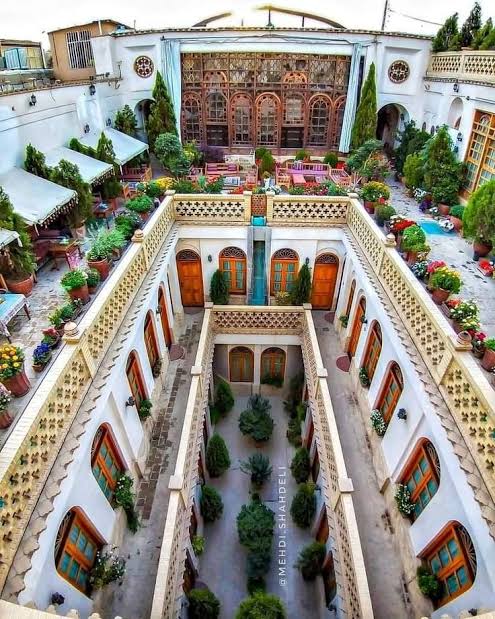
Heritage hotels are among the most memorable places to stay in Iran. Many occupy restored historic houses, particularly in Kashan, Yazd, Isfahan, Shiraz, and Kerman. Their appeal lies less in standardized luxury than in spatial character: inward-facing courtyards, carved plasterwork, stained glass, gardens, pools, and windcatchers designed to respond to the climate.
Saraye Ameriha (Ameriha Boutique Hotel) in Kashan is one prominent example of a historic residential complex adapted as a hotel. Kashan’s grand nineteenth-century houses are closely connected with the city’s mercantile prosperity and its distinctive domestic architecture, although dates and original ownership histories vary from property to property.
In Tehran, boutique conversions tend to be smaller and more urban. Hanna Boutique Hotel, in Tehran downtown, occupies a restored twentieth-century house and reflects a different chapter of Iranian architecture from the grand courtyard houses of central Iran. A heritage stay works best when travelers value atmosphere, central historic locations, and a building with a story over large rooms, extensive leisure facilities, or chain-hotel uniformity.

Courtyard Guesthouses: Small-Scale Hospitality
Traditional guesthouses often provide the warmest middle ground between a full-service hotel and a homestay. These small properties are usually arranged around a courtyard, with a limited number of rooms, shared seating areas, and sometimes home-style meals by arrangement.
Yazd and Kashan are especially well suited to this style. Their historic quarters are compact, pedestrian-friendly, and shaped by climate-conscious architecture: thick mud-brick walls, shade, enclosed courtyards, and windcatchers. Yazd’s historic city is inscribed on UNESCO’s World Heritage List partly for this long-developed adaptation to an arid environment.
Guesthouses vary widely. Some have private en-suite rooms and polished restoration; others are simpler, with shared facilities or limited English-language support. Read recent reviews, clarify the bathroom arrangement, and confirm whether breakfast, heating, air conditioning, and transport assistance are included before committing.
Eco-Lodges and Desert Camps: Landscape After Dark
Outside the principal cities, accommodation becomes less about architectural restoration and more about setting. Rural eco-lodges, village stays, and permanent desert camps are available in parts of central Iran, the Zagros foothills, Kerman Province, and areas approached from the Maranjab Desert.
These stays can be deeply rewarding, but expectations should be realistic. A compelling desert camp may provide a clear night sky, local food, and a sense of remoteness, while offering basic rooms, shared facilities, intermittent Wi-Fi, and limited heating or cooling. The Lut Desert is a UNESCO World Heritage property, recognized for its exceptional desert landforms and extreme environmental conditions, but its most remote landscapes should be visited with experienced local support.
For a desert-focused route, it is usually safer and more efficient to combine transport, accommodation, and local guiding through an established operator — especially when travelling beyond the main roads around Kerman. A Kerman day tour can also provide a useful starting point for understanding which surrounding landscapes are realistic within your available time.

Hostels: Budget Beds and Social Stays
Hostels are the most budget-conscious accommodation type in Iran, particularly useful for solo travelers, students, and independent travelers who value a sociable setting over hotel-style privacy. They are most common in larger visitor centers such as Tehran, Isfahan, Shiraz, Yazd, Kashan, and Tabriz, though availability is more limited than in many European or Southeast Asian destinations.
Most Iranian hostels offer a mix of dormitory beds and private rooms, often with shared lounges, kitchens, travel advice, and organized local activities. Standards vary substantially: confirm whether bathrooms are private or shared, whether dormitories are single-gender or mixed, and whether reception is staffed for late arrivals. For foreign visitors, choosing an established, registered hostel with recent guest feedback is the safest approach.
For travelers who want to meet others and keep costs low, a hostel can work well in a major city. For an atmospheric stay in Yazd or Kashan, however, a traditional guesthouse often offers better access to the historic center and a stronger sense of place.
Where to Stay in Major Iranian Cities
Tehran: Modern Comfort and Strategic Locations
Tehran generally rewards convenience. A modern four- or five-star hotel can make arrival straightforward, especially after an international flight or before an early departure. Prioritize proximity to the parts of the city you want to see rather than relying only on a star rating.
For longer stays, a small boutique hotel in an older neighborhood can offer a more intimate counterpoint to Tehran’s scale. It is worth remembering, however, that Tehran is not a compact walking city; even an excellent hotel can require taxis or a metro journey to reach major sights.

Kashan: Courtyard Houses and Quiet Mornings
Kashan is one of Iran’s strongest destinations for heritage accommodation. The old city’s residential architecture makes it possible to sleep in buildings whose courtyards, sunken gardens, windcatchers, and reception rooms were integral to elite domestic life in the nineteenth century.
Choose a heritage hotel if the building itself is part of why you came. Choose a smaller guesthouse if you prefer a more informal atmosphere, lower cost, and a chance to stay close to the historic lanes without paying for extensive hotel services.
Yazd: Mud-Brick Lanes and Windcatchers
Yazd is perhaps the clearest place to choose a traditional guesthouse. The old city’s network of earthen alleys, rooftops, mosques, and windcatchers is best appreciated slowly, and staying within or near the historic center makes early mornings and late evenings far more rewarding.
A courtyard property is especially useful here because it offers calm after the heat and bustle outside. Still, check access carefully: some atmospheric old-city properties are reached through narrow lanes where vehicles cannot stop directly at the entrance.
Isfahan: Heritage Character and City Convenience
Isfahan offers a broader range of accommodation than Kashan or Yazd. Visitors can choose heritage hotels with period character, practical mid-range hotels, or larger contemporary properties with more consistent facilities. The best choice depends on whether the trip is focused on walking around Naqsh-e Jahan Square, exploring Armenian New Julfa, or balancing sightseeing with comfort.
A centrally located property helps make the most of an Isfahan city tour and reduces time spent navigating traffic between the city’s major monuments. Isfahan’s UNESCO-listed Meidan Emam — also known as Naqsh-e Jahan Square — remains the natural center of a first visit.
Shiraz: Gardens, Poetry, and Urban Hotels
Shiraz has a practical mix of mid-range city hotels, larger modern properties, and smaller characterful stays. A hotel near the historic center works well for travelers planning to visit mosques, bazaars, gardens, and the Vakil complex on foot or by short taxi rides.
Those using Shiraz as a base for Persepolis, Pasargadae, and Naqsh-e Rostam should place equal value on early-departure logistics. The city’s appeal is not only its own historic core; it is also the gateway to the Achaemenid sites of Fars Province. A well-planned Shiraz city tour can help determine whether a central heritage property or a more accessible contemporary hotel makes better sense.
Kerman: Gateway to Desert Landscapes
Kerman’s accommodation ranges from city hotels to traditional properties, but it is most often part of a wider route into the desert, the Kaluts, Rayen, Mahan, or the wider southeast. A comfortable city base is useful before and after more basic rural or desert accommodation.
This is a place where itinerary timing matters. A memorable eco-lodge can be an excellent choice for one night, but multiple nights may be better spent in Kerman if the route involves long driving distances and early excursions.
Tabriz: Practical Hotels and Bazaar Access
Tabriz is best served by modern city hotels and dependable mid-range properties, particularly for travelers using the city as a base for the UNESCO-listed Tabriz Historic Bazaar Complex, Kandovan, or the wider northwest. Choose a hotel with straightforward access to the bazaar, El Goli Park, or the airport rather than focusing only on its star rating; the city is spread out, and a practical location can save considerable time.
Heritage-style stays exist but are less central to the visitor experience than they are in Kashan or Yazd. For most first-time visitors, a comfortable modern hotel is the most reliable choice, especially during a route linking Tabriz with Kandovan, Jolfa, or the Armenian monastic ensembles of northwestern Iran.
Mashhad: Shrine-Side Convenience and Comfort
Mashhad has one of Iran’s largest concentrations of hotels, shaped by the year-round flow of pilgrims and visitors to the Imam Reza Shrine. Accommodation ranges from economical one- and two-star hotels and apartment-style stays to polished four- and five-star properties with restaurants, meeting facilities, and airport-transfer support. The shrine complex is the city’s defining landmark and an important destination for Shi’a pilgrimage.
For travelers visiting the holy shrine of Imam Reza, location is especially important: staying within easy reach of its entrances can make early-morning and evening visits much simpler. Visitors seeking museums, parks, or a more residential atmosphere may prefer a hotel slightly beyond the shrine district, where rooms can be quieter and larger. Mashhad’s scale and visitor infrastructure make it one of the strongest cities in Iran for travelers who prioritize hotel choice, dependable services, and a wide range of budgets.
Kish Island: Iran’s Resort Exception
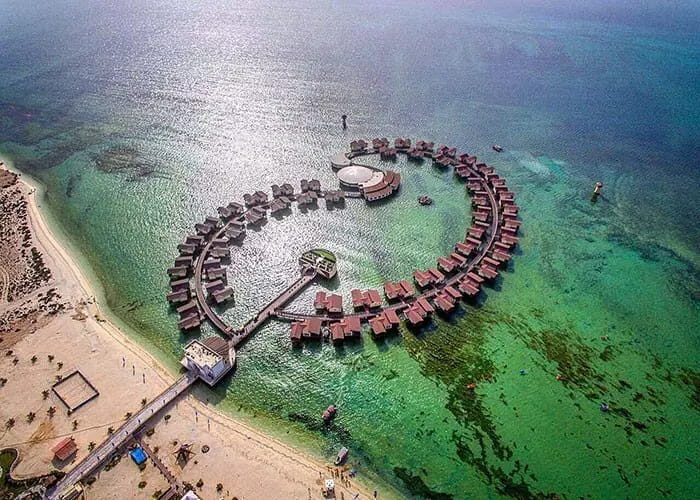
Kish Island follows a different accommodation model from the historic cities. Hotels are geared more toward leisure travel, beaches, shopping, and resort-style holidays than toward a sequence of architectural monuments. International visitors should still confirm entry requirements, hotel policies, and seasonal conditions in advance, as travel arrangements for Persian Gulf islands can differ from a standard overland Iran itinerary.
Foreign Visitor Booking Essentials
Registered Stays: Choose Established Properties
Foreign visitors should use officially registered hotels, guesthouses, and eco-lodges. This is a routine practical requirement and one reason to avoid improvised accommodation arrangements from unverified social-media listings.
A reputable property should be able to provide a clear confirmation, identify its address and contact details, and explain its payment requirements. If a rate seems unusually low or the host cannot issue meaningful written confirmation, choose another option.
Star Ratings: Read Beyond the Number
Iranian hotel star ratings are not a perfect translation of international chain-hotel expectations. A five-star heritage hotel may offer exceptional restoration and attentive service but fewer facilities than a five-star hotel in Dubai or Europe. Conversely, a modestly rated property may be impeccably run, central, and far more characterful than its classification suggests.
Look instead at five practical details:
- Exact location and walking distance to the places you want to see.
- Private versus shared bathrooms.
- Reliable heating, cooling, and hot water.
- Recent guest comments about cleanliness and service.
- Whether the property can assist with transfers, local guides, or onward transport.

Money: Plan for Cash Expenses
Foreign-issued Visa and Mastercard cards generally do not function in Iran’s domestic banking and point-of-sale network because of financial sanctions. Travelers should plan to bring enough cash in an accepted foreign currency and exchange it through legal channels after arrival, while keeping funds secure and distributed sensibly.
Some specialist Iran travel providers may accept payment by international card before the trip, but that does not mean a hotel reception can process the same card once you are in Iran. Confirm whether airport transfers, meals, minibar purchases, laundry, and other extras are paid locally.
Couples: Confirm Policies Directly
Hotel practice can vary by property, city, and the nationalities of the guests. Foreign couples are commonly accommodated together in private rooms, but travelers should avoid assuming that every hotel will handle every circumstance identically. The most reliable approach is to confirm the room arrangement in writing before booking, particularly for Iranian nationals and mixed-nationality couples.
How to Book Iran Accommodation
Local Tour Operator Bookings: The Simplest Route
For a multi-city first trip, arranging hotels through a specialist tour operator is usually the least complicated option. Accommodation can be matched to transport times, access constraints, the quality level of each destination, and the realities of peak-season availability.
This approach is particularly useful for routes that combine cities with desert areas, where the right lodge may be more important than the apparent star rating. It also avoids the problem of arriving in a historic district with luggage only to discover that the hotel entrance lies beyond a maze of pedestrian lanes.

Specialist Platforms: Independent Convenience
Iran-focused booking platforms can be useful for travelers who want to choose each property themselves while paying before arrival with an international card. Before booking, check whether the confirmation is immediate, what cancellation rules apply, whether the quoted amount includes taxes and breakfast, and whether the property has recent foreign-visitor reviews.
Do not treat an online listing alone as a complete guarantee. Send a brief message to the property to reconfirm arrival time, room type, airport pickup if required, and any special needs.
Direct Hotel Contact: Best for Specific Properties
Direct contact makes sense when a particular heritage hotel or guesthouse is central to the trip. Email and WhatsApp are both widely used, especially by smaller properties.
Ask for:
- The room type and bed configuration.
- The total price, currency, and what it includes.
- Payment instructions and cancellation terms.
- The full address, map location, and arrival directions.
- Written confirmation with the traveler’s name and dates.
During Nowruz, Iran’s Persian New Year holiday period, book considerably earlier than usual. Domestic travel rises sharply, and small heritage properties can sell out before large city hotels. For seasonal context, see Compassimo’s guide to the best time to visit Iran.

Stays for Different Iran Trips
First-Time Routes: Balance Comfort and Character
A first visit is usually best served by a mix rather than one accommodation style throughout. Start in Tehran with a practical modern hotel, then introduce heritage stays in Kashan or Yazd, and use a dependable city hotel in Isfahan or Shiraz when the itinerary becomes more intensive.
This approach gives you a genuine sense of Iranian architectural and domestic traditions without turning every check-in into a logistical challenge. It also reflects the differences among Iran’s major cities and regions, rather than treating the country as a single uniform destination.
Slow Travel: Guesthouses and Eco-Lodges
Travelers returning to Iran, or those with a more generous schedule, can lean further into small guesthouses and rural eco-lodges. These stays tend to reward time: breakfast conversations, walks through village lanes, evening meals, and local knowledge that never appears on a hotel concierge desk.
The trade-off is consistency. Wi-Fi may be uneven, bathrooms may be simpler, and English may be limited. A flexible attitude matters more here than a fixed expectation of international-standard service.
Small Groups: Choose Consistency Carefully
Couples and solo travelers have the greatest freedom to choose small, distinctive properties. Larger groups need to think more carefully about room inventory, coach access, meal service, and whether everyone is comfortable with stairs, uneven surfaces, or more basic facilities.
For groups, a dependable hotel may be preferable in transit cities, with one or two carefully selected heritage or rural stays providing the memorable contrast.

Practical Choices Before Booking
Best Time: Reserve Earlier for Nowruz
Spring and autumn are widely favoured for a classic route through Tehran, Kashan, Isfahan, Yazd, and Shiraz because temperatures are often more manageable than high summer. Nowruz is culturally compelling but requires earlier reservations and more flexibility because domestic demand is high.
Summer can be intensely hot in central and southern Iran, though higher-altitude areas and northwestern regions may be more comfortable. Winter can be quiet and good value in several cities, but mountain roads and desert nights require more careful planning.
Getting Around: Let Location Save Time
A centrally located guesthouse is valuable in Yazd or Kashan because the old quarters reward walking. In Tehran, where distances are larger, a hotel near the relevant metro line or planned sights can be more useful than a nominally central address.
For rural and desert properties, confirm road access and pickup arrangements. Do not assume that a map pin indicates easy access after dark or that public transport will reach the lodge.
Etiquette: Respect the Setting
Dress expectations in hotel public areas broadly follow the norms outside the property. Guests should also be mindful that heritage houses can be fragile: old staircases, historic surfaces, and narrow passageways are part of the experience, not inconveniences to be ignored.
Photography is usually welcome in common areas, but ask before photographing staff, other guests, or private family spaces at smaller guesthouses.
Final Thoughts: Where You Sleep Is Part of the Story
Where you stay in Iran can quietly shape the entire journey. A restored courtyard house gives architectural ideas a human scale: shade, water, privacy, ornament, and the careful relationship between a home and a harsh climate. A family-run guesthouse may make room for an unplanned conversation that becomes more memorable than a scheduled monument visit.
The country’s hotel landscape also rewards discernment. Not every historic property is equally comfortable, not every desert camp is equally remote, and not every five-star label means the same thing. But when a stay is chosen to fit the city, the season, and the rhythm of the route, accommodation becomes part of the travel story rather than a pause between destinations. Once your route is set, the right hotel or guesthouse for each stop can be arranged before you arrive. See Compassimo’s Iran tours to explore routes where accommodation is matched to the itinerary, city by city.
Your stay can be sorted out before your trip even begins.
FAQs about Hotels in Iran
1. Can I book Iran hotels through Booking.com or Expedia?
Coverage on major global booking platforms is limited because Iranian accommodation providers often cannot use their international payment systems. Specialist Iran booking services, tour operators, and direct booking with hotels are generally more reliable options.
2. What is the best hotel type for a first Iran trip?
Use a combination: a modern hotel in Tehran for arrival convenience, then heritage hotels or courtyard guesthouses in Kashan, Yazd, Isfahan, or Shiraz for atmosphere and location.
3. Are heritage hotels in Iran expensive?
They are usually among the more expensive local options, especially well-known restored mansions. Even so, a traditional guesthouse can often provide a similar courtyard experience at a lower price and with fewer formal hotel services.
4. Can unmarried foreign couples share a hotel room in Iran?
Many hotels accommodate foreign couples in private rooms, but practices can differ by property and circumstance. Confirm the arrangement with the hotel in writing before booking.
5. Do Iranian hotels accept foreign bank cards?
Foreign-issued cards generally do not work directly in Iran’s local payment network. Bring sufficient cash for local spending and confirm in advance whether your booking provider accepts international cards for prepayment.
6. What is a traditional Iranian guesthouse?
It is usually a small, often family-run property with a courtyard, a limited number of rooms, and more personal service than a conventional hotel. Standards range from simple rooms with shared facilities to polished boutique-style stays.
7. When should I book accommodation in Iran?
For most trips, one to two months ahead is a sensible starting point. Book significantly earlier for Nowruz, major holiday periods, and sought-after heritage hotels in Kashan and Yazd.
8. Where should I stay for a desert experience?
Choose a vetted eco-lodge or permanent desert camp near the particular landscape you plan to visit, such as areas approached from Kerman or Maranjab. Arrange transport and arrival details in advance, particularly for remote stays or late arrivals.
9. Are there resort hotels in Iran?
Yes. Kish Island and some Persian Gulf destinations have resort-style hotels more focused on leisure, beaches, and shopping than on the historic-city touring common elsewhere in Iran.
10. Is it better to book through a tour operator?
For a multi-city route, a tour operator can reduce payment, transport, vetting, and language complications while matching each accommodation type to the itinerary. Independent booking offers more control over individual properties but requires more verification.
11. Is it legal for foreign tourists to stay anywhere they choose in Iran?
Foreign visitors are required to stay in accommodation registered as a hotel, guesthouse, or eco-lodge. This is a standard requirement rather than a restriction in practice, and it’s one reason booking through a vetted channel simplifies the trip.
0 Comment