


Table of Contents
Few corners of Iran reward patience the way Kerman does. If you approach it expecting another desert city of crumbling facades and polite silence, it will quietly dismantle that expectation and offer something else entirely: a place where salt crystals still fall from the bazaar’s ceiling, where ancient desert engineering stored winter ice through the summer, where nomadic routes carved the geography, and where a garden can survive a dramatic temperature contrast with the surrounding desert. The best things to do in Kerman range from exploring a 400-year-old bazaar complex to walking the hottest desert ever measured from space, from admiring bronze sculptures by Rodin in a former orphanage to visiting the world’s only Zoroastrian anthropology museum.
Here is the honest map of a city that does not perform for tourism. Walk slowly, get lost once, and it will reveal itself.
At a Glance: Kerman Travel Summary
| Feature | Detail |
|---|---|
| Location | South-central Iran, ~1,000 km southeast of Tehran |
| Best time to visit | March–May and October–November (mild weather, garden blooming) |
| UNESCO sites in province | Bam and its Cultural Landscape, Lut Desert, Persian Garden (Shazdeh Mahan), Meymand |
| Top attractions | Ganjali Khan Complex, Shazdeh Mahan Garden, Grand Bazaar, Jabaliyeh Dome |
| Best day trips | Arg-e Bam, Lut Desert, Rayen Citadel, Shah Nematollah Vali Shrine |
| Ideal stay | 2–3 full days (1 day for city, 1–2 for day trips) |
| Getting around | Taxis within city; private car or guided tour for day trips |
| Entrance fees | Varies per site; foreigners typically pay more than locals |
Ganjali Khan Complex: A Safavid City Within a City
Construction on this massive urban complex began in the late 16th century, under the patronage of Ganjali Khan, governor of Kerman during the reign of Shah Abbas the Great. The complex, covering approximately 11,000 square meters, was built between 1596 and 1621 and includes a public square, a bazaar, a caravanserai, a school, a mosque, a mint, an ab-anbar (traditional water reservoir), and a bathhouse — a near-complete catalogue of Safavid-era civic architecture packed into one site. The architect was Mohammad Soltani, a craftsman from Yazd, and the complex survives today in an unusually intact state, still threaded through the living fabric of the city.
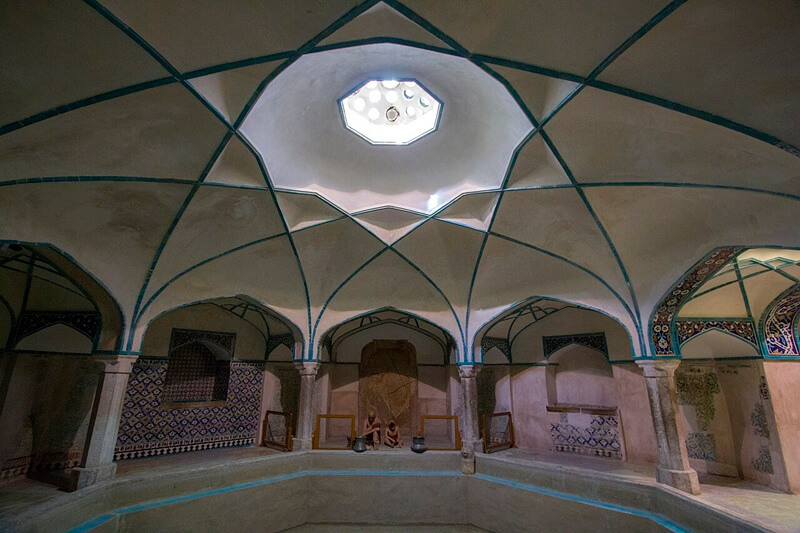
The bathhouse, built in 1611 and converted into an anthropology museum in 1971, is arguably the most striking single element. Its walls are lined with statues designed at Tehran University’s Faculty of Fine Arts in 1973, recreating scenes of traditional hammam life — scenes of washing, massage, and social gathering rendered in a way that still feels almost uncomfortably immediate. The architectural detailing is the real draw: vaulted ceilings, colored tilework, and a lighting system designed so that shafts of sunlight enter at angles that once allowed bathers to estimate the time of day. In the subterranean sections, the temperature drops sharply, and the engineering logic of the hammam — heating, water circulation, ventilation — becomes visible.
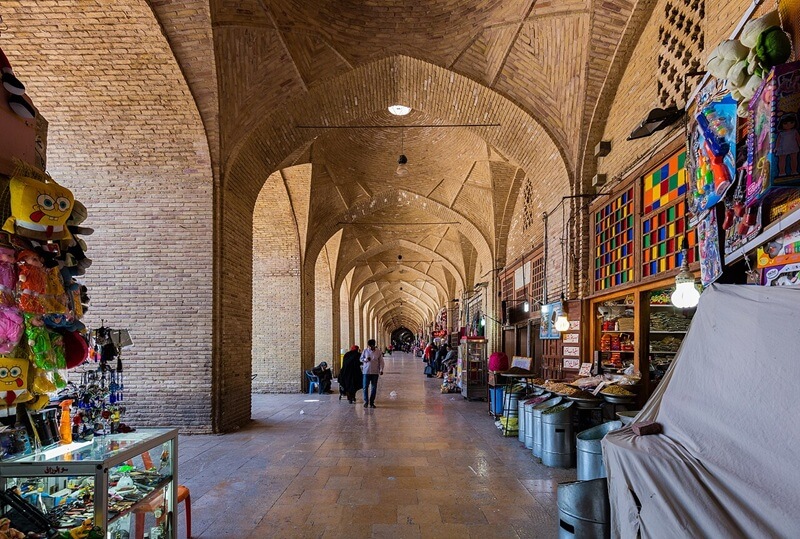
The bazaar, covered, is narrow and continuously active. Sections sell copper, textiles, spices, and sweets, and the sound of work being done — hammering, weighing, bargaining — is constant. Near the entrance, a ceiling detail worth pausing for: salt crystals, formed over centuries by evaporating moisture, still clinging to the brickwork.
📷Photo by Mostafameraji on Wikicommons
Shazdeh Mahan Garden: Desert Paradise Against the Heat
Approximately 35 kilometers from Kerman, near the town of Mahan, Shazdeh Mahan is a 19th-century Persian garden inscribed on the UNESCO World Heritage List as part of the Persian Garden serial property (inscribed under criteria (i), (ii), (iii), (iv), and (vi)). It is a textbook example of the chaharbagh — the four-part garden layout that symbolized paradise in Persian thought — laid out along a linear axis with a pavilion at the upper end and a reflecting pool descending through terraced levels.
The garden was commissioned by Abdolhamid Mirza Naseroddoleh, a Qajar-era governor of Kerman, and later expanded by his son. The engineering response to the surrounding climate is the most interesting element: the garden sits on the edge of the Lut Desert, where summer ground surface temperatures have been recorded as the hottest ever measured on Earth. Within the garden walls, the temperature difference can exceed 15 degrees. Tree canopy, water channels, and the orientation of the pavilion produce a microclimate that is still functional.
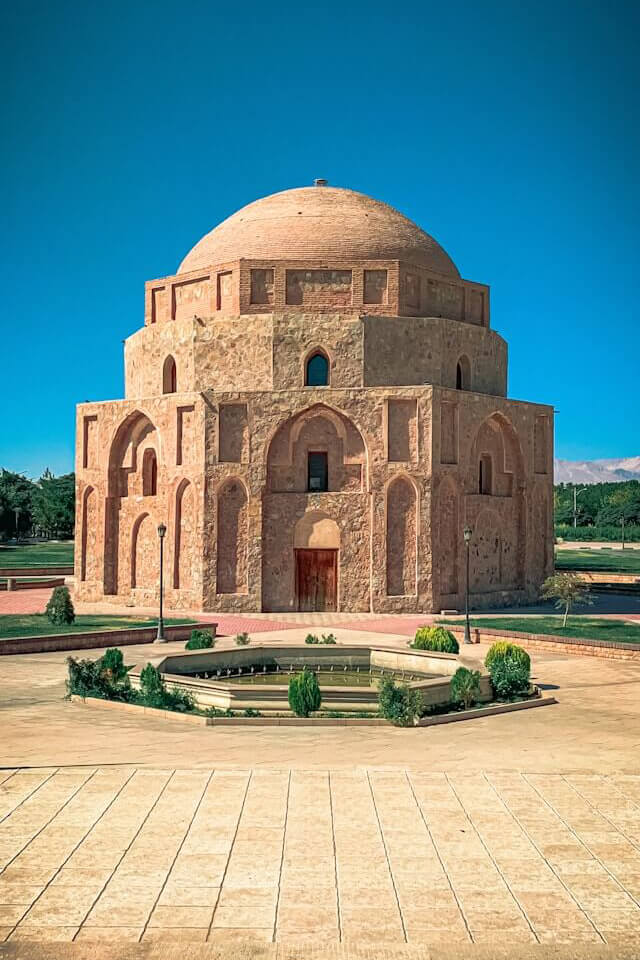
Jabaliyeh Dome: Mysterious Stone Octagon
Local legend attributes the building to a Zoroastrian fire temple; some scholars date the surviving structure to the Seljuk period; others argue for late Sassanid origins with Islamic-era repairs. What is verifiable is considerably more modest: the dome is octagonal, built largely of stone rather than the more usual brick, its architecture inspired by Sassanid forms, and it has been on Iran’s National Heritage List since 1937 (No. 296). The earliest written reference to the dome appears in a text from the early 16th century. Some European scholars, including Carole Hillenbrand, attribute it to the Seljuk rulers, while others note that “Jabali” may be a corruption of “Gabri” (a term for Zoroastrians), suggesting pre-Islamic origins. The debate is part of the building’s appeal. Since 2004, the dome has housed the Stone Museum of Kerman, displaying carved stones and inscriptions recovered from sites across the province.
Moshtaghieh Dome: Three Domes of Sufi Mystics
A Qajar-era mausoleum complex, also known as the Three Domes, housing the graves of three Sufi mystics — Moshtagh Ali Shah, Kousar Ali Shah, and Sheikh Esmail Herati. The first burial here dates to 1792, and the current building was completed in 1838 during the reign of Mohammad Shah Qajar. The complex was added to Iran’s National Heritage List in 1966.
Moshtagh Ali Shah was a musician, poet, and dervish of the Nimatullahi order. He is credited with adding a fourth string to the setar, a traditional Iranian lute — a string still known as the “Moshtaq string.” He was stoned to death in 1792 during the reign of Fath-Ali Shah Qajar, accused of reciting the Quran to the accompaniment of the setar. The two tiled domes belong to the tombs of Moshtaq Ali Shah and Kousar Ali Shah, while the brick dome covers the grave of Sheikh Esmail Herati. The complex features elaborate tilework, wall paintings, muqarnas, and stucco decorations. It is located at the end of the Ganjali Khan Bazaar, near Shohada Square.
Moayedi Ice House: World’s Largest Desert Refrigerator
One of the most remarkable examples of pre-industrial desert engineering in Iran, the Moayedi Ice House is a Safavid-era structure widely regarded as the largest mud-brick ice house (yakhchal) in the world. Standing 20 meters tall, it was registered as a national heritage site in 1999. The yakhchal was part of a system that produced and stored ice in the middle of a desert city — water was channeled into shallow pools, frozen on winter nights, then cut and stored in the massive conical structure, where it could last through the summer months. The Moayedi Ice House also served as a water reservoir. It is located in Kerman’s old neighborhood and is best visited in combination with the Grand Bazaar and other city-center sites.
Sanati Museum: Rodin and Kandinsky in a Former Orphanage
The museum grew out of the Sanati orphanage and is named for Ali Akbar Sanati, a sculptor raised in the orphanage who became one of Iran’s notable modern artists. The institution was founded by the philanthropist Haj Aliakbar Sanati Zadeh. The collection includes approximately 1,200 to 1,500 pieces — paintings, stone mosaics, and sculptures in plaster, marble, bronze, and wood. The museum is considered by some to be the second richest museum of contemporary art in Iran after the Tehran Museum of Contemporary Art.
What makes it genuinely surprising is the presence of works by Western artists: bronze pieces attributed to Auguste Rodin, alongside works by Henry Moore, Wassily Kandinsky, Emil Nolde, Ben Nicholson, and Albert Marquet. The juxtaposition of these names with the museum’s origin as an orphanage in southeastern Iran is disorienting in the best way. Iranian artists represented include Kamal-ol-Molk, Parviz Tanavoli, Sohrab Sepehri, and Bahman Mohassess.
Kerman Grand Bazaar: A Living Artery of Trade and Sound
Not a single building but a long covered bazaar, several kilometers in total, connecting the Ganjali Khan Complex in the north to the Moshtaghieh Dome in the south. The bazaar is among the longest in Iran, and unlike many historic markets that have been partially gentrified for tourism, this one still functions as a working commercial space. You will walk past hardware stalls, wedding-dress shops, gold dealers, bread bakeries, and spice merchants in roughly the same sequence that locals have for centuries. The bazaar is punctuated at intervals by caravanserais, mosques, and small squares, and several of these side structures — the Vakil caravanserai, the Mesgar (coppersmith) section — are worth detouring into.
📷Photo by Diego Delso on Wikicommons
Harandi Garden Museum: A Qajar Mansion
A Qajar-era garden mansion, approximately 100 years old, once owned by a prominent Kerman merchant. The complex is historically significant as the place where Reza Shah Pahlavi stayed for several days en route to exile on Mauritius Island in 1941. Today, the 25,000-square-meter garden houses two museums: the Museum of Traditional Iranian Musical Instruments, opened in 2002, displaying instruments such as the santour, qanun, rabab, qichak, and oud crafted by renowned masters; and the Archaeology Museum, featuring artifacts from the Shahdad Desert and the Halilrud (Jiroft) cultural area. The garden itself, with its old pines, pomegranate and fig trees, and rose beds, is a pleasant place to rest between the heavier historical sites. Located at the Somayyeh (Tahmasbabad) crossroad in central Kerman.
Zoroastrian Fire Temple: Museum of an Ancient Faith
Kerman has one of Iran’s oldest Zoroastrian communities, and the Fire Temple (Atashkadeh), established in 1924, now houses the only anthropology museum of Zoroastrians in the world. The museum was inaugurated in 2005 during the Tirgan festival by Iran’s Cultural Heritage, Handicrafts and Tourism Organization. It displays Zoroastrian religious texts — including a handwritten version of the Gathas estimated to be at least 200 years old — clothing, ceremonial objects, fireplaces, incense burners, and statues of prominent Zoroastrian figures such as Maneckji Limji Hataria. The fire temple is located on Moshtaqieh Square, near the Zarisf (Shohada) street area. For travelers interested in Iran’s pre-Islamic heritage, this site provides a living connection to one of the world’s oldest monotheistic religions, still practiced by a small but active community.
Kerman Grand Mosque: A 14th-Century Prayer Hall
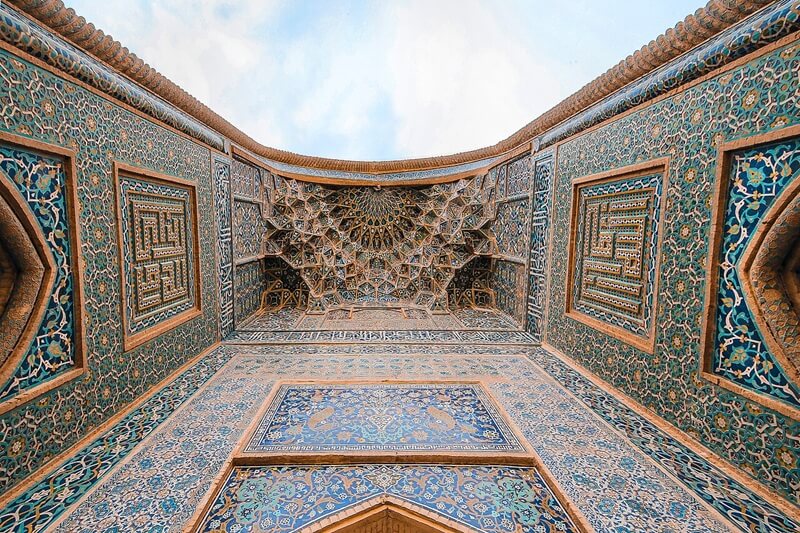
Located on the western side of Moshtaqieh Square, the Jameh Mosque of Kerman is one of the city’s oldest religious structures. The current building dates largely to the Muzaffarid period (14th century), with later additions and restorations. The mosque features a large courtyard, a deep winter prayer hall (shabestan), and impressive tilework. Its proximity to the Moshtaghieh Dome and the southern end of the Grand Bazaar makes it a natural stop on a walking tour of the historic center.
📷Photo by Edrak Art on Wikicommons
Fathabad Garden: Overlooked Model for Shazdeh Mahan
Located 25 kilometers from Kerman in the Ekhtiarabad district, Fathabad Garden is a 13-hectare Qajar-era garden often overshadowed by the more famous Shazdeh Mahan Garden — yet some historians believe Fathabad served as the architectural model for Shazdeh Mahan. Usually dated to the Qajar period and associated with Fazlali Khan Biglarbeigi, governor of Kerman during the reign of Mohammad Shah Qajar, the garden features a two-story mansion with European-Iranian architectural style, a pool, and four tree-lined boulevards originally 6 kilometers long and 60 meters wide. The garden fell into neglect during the Pahlavi era, and its qanat — the underground water channel that sustained it — dried up. A comprehensive restoration project begun in 2014 revived the garden, and it reopened to the public in 2015. Today, it serves as a cultural hub with handicrafts exhibitions, tearooms, and restaurants. Listed on Iran’s National Heritage List since 2003 (No. 7284).
Best Day Trips from Kerman
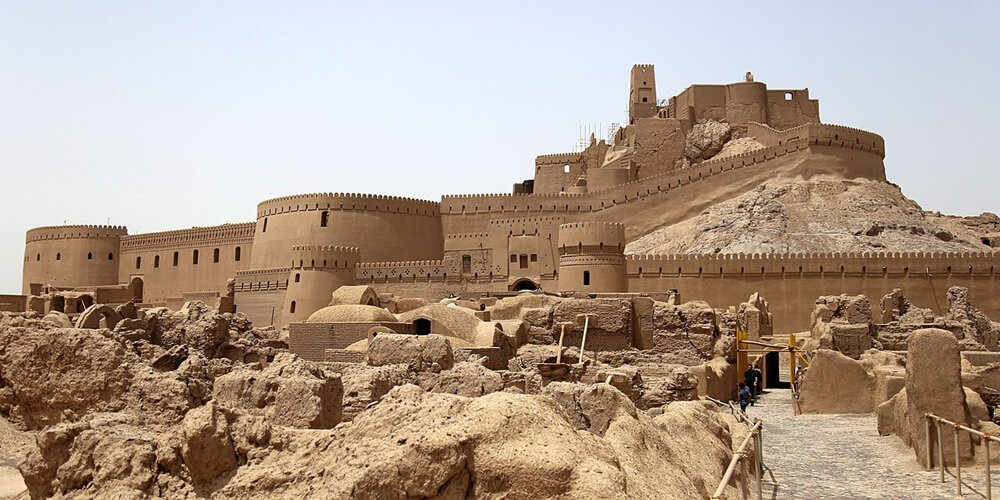
Arg-e Bam: Adobe Citadel Rose from the Rubble
The Arg-e Bam, approximately 200 kilometers south of Kerman, is one of the largest adobe structures in the world and was inscribed on the UNESCO World Heritage List in 2004 as “Bam and its Cultural Landscape” (criteria (ii), (iii), (iv), and (v)). The citadel was a settlement, a fortress, and a major stop on trade routes reaching toward the Indian Ocean, and it remained continuously inhabited until the mid-20th century.
The December 2003 earthquake that devastated Bam destroyed more than 80 percent of the city’s buildings, including approximately 85 percent of the citadel’s structures, and claimed tens of thousands of lives. The scale of the loss is difficult to convey. Restoration has been underway for more than two decades, supported by an international effort coordinated through UNESCO and Iran’s Cultural Heritage Organization, and significant progress has been made — but the experience of visiting is still shaped by the awareness of what was lost. You can read more in our complete guide to the Bam Citadel.
Lut Desert: The Hottest Surface on Earth
The Dasht-e Lut is a UNESCO World Heritage Site (inscribed in 2016 under criteria (vii) and (viii)) and one of the most extreme environments on Earth. NASA satellite data identified the Lut Desert as the hottest land surface temperature on Earth, with a reading of 70.7°C (159.3°F) recorded in 2005 by the MODIS instrument on the Aqua satellite. A 2019 study using improved MODIS data reported an even higher figure of 80.83°C (177.49°F). These are land surface temperatures, not air temperatures — the air temperature at the time of the 70.7°C reading was estimated at 30 to 54°C.

📷Photo by Mahdi Kalhor on Wikicommons
Guided tours from Kerman typically reach the Shahdad section, where the Kaluts — wind-carved ridges extending across the horizon in long, narrow formations — are the primary feature. These formations, created by wind erosion over millennia, produce a landscape that looks closer to a different planet than to anything in the Iranian plateau. A small handful of nomadic and semi-nomadic communities, including the Afshar and other tribal groups, still move through parts of the surrounding region, though far fewer than in previous decades.
Tours are organized through agencies, and traveling independently into the deep desert is not advisable. The temperature differential between the desert floor and the mountain village of Sirch, less than 40 kilometers away, is one of the most striking geographical contrasts in Iran. Read more in our guide to the Lut Desert UNESCO Heritage Site.
Rayen Citadel: A Thousand-Year-Old Fortress
Roughly 100 kilometers south of Kerman, the Arg-e Rayen is a historic adobe fortress believed to be at least 1,000 years old, with foundations that may date to the pre-Islamic Sasanian era. Unlike Bam, Rayen was largely spared by the 2003 earthquake and remains remarkably well preserved. The citadel displays the architectural hallmarks of Iranian fortress design — high walls, narrow internal streets, residential quarters, a governor’s section, and a bazaar area. Contemporary documents indicate that Rayen was a center for trading valuable goods, textiles, and sword and knife manufacturing, located on an important trade route. It was inhabited until 1868. Rayen is on UNESCO’s tentative list for World Heritage inscription.
Shah Nematollah Vali Shrine: A Sufi Poet’s Resting Place
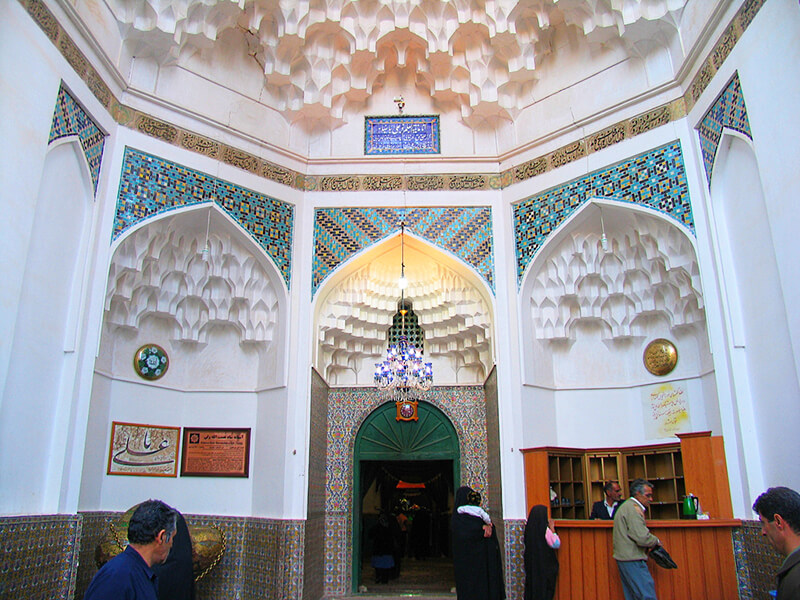
In the town of Mahan, near Shazdeh Garden, the shrine of Shah Nematollah Vali — a 14th-century Sufi mystic and poet — is one of the most significant religious sites in southeastern Iran. The complex, developed over several centuries, includes a tile-covered dome, a courtyard, a museum, and a garden. The tilework ranges across multiple periods, and the layering of styles produces one of the more visually dense interiors in the region. The shrine is a destination for both pilgrims and tourists, and the atmosphere is noticeably different from the more secular historic sites — quieter, more contemplative.
📷Photo by Alireza Parsi on Wikicommons
Sirch Village and Ski Resort
The mountain village of Sirch, located approximately 50–60 kilometers east of Kerman on the road to Shahdad, is one of the most unlikely attractions in the province. While the surrounding region is defined by desert, Sirch sits in a mountain valley with a cool, humid climate. It is home to the only ski resort in southeastern Iran, a natural slope on the Joftan Mountains that is covered in snow for up to six months of the year. The contrast with the Lut Desert — less than 40 kilometers away as the crow flies — is extreme. The village also features ancient twin cedar trees that are a local landmark. Best visited in late autumn through early spring when snow coverage is at its peak.
Meymand Village: A Cave Settlement
For travelers with additional time, the UNESCO-listed village of Meymand, approximately 230 kilometers from Kerman, offers one of Iran’s most distinctive cultural landscapes. This cave village, inhabited for an estimated 3,000 years, features hand-carved dwellings in a rocky hillside and represents one of the few surviving examples of troglodytic architecture in Iran. Read more in our guide to Meymand Village.
Suggested Kerman Itineraries
One Day in Kerman
If you have only one day, focus on the city center. Start at the Ganjali Khan Complex — allow at least two hours for the bathhouse museum, the bazaar, and the caravanserai. Walk south through the Grand Bazaar to the Moshtaghieh Dome, pausing at the Grand Mosque along the way. In the afternoon, visit the Jabaliyeh Dome and its Stone Museum, then the Sanati Museum of Contemporary Arts. End the day at the Harandi Garden Museum or the Zoroastrian Fire Temple and Museum. If time permits, the Moayedi Ice House is a short detour from the old neighborhood.
Two Days in Kerman
Day 1: Follow the one-day itinerary above.
Day 2: Take a guided day trip to Shazdeh Mahan Garden and the Shah Nematollah Vali Shrine in Mahan (morning), then continue to the Lut Desert and the Kaluts for an afternoon sunset tour. Alternatively, visit Fathabad Garden in Ekhtiarabad on the return.
Three Days in Kerman
Days 1–2: Follow the two-day itinerary above.
Day 3: Take a full-day trip to Arg-e Bam (morning) and Rayen Citadel (afternoon). Both are along the same southbound route from Kerman. If visiting in winter, consider replacing the desert trip with a visit to Sirch Village and its ski resort, or extend to Meymand Village for an overnight in a cave dwelling.
Practical Travel Tips in Kerman
When to go: March through May and October through November offer the most comfortable weather. Summer temperatures in Kerman can exceed 40°C, and the surrounding desert is far hotter. Winter is mild in the city but brings snow to the surrounding mountains — ideal for Sirch, less ideal for desert tours. Read our guide to the best time to visit Iran for seasonal planning.
Getting there: Kerman has a domestic airport with regular flights from Tehran, Shiraz, and other major cities. The city is also connected by train and long-distance bus. See our complete guide to travel to Iran for transport options.
Getting around: Within Kerman city, taxis are inexpensive and readily available. For day trips to Bam, Rayen, the Lut Desert, or Mahan, a private car or organized tour is strongly recommended. We offer Kerman day tours and Kerman desert tours that cover the main attractions with experienced local guides.
Accommodation: Kerman has a range of hotels and traditional guesthouses. Staying in the historic center provides easy walking access to the Ganjali Khan Complex, the Grand Bazaar, and most city attractions.
Cultural etiquette: As in all of Iran, modest dress is required. Photography is generally welcomed, but always ask before photographing people, especially inside religious sites. Read our guide to Iranian cultural etiquette and local customs for more.
Final Thoughts: A City of Quiet Depth and Dramatic Contrast
Kerman is not a city that announces itself. It does not have the immediate visual drama of Persepolis or the romantic pull of Isfahan. What it has instead is depth — a 400-year-old bazaar still in daily use, a garden that engineers its own climate against the hottest desert on Earth, a cave village inhabited for three millennia, and a Zoroastrian community that still tends its fire. Spend two days here and you will leave with a different understanding of what Iranian cities can be.
Looking for a Guided Tour to Explore Kerman?
FAQs about Top Things to Do in Kerman
1. How many days should I spend in Kerman?
Two to three full days is ideal. One day covers the city’s main attractions — the Ganjali Khan Complex, Grand Bazaar, Shazdeh Mahan Garden, and museums. A second day allows for a day trip to the Lut Desert or Bam. A third day can include Rayen Citadel, Sirch Village, or Meymand.
2. Is Kerman worth visiting?
Yes. Kerman is one of Iran’s most rewarding destinations for travelers interested in history, architecture, and desert landscapes. It has UNESCO World Heritage Sites (Bam, Lut Desert, Persian Garden), a remarkably intact 17th-century bazaar complex, museums that surprise (Rodin sculptures, the world’s only Zoroastrian anthropology museum), and some of the most dramatic geographical contrasts in the country — from the hottest land surface on Earth to a ski resort 40 kilometers away.
3. How far is Bam from Kerman?
Bam is approximately 200 kilometers south of Kerman, about a 2.5-hour drive. Rayen Citadel is roughly halfway, about 100 kilometers south of Kerman.
4. Can you visit the Lut Desert independently?
No. The Lut Desert is an extreme environment with no permanent weather stations, no roads into the deep desert, and no infrastructure. Guided tours from Kerman are the only safe way to visit the Shahdad Kaluts area. These can be arranged through local agencies or through our Kerman desert tour.
5. What is the best time to visit the Lut Desert?
October through March, when temperatures are lower. In summer, land surface temperatures in the Lut Desert have been recorded at 70.7°C (159.3°F) — the highest ever measured on Earth. Even in winter, bring sun protection and plenty of water.
6. Are there ski facilities in Kerman?
Yes — Sirch Ski Resort, about 50–60 kilometers east of Kerman, is the only ski resort in southeastern Iran. It is a natural slope on the Joftan Mountains, covered in snow for up to six months. Best visited from late autumn through early spring.
0 Comment